

Fitch cuts Israel’s credit rating to ‘A’ as Middle East tensions rise

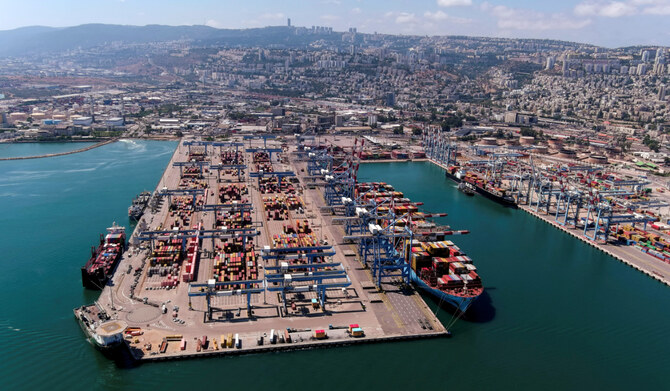
A general view shows Haifa Port. (REUTERS)
Short Url
Updated 13 August 2024
Follow

Fitch cuts Israel’s credit rating to ‘A’ as Middle East tensions rise

  • Israel’s shekel fell as much as 1.7 percent against the dollar on Monday and stocks ended over 1 percent lower in Tel Aviv as investors fret over a possible attack on Israel

NEW YORK: Credit ratings agency Fitch downgraded Israel’s credit rating to “A” from “A-plus” on Monday, citing worsening geopolitical risks as the war in Gaza drags on, and kept the rating outlook negative, meaning a further downgrade is possible.
Israel’s war on Gaza, triggered by the Islamist group Hamas-led cross-border attack on Oct. 7, has cost thousands of lives and unfolded into a humanitarian crisis.
“In our view, the conflict in Gaza could last well into 2025 and there are risks of it broadening to other fronts,” the ratings agency said in a statement. “The downgrade following the war and the geopolitical risks it creates is natural,” Israeli Finance Minister Bezalel Smotrich said on X.
Fears that the conflict in Gaza could turn into a broader Middle East war have escalated after the killing of Hamas leader Ismail Haniyeh in Iran and top Hezbollah military commander Fuad Shukr in Beirut.
Israel’s shekel fell as much as 1.7 percent against the dollar on Monday and stocks ended over 1 percent lower in Tel Aviv as investors fret over a possible attack on Israel.
Heightened tensions between Israel and Iran and its allies could imply significant additional military spending, destruction of infrastructure and damage to economic activity and investment, Fitch said.
The ratings agency expects the Israeli government to permanently increase military spending by close to 1.5 percent of GDP versus pre-war levels as the country strengthens its border defenses.
“Public finances have been hit and we project a budget deficit of 7.8 percent of GDP in 2024 and debt to remain above to 70 percent of GDP in the medium term,” Fitch said. It forecast the country’s debt will remain on an upward trend beyond 2025 if higher military spending and economic uncertainties continue.


US envoy calls for ceasefire deal in northeastern Syria to be maintained

Updated 27 January 2026
Follow

US envoy calls for ceasefire deal in northeastern Syria to be maintained

  • Tom Barrack, ambassador to Turkiye and special envoy for Syria, reiterates Washington’s support for Jan. 18 integration agreement between Syria’s government and Syrian Democratic Forces

LONDON: Tom Barrack, the US ambassador to Turkiye and special envoy for Syria, on Monday reiterated Washington’s desire to ensure the ceasefire agreement in northeastern Syria between Syria’s government and the Syrian Democratic Forces continues.

In a message posted on social media platform X, he wrote: “Productive phone call this evening with his excellency Masoud Barzani to discuss the situation in Syria and the importance of maintaining the ceasefire and ensuring humanitarian assistance to those in need, especially in Kobani.”

Barzani has been the leader of the Kurdistan Democratic Party since 1979, and served as president of Kurdistan region between 2005 and 2017.

The current present, Nechirvan Barzani, previously welcomed a recent decree by the Syrian president, Ahmad Al-Sharaa, officially recognizing the Kurdish population as an integral part of the country.

Barrack reiterated Washington’s support for efforts to advance the Jan. 18 agreement between Syria’s government and the SDF to integrate the latter into state institutions. The SDF is a Kurdish-led faction led by Mazloum Abdi that operates in northeastern Syria and recently clashed with government forces.

On Saturday, the Syrian Arab News Agency reported that the Syrian Ministry of Defense had announced a 15-day extension of the ceasefire deal.