

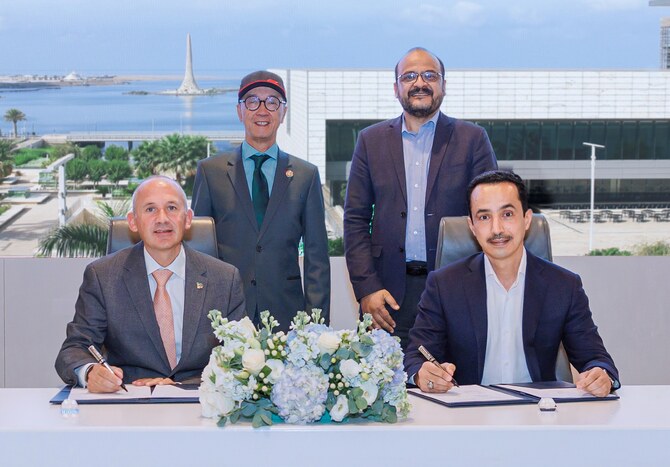
Saudi Aramco commits $100m to KAUST for R&D in energy transition, sustainability

Aramco Senior Vice President of Technology Oversight and Coordination Ali Al-Meshari and Vice President of KAUST’s National Transformation Initiative Ian Campbell sign the MoU in the presence of Aramco Executive Vice President of Technology and Innovation Ahmad Al-Khowaiter and KAUST President Tony Chan. Supplied
Short Url
Updated 12 August 2024
Follow

Saudi Aramco commits $100m to KAUST for R&D in energy transition, sustainability

  • Collaboration to focus on developing commercially viable solutions to support energy transition and sustainability goals
  • Projects aim to accelerate innovation in Saudi Arabia and address some of the most pressing global and local challenges

RIYADH: Saudi energy giant Aramco has announced a $100 million commitment to fund research and development at King Abdullah University of Science and Technology over the next decade. 
The collaboration aims to accelerate innovation in Saudi Arabia and develop commercially viable solutions that support the global energy transition and sustainability goals, the company said in a press release. 
The agreement, formalized through a memorandum of understanding, will see Aramco and KAUST partner on a range of projects that span essential research and applied technologies. 
The initiatives will focus on areas including energy transition, sustainability, materials science, upstream technologies, and digital solutions. 

This comes as Saudi Arabia intensifies its efforts to position itself as a global leader in energy innovation and sustainability, in line with its Vision 2030 strategy to diversify the economy and reduce reliance on oil. 
As part of this broader initiative, the country is making substantial investments in research and development to advance technologies that support the energy transition and address critical environmental challenges. 
Aramco President and CEO, Amin Nasser, said: “This collaboration will further deepen Aramco’s relationship with KAUST and we look forward to exploring new possibilities and frontiers with a strong focus on R&D and technology development, reflecting our firm belief in the importance of innovation across industries and applications.” 
The collaboration will target key areas such as liquids-to-chemicals conversion, low-carbon aviation fuels, and future refineries within the energy transition field. 
“The partnership exemplifies KAUST’s dedication to fostering impactful research that drives technological advancements and addresses real-world challenges. Our collaboration with Aramco will leverage our combined expertise to develop innovative solutions for a sustainable future,” said KAUST President Tony Chan. 
As part of the deal, sustainability efforts will focus on hydrogen, carbon capture and storage, renewables, and energy storage technologies. 
Additional projects are expected to address advanced carbon materials and geothermal energy, among other initiatives, according to the release. 
Founded in 2009, KAUST is a graduate research university focused on addressing key scientific and technological challenges in areas such as food, health, water, energy, environment, and digital technologies. 
The partnership marks a significant step in Saudi Arabia’s ongoing commitment to becoming a global hub for energy innovation and sustainable development.


Saudi Arabia ranks 2nd globally in digital government, World Bank 2025 index shows


Updated 18 December 2025
Follow

Saudi Arabia ranks 2nd globally in digital government, World Bank 2025 index shows


WASHINGTON: Saudi Arabia has achieved a historic milestone by securing second place worldwide in the 2025 GovTech Maturity Index released by the World Bank.

The announcement was made on Thursday during a press conference in Washington, DC, which evaluated 197 countries.

The Kingdom excelled across all sub-indicators, earning a 99.64 percent overall score and placing it in the “Very Advanced” category.

It achieved a score of 99.92 percent in the Core Government Systems Index, 99.90 percent in the Public Service Delivery Index, 99.30 percent in the Digital Citizen Engagement Index, and 99.50 percent in the Government Digital Transformation Enablers Index, reflecting some of the highest global scores.

This includes outstanding performance in digital infrastructure, core government systems, digital service delivery, and citizen engagement, among the highest globally.

Ahmed bin Mohammed Al-Suwaiyan, governor of the Digital Government Authority, attributed this achievement to the unwavering support of the Saudi leadership, strong intergovernmental collaboration, and effective public-private partnerships.

He highlighted national efforts over recent years to re-engineer government services and build an advanced digital infrastructure, which enabled Saudi Arabia to reach this global standing.

Al-Suwaiyan emphasized that the Digital Government Authority continues to drive innovation and enhance the quality of digital services, in line with Saudi Vision 2030, supporting the national economy and consolidating the Kingdom’s transformation goals.

The 2025 GTMI data reflects Saudi Arabia’s excellence across key areas, including near-perfect scores in core government systems, public service delivery, digital citizen engagement, and government digital transformation enablers. This balanced performance places the Kingdom firmly in the “Grade A” classification for very advanced countries, demonstrating the maturity of its digital government ecosystem.

Saudi Arabia’s progress in the index has been remarkable: from 49th place in the 2020 edition, to third in 2022, and now second in 2025, confirming its status as a global leader in digital transformation and innovation.

The achievement also reflects the Kingdom’s focus on putting people at the center of digital transformation, enhancing user experience, improving government efficiency, and integrating artificial intelligence and emerging technologies across public services.