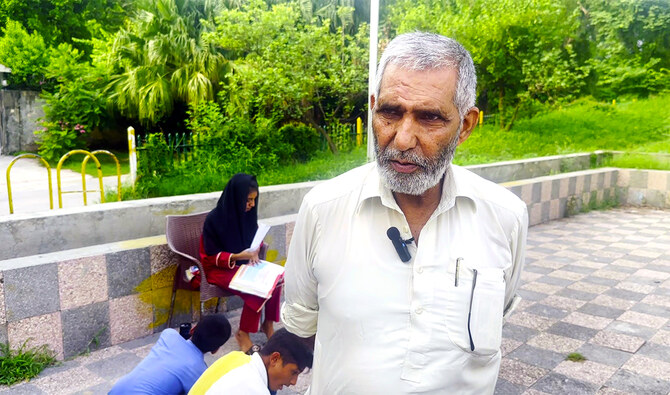

ISLAMABAD: The children sat huddled on the concrete floor of a park in Islamabad’s F-6 sector, scribbling on their notebooks as they listened intently to the teachers.
This is the open-air classroom run by 66-year-old Mohammed Ayub, better known as “Master Ayub” to the thousands of students the retired government employee has taught in the federal capital since 1982.
According to UNICEF, Pakistan has the world’s second-highest number of out-of-school children with an estimated 26.2 million children aged 5-16 not attending school. Gaps in service provision at all education levels, socio-cultural demand-side barriers combined with economic factors and issues such as availability of school facilities and teachers together hamper access and retention of certain marginalized groups, in particular adolescent girls.
Ayub wants to change this.
“These children should not become addicts,” he told Arab News at his open-air classroom. “If they study, someone will become a doctor, an engineer, someone will go to colleges and schools, my country will progress. This is my passion, this is my love for these children.”
Ayub moved to Islamabad in 1976 from his hometown of Mandi Bahauddin to provide for his seven siblings after his father passed away. He got a job at the government’s civic emergency services department and became a firefighter and would retire ultimately as the Chief Fire Officer at the Pakistan Secretariat.
Ayub was motivated to start a learning center for the underprivileged when he met a 12-year-old bussing tables at a restaurant in Islamabad in 1982. When the boy told Ayub his parents couldn’t afford tuition, Ayub started giving him lessons on a footpath initially and later at a park.
His initial group of students came from Islamabad’s slums and grew in number as the years passed, with many going on to get admissions in colleges and universities and find jobs at hospitals and in the army and police departments, said Ayub, who has been given Pakistan’s national “Pride of Performance” award for his contributions to education.
“CHANGED MY LIFE”
Up to 270 students are enrolled at Ayub’s free school at any one time. One student who has passed through is Zafran Ali, AGE, who now works as a firefighter at the IT ministry.
Ali became a child laborer after his parents moved to Islamabad to find domestic work but started studying at Ayub’s classroom in 2000, taking grade 1 lessons with his two sisters and a brother. Six years old at the time, Ali’s other classmates were daily wage laborers, flower sellers and car washers. He went on to pass his matriculation exams and get a Faculty of Arts (FA) qualification, degrees that helped him get a decent job.
“My family was working in someone’s house and if I had not studied here or if Master Ayub had not worked so hard on me, I would also be working in someone’s house,” Ali told Arab News.
Ali, who is now married with two children, said Ayub was so dedicated to his task he would show up at children’s homes when they did not come to class.
“Master Ayub has changed my life, and not only mine but also the lives of many others,” Ali said, giving examples of other peers who went on to secure “good positions,” including as policemen.
Azika Shehbaz, an 18-year-old intermediate student, was also Ayub’s student years ago and is now a volunteer teacher at his school.
“When he used to teach children, we were watching him from the beginning,” Shehbaz told Arab News. “So, in our hearts, we thought that we have to become teachers also.”
In 2022, Ayub’s classroom closed briefly for the first time in 40 years when he had an accident in which his wife, brother and child were killed while the teacher escaped with a broken arm and leg.
Despite his grief, Ayub said people lifted his spirits and convinced him to resume classes for the children.
“People came to me, Muslims and Christians alike, they said, ‘Master sahib, this is life, we all have to go’,” Ayub recalled. “They said to me, ‘Get up again. If you don’t, these children’s lives will be ruined’.”
Now, as the teacher’s classes continue, his request to people is not for funds but for donations of books and notebooks for the students.
“It is my intention that as long as there is a drop of blood in my body,” he said, “I will continue to educate these children.”