



RIYADH: An online teaching platform is strengthening Saudi children’s educational journeys while also unleashing the potential of local and international educators.
Cindy Mi, an English teacher for 25 years who founded VIPKid a decade ago and brought the company to Saudi Arabia about two years ago, told Arab News: “I’ve always been a student and a teacher myself. The goal is to build a global classroom to allow more children to get access to best quality language learning educational experiences … so they can be ready for their more globalized future.”
Since its founding in 2013, VIPKid has helped more than 1 million children worldwide learn English and delivered over 280 million live online classes in English and Mandarin.

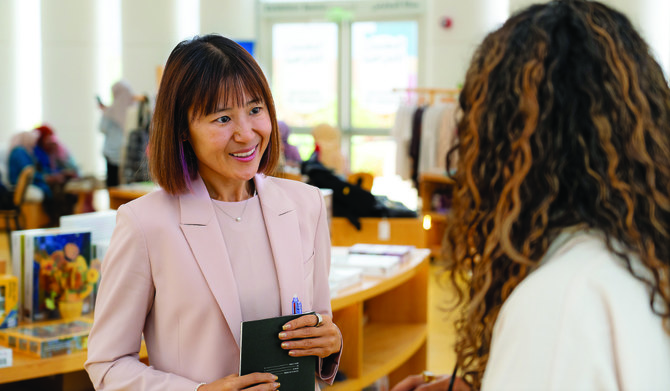
Cindy Mi is an english teacher for 25 years who founded the online learning platform VIPKid a decade ago and brought the company to Saudi Arabia about two years ago. (AN photo by Abdulrhman Bin Shalhoub/Supplied)
The CEO was inspired to expand the platform to the region after speaking on a Future Investment Initiative session about the future of education with Saudi Ambassador to the US Princess Reema bint Bandar.
Reflecting on her discussion with Princess Reema, Mi said: “Her vision of empowering women and especially the youth of the Kingdom for the future was truly an inspiration.”
She added that Saudi Vision 2030’s goal to improve education was also part of the inspiration.
I can totally see so many women in the Kingdom, in the region, teach children around the globe and share the wonderful culture with the world.
Cindy Mi, VIPKid CEO
“We are very happy and honored to support the initiative by providing the children of the Kingdom with the highest quality language tutors from the US or from China, learning Mandarin Chinese and English, so that the children can be well prepared for the future.”
Over the years, VIPKid has built more than 10 core language-learning modules. It also offers over 1,800 supplemental elective classes for learning English and Mandarin.
VIPKid launched a pilot training program for local English teachers in 2023. It ended last month, and was designed to raise the standard for both proficiency and pedagogy.
Mi added that VIPKid’s multicultural programs allow experienced teachers from all over the world to meet with their Saudi counterparts in order to share best practices, improve subject matter competency and gain confidence in the classroom.
“We work with partners like government bodies, educational institutions and other tech companies so that we can help them launch similar programs, especially in the field of teacher training.”
In order to help students learn better at school, teachers also need to learn themselves, which requires investment, Mi said. “I think the Kingdom has invested a lot (in) teachers … it is very helpful for them to improve their language proficiency with a peer from other parts of the world.”
According to Mi, VIPKid’s classrooms are a safe space to make mistakes and teachers encourage students in ways that promote confidence. “That confidence would be the light in the learning,” she added. “It would be the lighthouse, and then the students would say, ‘Oh, I can do this. I can speak very confidently’.”
Noting the advancements and changes brought about by technology and artificial intelligence, Mi said that “the human part is always the most important.”
As a technology-dependent platform, the online institute has been able to create a more personalized learning experience for students with real-time feedback.
This has also opened up the prospect of AI teacher and student learning assistants, which allow both parties to identify improvement points through comprehensive analytical tools.
To improve the learning experience, VIPKid is leveraging its data to create an AI tutor who works with children to acquire the fundamentals of a language, such as phonetics, freeing up teachers to focus on more advanced topics.
“When it comes to technology, I think education can be affordable, accessible and personalized, that I think would unleash the potential of educators, but also truly be able to provide a high-quality learning experience for children across the globe,” she said.
Mi is also discussing the launch of Arabic tutoring programs with local partners: “There are so many children around the globe that are curious to learn the language, and also the many expats in the region … their children and family need to learn Arabic as well.”
She added that localizing further would benefit female teachers in the region by “the impact and income they can make.”
According to Mi, her experience in building a community of teachers with American, Canadian and Chinese teachers suggests that women tend to take up the profession more frequently: “I think women are equipped with the loving, passionate characteristics and personality to work with the kids.
“I can totally see so many women in the Kingdom, in the region, teach children around the globe and share the wonderful culture with the world.”
She added that “the empowerment of the youth for the future” is a common theme in China and Saudi Arabia.
“One thing I see VIPKid contributing is global educational resources and the teacher sources that can help children connect with the world and, at the same time, sharing our culture to the world as well,” she said.


