

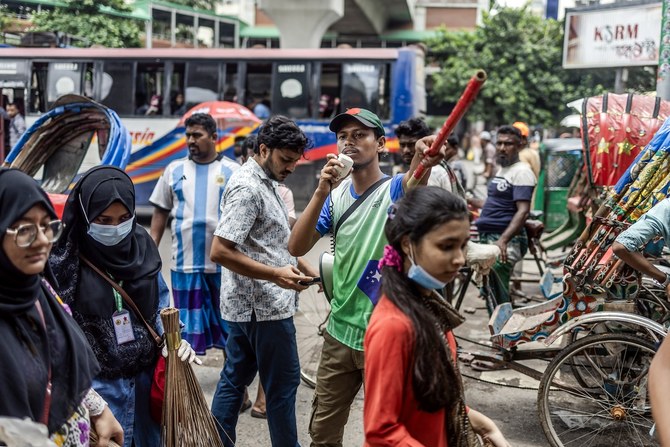

DHAKA: Nearly a week on from the sudden collapse of Bangladeshi Prime Minister Sheikh Hasina’s government, police are nowhere to be seen in the country’s capital, Dhaka. Students and volunteers have stepped in as substitutes in an attempt to stop the city descending into chaos.
The Bangladesh Police Association, which represents 150,000 of the country’s police officers, announced its strike on Tuesday, a day after the ouster of Hasina’s government by student-led protestors.
The lack of police is one of the country’s newly appointed interim government’s top priorities.
“There is an absence of law enforcement,” Farida Akhter, adviser to the caretaker cabinet, told Arab News on Saturday. “We are in a transition period at the moment. Normalcy can’t be restored unless law enforcers return to work.”
But many police fear retribution and punishment from the new administration and the student movement for the force with which they tried to crush the uprising. Hundreds were killed in the weeks-long protests.
The BPA has since apologized and claimed police had been “forced” to open fire.
“We are working to build confidence among members of the law enforcement agency,” said Akhter, who was sworn in on Thursday evening along with other members of the caretaker government, which is led by Nobel-winning economist Muhammad Yunus.
Reports of robbery, attacks on minorities and their places of worship, arson, destruction of government buildings, and other criminal activity have been rife over the past few days.
“We are concerned about this issue and want to address this first. My colleague in charge of the home ministry is working on this. We hope to see some positive development this week,” Akhter said. “In many cases, community members and students have joined hands to protect others ... It’s very significant.”
Sabikun Nahar, a student at Eden Mohila College in Dhaka, was trying to manage traffic in the Dhanmondi area of Dhaka on Saturday.
“The police have disappeared from the scene ... That’s why students are volunteering to manage the traffic. As soon as the police take over, we will return to classrooms,” she told Arab News.
With more than 20 million residents, Dhaka is widely considered the world’s most densely populated urban area and relies on thousands of police wardens to manage its severe congestion.
“We are asking people on the streets to abide by the traffic rules,” Nahar said. “But managing the traffic is not our job. The sooner the police come back, the better for all of us.”
Dhaka residents, meanwhile, are focused on the struggle to keep their neighborhoods safe.
“This situation has pushed the city into a state of anarchy. Incidents of robbery have occurred in many places,” said Mansura Begum, who lives in Badda, where residents have been guarding their homes with bamboo sticks and iron rods.
“How long we will be able to remain safe in this way? The authorities should move fast to restore law and order in the country.”


