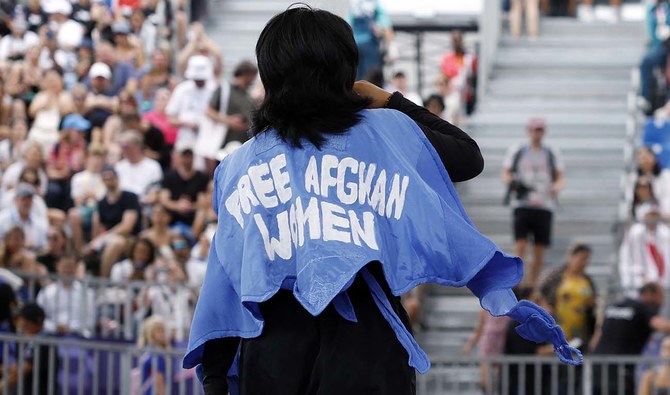
PARIS: Olympic Refugee Team breakdancer Manizha Talash from Afghanistan was disqualified from the breaking competition after she wore a cape saying “Free Afghan Women,” the World DanceSport Federation told AFP on Saturday.
B-girl Talash, 21, unveiled the blue top with the slogan on Friday just before the first duel of the whole competition, against India Sardjoe of the Netherlands.
“Refugee athlete B-girl Talash... was disqualified for displaying a political slogan on her attire in violation of Rule 50 of the Olympic Charter,” the association said in a statement to AFP.
That rule states that “no kind of demonstration or political, religious or racial propaganda is permitted in any Olympic sites, venues or other areas.”
Born in Kabul, under Taliban control since 2021, Talash fled the country to live in Spain with her two brothers.
Before arriving in Spain, she spent a year in hiding in Pakistan because she did not have a passport.
“I didn’t leave Afghanistan because I’m afraid of the Taliban or because I can’t live in Afghanistan,” she said before the competition.
“I left because I want to do what I can for the girls in Afghanistan, for my life, my future, for everyone.”
In Kabul, she discovered breaking online and joined a local club, where she was the only girl.
Despite the risks — the troupe was forced to switch practice venues after receiving death threats — she was determined to pursue her passion.
“I took the risk of becoming a target. I have fear in my heart but I won’t give up,” she told AFP in 2021.
Six athletes represented Afghanistan — including three women not acknowledged by the Taliban government — at the Paris Olympics in cycling, athletics, swimming and judo.

‘Free Afghan Women’: Olympic refugee breakdancer disqualified for slogan
https://arab.news/vb2hn
‘Free Afghan Women’: Olympic refugee breakdancer disqualified for slogan
- Born in Kabul, 21-year-old Manizha Talash fled the country to live in Spain with her two brothers
- Before arriving in Spain, she spent a year in hiding in Pakistan because she did not have a passport
Justice Department faces hurdle in seeking case against Comey as judge finds constitutional problems
WASHINGTON: The Justice Department violated the constitutional rights of a close friend of James Comey and must return to him computer files that prosecutors had hoped to use for a potential criminal case against the former FBI director, a federal judge said Friday.
The ruling from US District Judge Colleen Kollar-Kotelly represents not only a stern rebuke of the conduct of Justice Department prosecutors but also imposes a dramatic hurdle to government efforts to seek a new indictment against Comey after an initial one was dismissed last month.
The order concerns computer files and communications that investigators obtained years earlier from Daniel Richman, a Comey friend and Columbia University law professor, as part of a media leak investigation that concluded without charges. The Justice Department continued to hold onto those files and conducted searches of them this fall, without a new warrant, as they prepared a case charging Comey with lying to Congress five years ago.
Richman alleged that the Justice Department violated his Fourth Amendment rights by retaining his records and by conducting new warrantless searches of the files, prompting Kollar-Kotelly to issue an order last week temporarily barring prosecutors from accessing the files as part of its investigation.
The Justice Department said the request for the return of the records was merely an attempt to impede a new prosecution of Comey, but the judge again sided with Richman in a 46-page order Friday that directed the Justice Department to give him back his files.
“When the Government violates the Fourth Amendment’s prohibition on unreasonable searches and seizures by sweeping up a broad swath of a person’s electronic files, retaining those files long after the relevant investigation has ended, and later sifting through those files without a warrant to obtain evidence against someone else, what remedy is available to the victim of the Government’s unlawful intrusion?” the judge wrote.
One answer, she said, is to require the government to return the property to the rightful owner.
The judge did, however, permit the Justice Department to file an electronic copy of Richman’s records under seal with the Eastern District of Virginia, where the Comey investigation has been based, and suggested prosecutors could try to access it later with a lawful search warrant.
The Justice Department alleges that Comey used Richman to share information with the news media about his decision-making during the FBI’s investigation into Hillary Clinton’s use of a private email server. Prosecutors charged the former FBI director in September with lying to Congress by denying that he had authorized an associate to serve as an anonymous source for the media.
That indictment was dismissed last month after a federal judge in Virginia ruled that the prosecutor who brought the case, Lindsey Halligan, was unlawfully appointed by the Trump administration. But the ruling left open the possibility that the government could try again to seek charges against Comey, a longtime foe of President Donald Trump. Comey has pleaded not guilty, denied having made a false statement and accused the Justice Department of a vindictive prosecution.
The Comey saga has a long history.
In June 2017, one month after Comey was fired as FBI director, he testified that he had given Richman a copy of a memo he had written documenting a conversation he had with Trump and had authorized him to share the contents of the memo with a reporter.
After that testimony, Richman permitted the FBI to create an image, or complete electronic copy, of all files on his computer and a hard drive attached to that computer. He authorized the FBI to conduct a search for limited purposes, the judge noted.
Then, in 2019 and 2020, the FBI and Justice Department obtained search warrants to obtain Richman’s email accounts and computer files as part of a media leak investigation that concluded in 2021 without charges. Those warrants were limited in scope, but Richman has alleged that the government collected more information than the warrants allowed, including personal medial information and sensitive correspondence.
In addition, Richman said the Justice Department violated his rights by searching his files in September, without a new warrant, as part of an entirely separate investigation.
“The Court further concludes that the Government’s retention of Petitioner Richman’s files amounts to an ongoing unreasonable seizure,” Kollar-Kotelly wrote. “Therefore, the Court agrees with Petitioner Richman that the Government has violated his Fourth Amendment right against unreasonable searches and seizures.”


