VINHEDO, Brazil: An airplane carrying 57 passengers and four crew crashed Friday in Brazil’s Sao Paulo state, killing everyone on board, the airline said.
The aircraft, an ATR 72-500 operated by Voepass airline, was traveling from Cascavel in southern Parana state to Sao Paulo’s Guarulhos international airport when it crashed in the city of Vinhedo.
Voepass initially said the plane was carrying 58 passengers, but a statement later on the airline’s website revised the figure to 57.
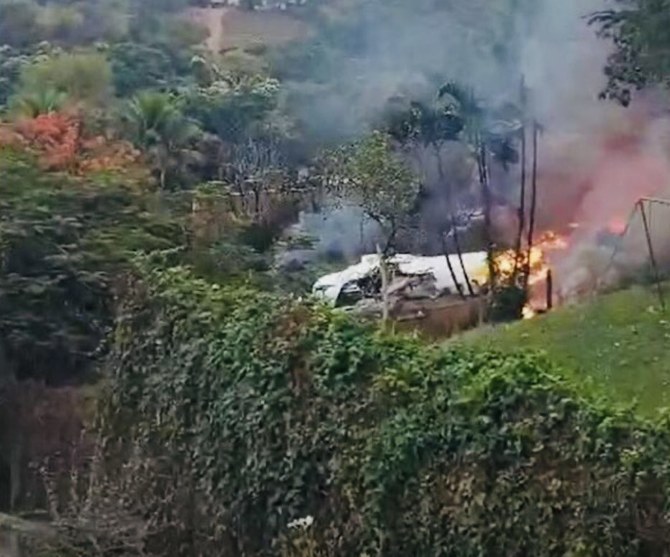
Images broadcast on local media showed a large plane spinning as it plummeted almost vertically, while other footage showed a large column of smoke rising from the crash site in what appeared to be a residential area.
“There were no survivors,” the city government in Valinhos — which was involved in the rescue and recovery operation in nearby Vinhedo — said in an email sent to AFP.
Vinhedo, with about 76,000 residents, is located approximately 80 kilometers (50 miles) northwest of Sao Paulo.
“The bodies are being taken to the morgue,” the Vinhedo city government told AFP.
Before an official death toll was given, President Luiz Inacio Lula da Silva said during an event in Santa Catarina state that it appeared there were no survivors, and called for a moment of silence for the victims.
In a statement, Voepass reported “an accident involving flight 2283.”
The company said it was cooperating with authorities to “determine the causes of the accident,” while giving full assistance to victims’ families.
The plane, a twin-engine turboprop, took off “without any flight restrictions, with all its systems operational,” the statement added.
ATR, a Franco-Italian aircraft maker and Airbus subsidiary, said its experts were working to help investigators.
Nathalie Cicari, who lives near the crash site, told CNN Brasil the impact was “terrifying.”
“I was having lunch, I heard a very loud noise very close by,” she said, describing the sound as drone-like but “much louder.”
“I went out on the balcony and saw the plane spinning. Within seconds, I realized that it was not a normal movement for a plane.”
Cicari was not hurt but had to evacuate her house, which was filled with black smoke from the crash.
“I arrived at the scene and saw many bodies on the ground — many of them,” another witness, Ricardo Rodrigues, told local Band News.
Firefighters, military police and state civil defense were deployed at the scene.
Military police on the ground told local media that the accident had not caused any additional casualties at the crash site, and that the fire sparked by the crash had been brought under control.
The plane’s black box “has already been found, apparently preserved,” Sao Paulo state security official Guilherme Derrite told reporters at the scene.
The doomed plane recorded its first flight in April 2010, according to the website planespotters.net.
Air safety has improved dramatically in recent decades, with deadly passenger plane crashes becoming ever-more rare worldwide, though still more frequent in developing nations.
In January 2023, another ATR 72 operated by Yeti Airlines crashed after stalling in Nepal, killing all 72 on board.
Nepalese authorities attributed the incident to pilot error.


![]()

Passenger plane crash in Brazil kills all 61 on board
Short Url
https://arab.news/wtby3
Passenger plane crash in Brazil kills all 61 on board
- President Luiz Inacio Lula da Silva said during an official event that it appeared there were no survivors
- The aircraft was traveling from Cascavel in southern Parana state to Sao Paulo’s Guarulhos international airport


Latest updates


© 2026 SAUDI RESEARCH & PUBLISHING COMPANY, All Rights Reserved And subject to Terms of Use Agreement.