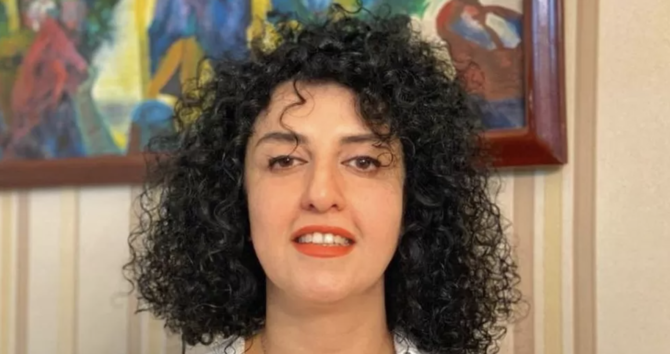
PARIS: Jailed Iranian Nobel peace prize winner Narges Mohammadi and other female inmates were hurt in clashes that erupted at Tehran’s Evin prison following a spate of executions, her family said, raising new concerns for her health.
Iranian authorities acknowledged a confrontation had taken place on Tuesday but blamed Mohammadi for a “provocation” and denied any of the prisoners had been beaten.
Human rights activist Mohammadi, 52, who won the 2023 prize for her campaigning including against the death penalty, has been jailed since November 2021, and has spent much of the past decade in and out of prison.
The Paris-based family of Mohammadi emphasized it had had no direct contact with her since her right to make phone calls was revoked in November.
But it said it had learnt from several other families of detainees held in Evin that clashes erupted on Tuesday as the female prisoners launched a protest in the yard against the executions.
According to rights groups, around 30 convicts were hanged this week, including Gholamreza (Reza) Rasaei, who the Iranian judiciary said was executed on Tuesday in connection with 2022 protests.
“The protest by prisoners against the execution of Reza Rasaei led to a violent crackdown by prison guards and security agents,” Mohammadi’s family said in a statement late Thursday, citing the reports.
“Several women who stood in front of the security forces were severely beaten. The confrontation escalated, resulting in physical injuries for some prisoners.”
The family said that after being punched in the chest, Mohammadi suffered a respiratory attack and intense chest pain, causing her to collapse and faint on the ground in the prison yard.
She was bruised and treated in the prison infirmary but not transferred to a hospital outside, it said.
“We are deeply worried about her health and well-being under these circumstances,” the family said.
Relatives and supporters had earlier this month raised concern about Mohammadi’s condition, saying they had been informed of the results of medical tests carried out in July “which showed a worrying deterioration of her health.”
In the past eight months, Mohammadi has been suffering from acute back and knee pain, including a slipped disc. In 2021, a stent was placed on one of her main coronary arteries due to a blockage.
Iran’s prison authority denied that prisoners were beaten and blamed the confrontation on Mohammadi and other inmates who it said had broken the lock of an outer door.
Two prisoners “had heart palpitations due to the stress,” but medical examinations determined that their general condition “is favorable,” it said in a statement, according to the Tasnim news agency.
Reports have suggested increasing tensions in the women’s wing of Evin prison after two Kurdish female activists, Sharifeh Mohammadi and Pakhshan Azizi, were sentenced to death on charges of membership of an outlawed group.
Rights groups say that Iran has intensified the use of capital punishment after a brief lull in the run-up to the June-July election that brought reformist President Masoud Pezeshkian to power.
Authorities executed 29 people at two prisons in the Tehran satellite city of Karaj on Wednesday alone, according to Norway-based Iran Human Rights.
Volker Turk, the UN high commissioner for human rights, “is extremely concerned” by the reports, spokeswoman Elizabeth Throssell told journalists in Geneva. “This represents an alarmingly high number of executions in such a short period of time.”
Mohammadi has kept campaigning even behind bars and strongly supported the protests that erupted across Iran following the September 2022 death in custody of Mahsa Amini. The 22-year-old Iranian Kurd had been arrested for an alleged breach of Iran’s strict dress rules for women.
She received a new one-year prison term in June for “propaganda against the state,” adding to sentences that already amounted to 12 years and three months of imprisonment, 154 lashes, two years of exile and various social and political restrictions.


Iran Nobel winner hurt in prison clashes with guards: family
https://arab.news/csjrj
Iran Nobel winner hurt in prison clashes with guards: family

- “The protest by prisoners against the execution of Reza Rasaei led to a violent crackdown by prison guards and security agents,” Mohammadi’s family said
- The family said that after being punched in the chest, Mohammadi suffered a respiratory attack and intense chest pain, causing her to collapse and faint


The art of war: fears for masterpieces on loan to Louvre Abu Dhabi
- UAE paid more than €1 billion to borrow priceless works, but experts in France want them back
PARIS: The Middle East war has raised fears for the safety of priceless masterpieces on loan from France to the Louvre Abu Dhabi, the museum’s only foreign branch.
The Abu Dhabi museum, which opened in 2017, has so far escaped damage from nearly 1,800 Iranian drone and missile strikes launched since the conflict erupted on Feb. 28.
However, concerns are mounting in France. “The works must be removed,” said Didier Selles, who helped broker the original agreement between France and the UAE.
French journal La Tribune de l’Art echoed that alarm. “The Louvre’s works in Abu Dhabi must be secured!” it said.
France’s culture ministry said French authorities were “in close and regular contact with the authorities of the UAE to ensure the protection of the works loaned by France.”
Under the agreement with the UAE, France agreed to provide expertise, lend works of art and organize exhibitions, in return for €1 billion, including €400 million for licensing the use of the Louvre name. The deal was extended in 2021 to 2047 for an additional €165 million.
Works on loan include paintings by Rembrandt and Chardin, Classical statues of Isis, Roman sarcophagi and Islamic masterpieces: such as the Pyxis of Al-Mughira.
A Louvre Abu Dhabi source said the museum was designed to protect collections from both security threats and natural disasters.