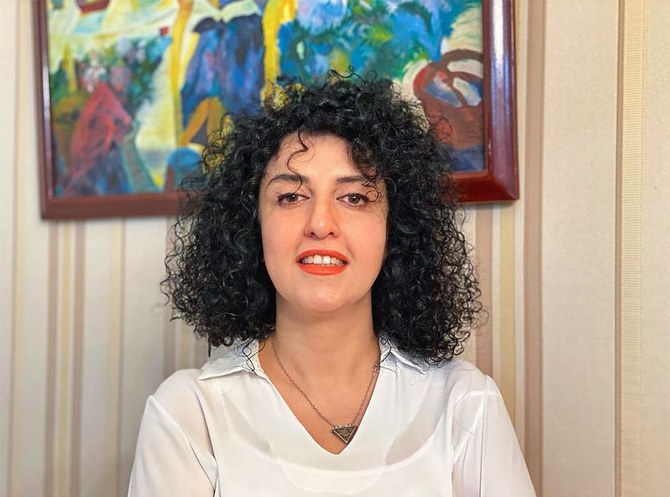
Nobel Peace Prize laureate Narges Mohammadi goes on a hunger strike while imprisoned in Iran

A handout photo provided by the Narges Mohammadi Foundation on October 2, 2023 shows an undated, unlocated photo of Iranian rights campaigner Narges Mohammadi. (File/AFP)
Short Url
Updated 06 November 2023
Follow

Nobel Peace Prize laureate Narges Mohammadi goes on a hunger strike while imprisoned in Iran

  • Mohammadi, 51, has kept up her activism and has remained a leading light for nationwide, women-led protests

DUBAI: A campaign urging Iran to free Nobel Peace Prize laureate Narges Mohammadi said Monday that the activist has begun a hunger strike over the conditions of her imprisonment and the country's requirement that women wear headscarves.
The Free Narges Mohammadi campaign said she “through a message from Evin Prison has informed her family that she started a hunger strike several hours ago.” It said Mohammadi and her lawyer for weeks have sought her transfer to a specialist hospital for heart and lung care.
It did not elaborate on what conditions Mohammadi suffered from, though it described her as receiving an echocardiogram of her heart.
Iranian state media did not immediately acknowledge that Mohammadi had gone on a hunger strike.
Mohammadi, 51, has kept up her activism despite numerous arrests by Iranian authorities and spending years behind bars. She has remained a leading light for nationwide, women-led protests sparked by the death last year of a 22-year-old woman in police custody that have grown into one of the most intense challenges to Iran’s theocratic government.
That woman, Mahsa Amini, had been detained for allegedly not wearing her headscarf, or hijab, to the liking of authorities.


UN chief condemns Israeli law blocking electricity, water for UNRWA facilities

Updated 01 January 2026
Follow

UN chief condemns Israeli law blocking electricity, water for UNRWA facilities

  • The agency provides education, health and aid to millions of Palestinians in Gaza, the West Bank, Jordan, Lebanon and Syria

United Nations Secretary General Antonio Guterres condemned on Wednesday a move by Israel to ban electricity or water to facilities owned by the UN Palestinian refugee agency, ​a UN spokesperson said.
The spokesperson said the move would “further impede” the agency’s ability to operate and carry out activities.
“The Convention on the Privileges and Immunities of the United Nations remains applicable to UNRWA (United Nations Relief and Works Agency for Palestine Refugees in the Near East), its property and assets, and to its officials and other personnel. Property used ‌by UNRWA ‌is inviolable,” Stephane Dujarric, spokesman for the ‌secretary-general, ⁠said ​while ‌adding that UNRWA is an “integral” part of the world body.
UNRWA Commissioner General Phillipe Lazzarini also condemned the move, saying that it was part of an ongoing “ systematic campaign to discredit  UNRWA and thereby obstruct” the role it plays in providing assistance to Palestinian refugees.
In 2024, the Israeli parliament passed a law banning the agency from operating in ⁠the country and prohibiting officials from having contact with the agency.
As a ‌result, UNRWA operates in East Jerusalem, ‍which the UN considers territory occupied ‍by Israel. Israel considers all Jerusalem to be part ‍of the country.
The agency provides education, health and aid to millions of Palestinians in Gaza, the West Bank, Jordan, Lebanon and Syria. It has long had tense relations with Israel but ties have deteriorated ​sharply since the start of the war in Gaza and Israel has called repeatedly for UNRWA to ⁠be disbanded, with its responsibilities transferred to other UN agencies.
The prohibition of basic utilities to the UN agency came as Israel also suspended of dozens of international non-governmental organizations working in Gaza due to a failure to meet new rules to vet those groups.
In a joint statement, Canada, Denmark, Finland, France, Iceland, Japan, Norway, Sweden, Switzerland and the United Kingdom said on Tuesday such a move would have a severe impact on the access of essential services, including health care. They said one in ‌three health care facilities in Gaza would close if international NGO operations stopped.