

Pakistan hopes to ‘deepen cooperation’ with Bangladesh under Nobel laureate Yunus 

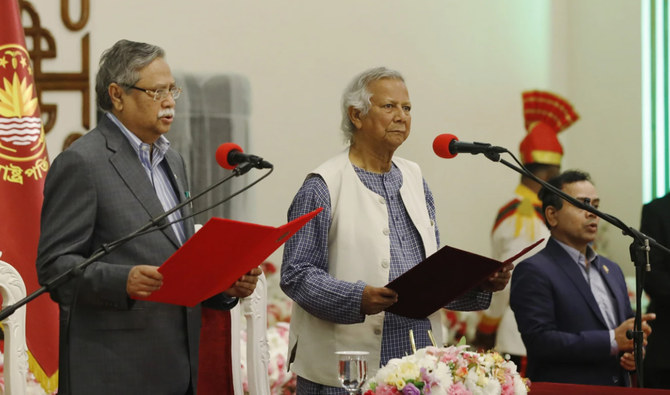
Bangladesh’s figurehead President Mohammed Shahabuddin administers the oath of office to Nobel laureate Muhammad Yunus, right, as the head of Bangladesh’s interim government, in Dhaka on August 8, 2024. (AP)
Short Url
Updated 09 August 2024
Follow

Pakistan hopes to ‘deepen cooperation’ with Bangladesh under Nobel laureate Yunus 

  • Yunus takes over caretaker government after weeks of violence forced PM Hasina to quit and flee to neighboring India
  • Bangladesh was born out of a war between India and Pakistan in 1971 in which nearly 3 million people were killed

ISLAMABAD: Prime Minister Shehbaz Sharif on Friday congratulated Nobel Peace laureate Muhammad Yunus on taking charge of Bangladesh’s caretaker government, saying he hoped to work with the new leader to “deepen cooperation” between the two South Asian nations.
Yunus took the reins of government on Thursday after weeks of violence that forced Prime Minister Sheikh Hasina to quit and flee to neighboring India. 
Pakistan and Bangladesh share a complex history, having been a single country known as East and West Pakistan until Bangladesh was born in 1971 after a war of liberation backed by Pakistan’s arch-rival and neighbor India. Nearly three million people were killed in the conflict.
Ties reached a new low in 2016 when Bangladesh executed several leaders of its Jamaat-e-Islami party on charges of committing war crimes in 1971. Pakistan called the executions and trials “politically motivated,” arguing that the convicts were being punished for taking a pro-Pakistan stance during the war. 
“Heartiest felicitations to Professor Muhammad Yunus on his swearing-in as Chief Adviser of the Government of the People’s Republic of Bangladesh. Wishing him great success in guiding Bangladesh toward a harmonious and prosperous future,” Prime Minister Sharif said on X. 
“I look forward to working with him to deepen cooperation between Pakistan and Bangladesh in the days ahead.”

Known as the “banker to the poor,” Yunus is the pioneer of the global microcredit movement. The Grameen Bank he founded won the 2006 Nobel Peace Prize for helping lift millions from poverty by providing tiny loans to the rural poor who are too impoverished to gain attention from traditional banks.
As chief adviser of the caretaker government, he is, however, tasked with bringing stability back to the country which witnessed some of its worst violence in decades, and then hold fresh parliamentary elections.
“The brutal, autocratic regime is gone,” Yunus said in a televised address to the nation after taking charge on Thursday. “Tomorrow, with the rising sun, democracy, justice, human rights, and full freedom of fearless expression will be enjoyed by all, regardless of party affiliation. That is our goal.”
Hasina’s flight from the country after weeks of deadly protests triggered jubilation and violence as crowds stormed and ransacked her official residence. Over 300 people were killed in clashes from July up until Hasina’s ouster. She had ruled for 20 of the last 30 years after winning a fourth term in January.
With inputs from Reuters


Suspect accused by police of abusing ‘over 100 children’ arrested in Karachi

Updated 5 sec ago
Follow

Suspect accused by police of abusing ‘over 100 children’ arrested in Karachi

  • Police link seven registered cases over five years to the suspect through forensic review
  • CCTV and geo-fencing helped trace prime suspect and his accomplice, leading to arrests

ISLAMABAD: Karachi police said on Saturday they arrested a suspect accused of sexually abusing “over 100 children,” describing the case as a major breakthrough in a long-running investigation, while official records examined so far document seven registered cases linked to the accused.

In a statement issued on Friday, the office of the Additional Inspector General of Police (IGP) Karachi said the arrest of the suspect and his accomplice was a significant achievement, praising the police for taking action after identifying a pattern across multiple cases reported over several years.

Senior Superintendent of Police (SSP) Investigation for Karachi’s East district, Muhammad Usman Sadozai, said police began connecting the cases after receiving a letter from a DNA laboratory detailing seven cases of sexual abuse involving minor boys reported between 2020 and 2025, all allegedly linked to the same perpetrator.

“When we examined the letter further, a clear pattern emerged across all seven cases,” Sadozai told Arab News over the phone, adding that the incidents occurred between 6 p.m. and midnight, mostly on weekends, and involved children being lured to the banks of the Malir River.

Police said CCTV footage and geo-fencing were used to trace the movements of the prime suspect and his accomplice, leading to their arrest. Three of the affected children have identified the suspects, according to investigators.
The victims are aged between 10 and 14, Sadozai said.

While the Additional IGP’s office described the suspect as being involved in the abuse of over 100 children, police records reviewed so far show that seven first information reports (FIRs) have been registered over the past five years at police stations including Sharafi Goth, Zaman Town, Qur’angi Industrial Area, Mehmoodabad and Defense.

All the FIRs invoke Section 377 of the Pakistan Penal Code, which deals with “unnatural offenses,” according to an order dated Jan. 6 establishing a special investigation team. Some cases also include additional charges such as kidnapping, criminal intimidation, bodily injury and attempted commission of an offense, reflecting varying levels of severity.

The Additional IGP said the protection of children was a top priority and vowed that those involved in such crimes would face the strictest punishment under the law, announcing commendation certificates and cash rewards for the police team involved.