

Restaurants in Karachi embrace Indian tradition of thali platters

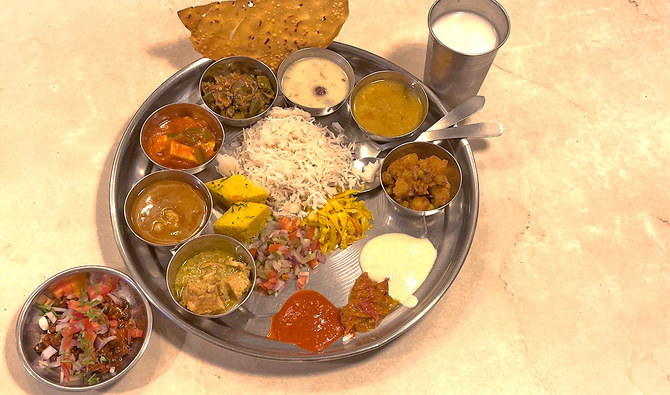
The picture taken on August 7, 2024, shows a thali platter at the Rajdhani Delights restaurant in Karachi, Pakistan. (AN photo)
Short Url
Updated 09 August 2024
Follow

Restaurants in Karachi embrace Indian tradition of thali platters

  • Thali is best described as a form of Indian tapas with a variety of dishes served together in small portions on a platter
  • Rajdhani Delights, Thali Inn and 52 Thali Restaurant are among a number of food outlets in Karachi serving thali platters

KARACHI: Though Karachi is considered Pakistan’s culinary hub, and all types of foods and cuisines from around the world can be found at its thousands of restaurants and street stalls, it was not easy until a few years ago to find a concept central to dietary traditions in neighboring India: the thali. 

Eleven years ago, the Pakistani port city saw the opening of Rajdhani Delights and with it the introduction of the thali platter, perhaps best described as a form of Indian tapas, or a variety of dishes served together in small portions. A thali is a large platter accompanied by small round bowls called katoris which are filled with different types of usually vegetable curries and lentils, as well as sauces, curds and condiments. Sometimes, the thali comes with built-in compartments for the different dishes, much like a bento box.

Few would have expected a vegetarian restaurant like Rajdhani Delights to thrive in meat-obsessed Karachi, but the eatery has been serving happy customers for a little over a decade in the city’s upscale Clifton area. 

Upon entering the restaurant, one is welcomed by Jerome Earnest, the manager, and led to a table where a staff member appears in a vibrant Rajasthani outfit of a turban and angarkha robe and presents a golden pot in which to wash one’s hands. 

A gleaming silver thali follows soon after, offering a colorful array of dishes like vegetable curries and stir fries made of potatoes, okra and cauliflower, as well as different types of lentils, phulka and puri breads, boiled rice, a variety of chutneys, salad, papri and dhokla. There is only one meat option of chicken on the menu.

“When someone comes here to eat ... they get a variety of dishes ... and especially the service, where people get to wash their hands and are presented food in a thali, that really attracts people,” Earnest the manager told Arab News.

Most people throng to Rajdhani Delights for the authentic flavor of its Gujarati thali, which comes from the state of Gujarat in Western India and includes several fried snacks, flatbreads, a variety of vegetable preparations cooked in ghee, as well as sweets.

Forty-year-old Farhan Rasheed, who runs an IT firm, said he had heard from elders in his family, many of whom migrated from India, about the country’s rich thali tradition.

“Now that we have the thali right in front of us [in Karachi], it feels even better,” he said as he sampled a dhokla, a savoury sponge dish made with a fermented batter that is steamed to a cake-like consistency. “It contains so many flavors.”

“You feel royal, which is the most important thing,” Rasheed added with a smile.

Much like Rasheed, who belongs to the Indian-origin Memon community, an elderly customer, a migrant from India who only identified herself as Mrs. Zaidi, also praised the restaurant’s “unique serving style” and its ability to generate a “sense of belonging.”

“We really appreciate that when we came, they washed our hands, we find that very nice,” she said. “Our food and culture remain the same [in India and Pakistan].”

“VARIETY OF OPTIONS”

The concept of serving an assortment of dishes on a platter has also inspired other eateries in Karachi. 

Thali Inn, located on Boat Basin, opened in 2020 and initially focused on Indian vegetarian thalis before adding in Pakistani, Afghan and Middle Eastern options. 

In India, too, thalis are not necessarily only vegetarian.

In the coastal regions of India, one can find variations of fish and seafood thalis. Kolhapur, a city in the state of Maharashtra in Western India, is famous for its various spicy mutton thali preparations and flavorful broths.

“Our thali now features more barbecue items,” Waseem Rehman, the manager at Thali Inn, told Arab News. “We offer vegetable thali but we have Arabic mandi thali and Afghan thali as well.”

Another outlet, 52 Thali Restaurant near the New Doleman Mall, offers platters featuring dishes from the Bohra community, a religious denomination within the Ismaili branch of Shia Islam.

“This thali is famous and includes all traditional Bohra dishes,” Hatim Muhammad, who runs the facility, said. “It features daal and rice, chicken cutlets, chicken steak, papri, samosas, chilies, pickles and salad.”

But many customers of Rajdhani Delights said they preferred the restaurant for sticking to its nearly-vegetarian menu of dishes cooked in traditional Indian styles.

“At many places, you only get meat,” said one customer who identified herself as Mrs. Shehzad. 

“Here, you have a variety of options, including vegetables, daal, and other dishes. This thali offers so many different flavors that it makes eating a real pleasure.”


Separated twice: An Afghan man’s life in Pakistan and the fear of losing home again

Updated 2 min 39 sec ago
Follow

Separated twice: An Afghan man’s life in Pakistan and the fear of losing home again

  • Lost as a child in Peshawar, Mohammad Rahim Khan built a life in Pakistan but remains undocumented
  • Deportation drive of ‘illegal’ foreigners exposes legal gaps around adoption, marriage, refugee status

ISLAMABAD: Mohammad Rahim Khan was five years old when he last saw his mother.

It was at the Hajji Camp bus stop in Pakistan’s northwestern city of Peshawar, more than four decades ago. His mother, an Afghan refugee fleeing war, had brought him across the Tari Mangal border in Kurram district and into Pakistan. While waiting at the crowded terminal, Khan wandered to a nearby toy shop. When he returned, she was gone.

He searched for her for two days. She never came back.

A local shopkeeper, Ali Muhammad, took pity on the child and brought him home, promising to help find his family. The temporary shelter became permanent. Khan grew up in Pakistan, adopted informally into the household, and never returned to Afghanistan.

Now 45, he lives on the outskirts of Islamabad in a modest two-room house, working as a daily wage laborer. But a nationwide deportation drive launched by Pakistan in 2023 has placed his entire life under threat.

Since November 2023, authorities have deported nearly 2 million Afghan nationals, targeting those without legal documentation. Khan, who has remained undocumented throughout his adult life, fears he may soon be among them.

“I spoke to my lawyer that I am very worried,” Khan told Arab News. “I love Pakistan.”

A FAMILY WITHOUT PAPERS

Ali Muhammad later married Khan to his daughter, Gul Mina. Together, they have six children, four daughters and two sons. Yet despite decades in Pakistan, Khan’s Afghan nationality continues to shadow the family.

Khan never held an Afghan refugee card, Afghan Citizen Card (ACC), Proof of Registration (POR), or any other formal documentation. His family assumed for decades that his informal adoption, marriage to a Pakistani citizen, and long residence would provide sufficient legal standing. They only sought legal advice when the deportation drive began threatening separation.

Without a Pakistani national identity card, his children cannot obtain Form-B, the birth registration document required for school enrolment.

“They [children] are told to get a Form-B,” Gul Mina told Arab News. “Otherwise, they will not go to school.”

Three of their daughters were forced to leave school after eighth grade.

Healthcare has also been affected. When Khan’s 13-year-old son, Ehsanullah, fractured his arm, a public hospital refused to issue a registration card without identity documents.

“Then I went to a [private clinic] in Chak Shahzad and got my treatment there,” Khan said.

The family has petitioned the Islamabad High Court to block his deportation. Lawyers say the case highlights how thousands of long-term residents fall through legal cracks created by Pakistan’s citizenship, refugee and documentation framework.

LEGAL GREY ZONE

Pakistan does not legally recognize Western-style adoption. Instead, it uses a guardianship system under the 1890 Guardians and Wards Act, aligning with Islamic principles that preserve lineage, so adopted children don’t inherit or change their family name but receive care, education and welfare through court-appointed guardianship.

“Because we don’t have a legal pathway for adoption per se, the adopted child does not get citizenship of the adopting parents automatically,” said Advocate Umer Ijaz Gillani, a legal expert on citizenship.

Years earlier, Khan’s father-in-law had offered to register him as his biological son to obtain identity documents, but Khan refused, calling the move fraudulent. Because Khan later married his father-in-law’s daughter, both he and his wife cannot legally list the same person as their father on official records, leaving them without a lawful workaround.

Marriage offers no certainty either. Pakistan’s Citizenship Act of 1951 grants citizenship to foreign women married to Pakistani men, but is silent on foreign husbands married to Pakistani women.

While higher courts have, at times, ruled in favor of such men, implementation has been inconsistent. In October 2025, the Supreme Court struck down a high court order that had directed authorities to grant citizenship to an Afghan man married to a Pakistani woman.

Even the Pakistan Origin Card (POC), a long-term residency document, remains difficult to secure.

“We have experienced that in the case of especially Afghan men who marry Pakistani women, the government authorities are often reluctant to recognize this right,” Gillani said.

According to submissions made by government officials in court, authorities have received at least 117 applications for nationality from Afghan men married to Pakistani women following directives issued by the Peshawar High Court, reflecting a broader pattern rather than isolated cases.

‘NO RELAXATION’

Officials say the deportation policy allows no exceptions.

“No relaxation has been granted by the government, including for those who’ve married to Pakistani citizens,” said Asmatullah Shah, the chief commissionerate for Afghan refugees.

“If they want to live here, they should go back and apply for a visa and then they can come here with valid documentation.”

Legal experts note that deportation would send Khan to Afghanistan despite having no known relatives there, and that returning legally would require obtaining an Afghan passport and a Pakistani visa, costs far beyond the means of a daily wage laborer.

For Khan’s mother-in-law, Husn Pari, who raised him for decades as her own son, the prospect is devastating.

“When I am not able to meet [Khan] for one day, my day does not pass,” she said. “His own mother, how much pain must she be in?”

For Khan, the fear of deportation echoes the trauma of his childhood.

“Before I was separated from my first mother,” he said. “The second time I will be separated from my second mother. This is very difficult for me.”