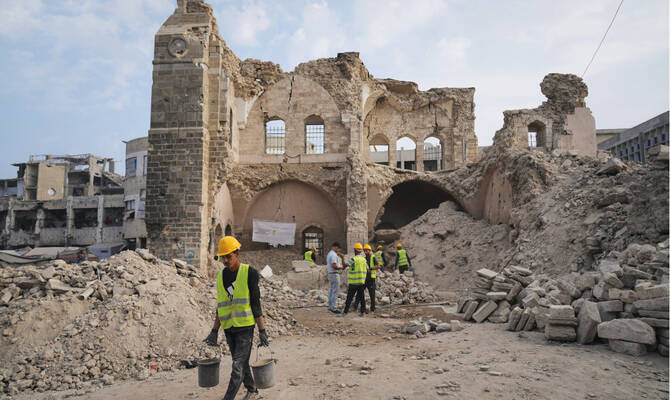
AL-MUKALLA: The US and UK militaries launched strikes on Houthi-held areas of Yemen’s Taiz province on Wednesday morning, hours after the US Central Command confirmed the destruction of a fresh wave of Houthi drones and missiles.
The Houthi-run Al-Masirah said that the US and UK “aggression” carried out two strikes on the province of Taiz, but provided no other information on the targeted areas.
This is the most recent wave of strikes by the US and UK against Houthi-held Yemeni territory in response to the militia’s assaults on ships in international commerce channels off Yemen.
The strikes in Taiz came shortly after the US military announced on Tuesday night that its forces had destroyed a drone and two ballistic missiles launched by the Houthis in Yemen over the Red Sea, which were aimed at US-led marine coalition ships as well as other naval and commercial ships in the critical shipping route.
Since November, the Houthis have struck ships in the Red Sea, Bab Al-Mandab Strait, the Gulf of Aden and Indian Ocean, and recently claimed to have attacked ships in the Mediterranean, in what the Yemeni militia sees as actions intended to force Israel to end its military operations in the Palestinian Gaza Strip, which have killed tens of thousands.
Critics of the Houthis say that they are using popular fury in Yemen over Israel’s destructive war in Gaza to recruit new militants, build up public support in Yemen, punish dissidents and assault government forces.
At the same time, Al-Masirah said that since November the militia had attacked 170 ships, including 41 Israeli ships, 72 American and 12 British, as well as 45 foreign ships, for allegedly violating their prohibition on traveling to Israel.
The majority of the ships were attacked in the Red Sea, and the Houthis claimed 49 warships, including many US destroyers, were hit in the operation.
Meanwhile, Human Rights Watch said on Wednesday that the recent Houthi arrests of relief workers in regions under their control in Yemen would aggravate the already dire humanitarian situation and the spread of illnesses such as cholera.
“More than 200 people have already died from this preventable disease, and the Houthis’ detention of aid workers poses a serious threat to further limit the presence of lifesaving aid,” Niku Jafarnia, Yemen and Bahrain researcher at Human Rights Watch said in a statement, accusing the Houthis of impeding relief work and enforcing “cumbersome” conditions for getting critical information on the spread of cholera and other illnesses.
The Houthis’ obstruction of information collection, lack of openness, aggressive anti-vaccine efforts and crackdown on humanitarian workers in Yemen had all contributed to the spread of Cholera in Yemen, the international rights groups said.
“The obstructions to aid work by Yemen’s authorities, in particular the Houthis, are contributing to the spread of cholera,” she said.
Since late May, the Houthis have abducted dozens of Yemeni workers from international relief, development and human rights groups, including several UN agencies, in a campaign that has sparked anger and strong condemnation from the UN and other organizations.
“The arrests have left many agencies questioning whether or how to continue safely providing humanitarian aid in Houthi-controlled territories, which has the potential to further exacerbate the current cholera outbreak,” Human Rights Watch said.