Pakistan among top countries as Dubai airport sees record 8% passenger number increase

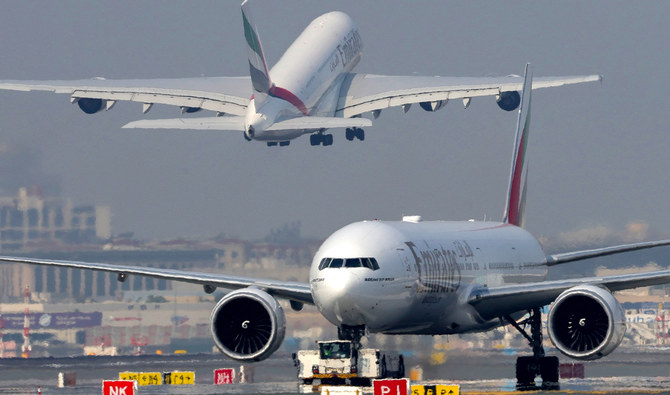
An Airbus A380-800 takes off behind an Emirates Boeing 777-300ER aircraft at Dubai International Airport in Dubai, on November 22, 2023. (AFP/File)
Short Url
Updated 07 August 2024
Follow

Pakistan among top countries as Dubai airport sees record 8% passenger number increase

  • Dubai International Airport welcomed 44.9 million passengers in the first half of the year
  • Dubai’s ruler approved a new terminal worth $35 billion with 260 million passenger capacity

RIYADH: Dubai’s main airport is on track to handle a record number of passengers this year after an 8% year-on-year increase in the first six months, operator Dubai Airports said on Wednesday.
Dubai International Airport (DXB), the world’s busiest airport for international traffic, welcomed 44.9 million passengers in the first half of the year, Dubai Airports said, noting strong demand from key markets such as India and the resurgence of China.
Traffic from China, hit hard by restrictions during the COVID-19 pandemic, exceeded one million passengers, up 80% year-on-year and representing 90% of 2019 levels.
“We have a very optimistic outlook for the remainder of the year, and we are on track to break records with 91.8 million annual guests forecasted for 2024,” CEO Paul Griffiths said in a statement.
In May, Griffiths forecast 91 million passengers for the year, surpassing the airport’s previous annual record of 89.1 million in 2018.
Dubai is a major tourism and trade hub in the Middle East, attracting a record 17.15 million international overnight visitors in 2023. Thousands of foreigners have flocked to the city, attracted by massive infrastructure spending, generous income tax policies and an open-door approach to immigration.
In April, Dubai’s ruler Sheikh Mohammed bin Rashid Al-Maktoum approved a new passenger terminal at Al Maktoum International airport worth 128 billion dirhams ($35 billion).
Al Maktoum International Airport will be the largest in the world with a capacity of up to 260 million passengers, and five times the size of DXB, the Sheikh said at the time, adding all operations at Dubai airport would be transferred to Al Maktoum in the coming years.
DXB connects to 269 destinations across 106 countries. After India, Saudi Arabia, Britain, and Pakistan were the top three countries by passenger numbers, Dubai Airports said.


Pakistan says defense pact with Saudi Arabia elevated brotherly ties to ‘new heights’

Updated 25 February 2026
Follow

Pakistan says defense pact with Saudi Arabia elevated brotherly ties to ‘new heights’

  • Pakistan, Saudi Arabia signed strategic defense pact last year pledging aggression against one will be treated as attack on both
  • Deputy PM Ishaq Dar says enduring bonds with Islamic and Arab nations form vital pillar of Pakistan’s foreign policy 

ISLAMABAD: Deputy Prime Minister Ishaq Dar said on Wednesday that Pakistan’s defense pact with Saudi Arabia elevated its brotherly ties with the Kingdom to “new heights,” stressing that close ties with Arab and Islamic nations form a key pillar of Islamabad’s foreign policy. 

Pakistan and Saudi Arabia signed a Strategic Mutual Defense Agreement on Sept. 17 last year, pledging that aggression against one country would be treated as an attack on both, enhancing joint deterrence and formalizing decades of military and security cooperation.

Both nations agreed in October 2025 to launch an economic cooperation framework to strengthen trade and investment ties. 

“In the Middle East, our landmark Strategic Mutual Defense Agreement with Saudi Arabia has elevated our brotherly ties to new heights,” Dar said while speaking at the Pakistan Governance Forum 2026 event in Islamabad. 

The Pakistani deputy prime minister was speaking on the topic “Navigating International Relations Amidst Changing Geo-Politics.”

Dar noted that Pakistan has reinforced partnerships with other Middle Eastern nations such as the UAE, Qatar, Jordan, Oman, Egypt and Bahrain. He said these partnerships have yielded “concrete agreements” in investment, agriculture, infrastructure, and energy sectors. 

“Our enduring bonds with Islamic and Arab nations form a vital pillar of our foreign policy, and we will continue to expand our partnerships across Asia, Latin America, and Africa,” he said. 

Dar pointed out that the presidents of Kazakhstan, Uzbekistan and Kyrgyzstan have undertaken visits to Pakistan in recent months, reflecting Central Asian nations’ desire to boost cooperation with Islamabad.

On South Asia, the Pakistani deputy PM said Pakistan has successfully transformed its fraternal ties with Bangladesh into “a substantive partnership.”

“Similarly, the trilateral mechanism involving China, Pakistan, and Bangladesh has been launched with a view to expanding and deepening regional cooperation and synergy,” the Pakistani minister said. 

He said Islamabad has strengthened its “all-weather” partnership with China via the second phase of the multi-billion-dollar China-Pakistan Economic Corridor agreement and “unwavering support” from both sides for each other’s core interests. 

Dar said Pakistan had also reinvigorated its partnership with the US, advancing cooperation in trade, technology, investment, and regional stability. 

“This calibrated approach has enhanced our ability to navigate complexity with skill and confidence, ensuring that our national interests are served without compromising our core foreign policy principles,” he said.