

Pakistan urges citizens to leave Lebanon amid escalating tensions in Middle East

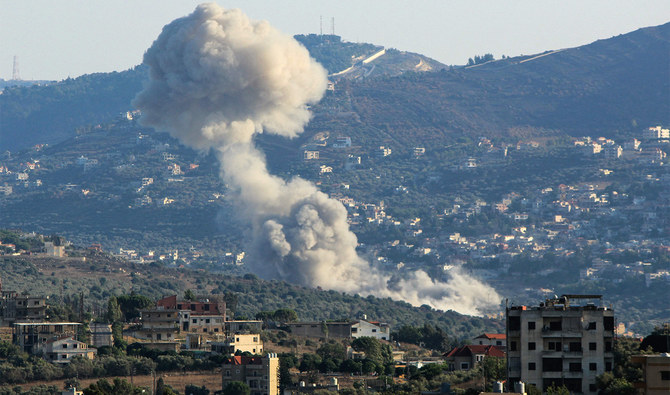
Smoke billows from the site of an Israeli strike on the southern Lebanese village of Kfar Kila on August 6, 2024. (AFP)
Short Url
Updated 07 August 2024
Follow

Pakistan urges citizens to leave Lebanon amid escalating tensions in Middle East

  • Tensions mounted in the region following the assassinations of a Hezbollah commander, Hamas political chief
  • The assassinations led to fears of a broader regional conflict as Iran threatened to retaliate against Israel

ISLAMABAD: Pakistan’s foreign office issued an advisory related to Lebanon on Tuesday, urging its citizens to leave the Arab country or avoid traveling there amid escalating security tensions in the region following the recent assassinations of a Hezbollah commander in Beirut and the Hamas political chief in Tehran.

The killings of Hezbollah’s Fouad Shukr and Hamas’s Ismail Haniyeh occurred within a span of a few hours in different parts of the Middle East last month, raising fears of a broader regional conflict as Iran threatened to retaliate against Israel in response to the latter event.

The Netanyahu administration did not claim responsibility for targeting Haniyeh, though it was widely believed to be behind the attack in Tehran while the Hamas leader was visiting Iran to attend the inauguration of its new president.

Iran-backed Hezbollah in Lebanon has already been engaged in skirmishes with Israel since the beginning of the conflict in Gaza on October 7.

“In view of the recent developments and the prevailing security situation in the region, all Pakistanis are advised to avoid travel to Lebanon till further notice,” the foreign office said in the advisory.

“All Pakistani nationals presently residing in Lebanon are advised to leave Lebanon while the commercial flights remain available,” it continued. “Those staying in Lebanon are advised to exercise extreme caution especially with regard to vulnerable areas.”

The foreign office also shared the contact details of its diplomatic mission Beirut, asking its citizens in Lebanon to remain in contact with its embassy.

Israel launched its air and ground offensive targeting Gaza last October following a surprise attack by Hamas in which around 1,200 people were killed and more than 250 were taken hostages.

The Palestinian group said its attack was in response to the deteriorating condition of Palestinian people living under occupation.

Israel’s response was widely viewed as disproportionate by the international community in which nearly 40,000 people, mostly women and children, have died.

Since the outset of the conflict, the international community has remained concerned the war could also spread to other parts of the Middle East.


Pakistan’s top military commander hails Saudi defense pact as ‘historic’ at scholars’ conference

Updated 5 sec ago
Follow

Pakistan’s top military commander hails Saudi defense pact as ‘historic’ at scholars’ conference

  • Asim Munir says Pakistan has a unique bond with the Kingdom, citing the ‘honor’ of helping safeguard the holy sites
  • He says only the state can declare jihad, urging religious scholars to counter extremist narratives and promote unity

ISLAMABAD: Chief of Defense Staff Field Marshal Asim Munir on Wednesday described the country’s joint security pact with Saudi Arabia as a “historic” milestone, telling a gathering of religious scholars that Pakistan and the kingdom share a deep strategic relationship.

Signed in September, the Strategic Mutual Defense Agreement has solidified decades of Saudi–Pakistan defense cooperation, covering intelligence-sharing, counterterrorism and regional stability.

The two nations have long coordinated on defense matters, with Pakistani military personnel deployed in the Kingdom.

“The defense agreement [with Saudi Arabia] is historic,” he said in an address to the conference in the federal capital.

The top military commander said Pakistan regarded its connection with the Kingdom as unique.

“Among all Muslim countries, Allah has given Pakistan the honor of helping safeguard the Haramain,” he continued, referring to the two holiest sites of Islam in Makkah and Madinah.

Munir used his speech to warn against extremism, saying that under the Islamic framework, only the state could declare jihad, a pointed reference to groups such as the Tehreek-e-Taliban Pakistan (TTP), which claims to act in the name of religion while carrying out attacks on civilians and security forces.

“When nations abandon knowledge and the pen, disorder takes hold,” he said, urging the religious scholars to help keep society unified and to “broaden the nation’s vision.”

Munir also criticized India, describing “terrorism” as “India’s habit, not Pakistan’s.”

His remarks came months after a four-day military confrontation in May, during which the two nuclear-armed neighbors exchanged artillery and missile fire and deployed drones and fighter jets.

India blamed Pakistan for a militant attack in Indian-administered Kashmir before launching a missile attack. Islamabad denied involvement and called for an international probe.

Pakistan claimed it had shot down six Indian fighter jets before a US-brokered ceasefire took effect.

“We do not hide when confronting the enemy,” Munir said. “We challenge openly.”