

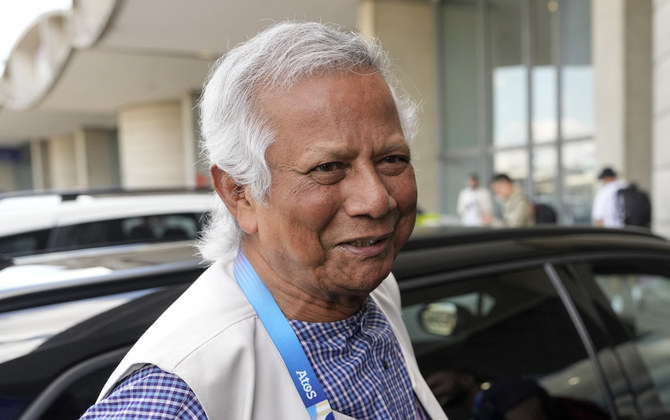

DHAKA: Nobel-winning economist Muhammad Yunus will lead Bangladesh’s interim government, the presidency said on Wednesday, after student protests forced longtime prime minister Sheikh Hasina to flee.
The 84-year-old pioneer of microfinancing, who is credited with lifting millions of Bangladeshis out of poverty, was nominated by the student movement, which forced out Hasina on Monday, after weeks of protests.
The decision to appoint Yunus was announced after President Mohammed Shahabuddin dissolved the parliament on Tuesday and met the heads of the armed forces and student leaders.
“Following a discussion with all the stakeholders, it has been decided that Dr. Yunus will lead the interim government of the country,” Joynal Abedin, press secretary of the president, told Arab News.
“The other names of the new government members are yet to be finalized. Works are underway.”
The Nobel laureate was in Paris at the time, undergoing a minor medical procedure. He accepted the nomination and was scheduled to return to Bangladesh on Thursday afternoon.
He called on Bangladeshis to keep calm and be patient in the unprecedented situation.
“Please refrain from all kinds of violence. I appeal to all students, members of all political parties and non-political people to stay calm. This is our beautiful country with lots of exciting possibilities. We must protect and make it a wonderful country for us and for our future generations,” Yunus said in a statement.
“Our youth is ready to give this leadership in creating a new world. Let us not miss the chance by going into any senseless violence. Violence is our enemy. Please don’t create more enemies. Be calm and get ready to build the country.”
Student protests started peacefully in early July but soon turned violent when Hasina’s followers and security forces clashed with demonstrators and cracked down on rallies, leaving at least 300 people dead and thousands injured. More than 11,000, mostly student activists, were arrested.
Student leaders were aware of how volatile the situation was following weeks of violence and the ousting of Hasina’s government, and chose Yunus believing that he could bring back stability.
“We have no government and no law enforcement on the streets, so in this situation we need a peaceful solution, a peaceful interim government who can control the whole situation,” Umama Fatema, coordinator of Students Against Discrimination, the main protest organizing group, told Arab News.
“We think that Dr. Muhammad Yunus will be a perfect match ... He is also a very trusted person in our country. All people in Bangladesh will listen to him.”
Yunus is an economics professor who in 1983 founded the Grameen Bank, an institution that introduced microloans to help poor people establish creditworthiness and financial self-sufficiency.
The bank is at the forefront of a world movement to eradicate poverty through microlending, and in 2006 Yunus was awarded the Nobel Peace Prize for his work.
His appointment to lead the interim government was “the best option” for Bangladesh, said Humayun Kabir, the country’s former ambassador to the US.
“He has got a good reputation in the world ... I believe that in this kind of complex situation, he will also be able to show his creativity to help the nation overcome this challenging situation,” Kabir told Arab News.
“Restoration of law and order in the country will be the priority task for Dr. Yunus’s government. Secondly, the students are saying that they want to change the system to make it accountable, just and fair. The new government will have to start working on this and on justice to be demonstrated and delivered, because a lot of injustice has happened in the recent weeks.”
Yunus’s administration will also set up the country’s new elections.
The most recent general polls took place in January, with Hasina, who had been in power since 2009, retaining her office for another term. Her administration was accused of rigging the vote, in which the opposition did not take part.
The controversial election was also widely criticized abroad.
Brig. Gen. (Rtd) Dr. Shakhawat Hossain, former election commissioner, said that Yunus was a “good appointment” for improving Bangladesh’s foreign relations.
“Dr. Yunus has a very good international reputation. He has many things to do. He has an international face. We could benefit from this,” he told Arab News.
“The recent unrest in the country caused a setback for us on the global arena. The economy has been disrupted. He has good terms with many countries across the world ... He doesn’t have any conflict with any country. Everyone respects him globally.”


