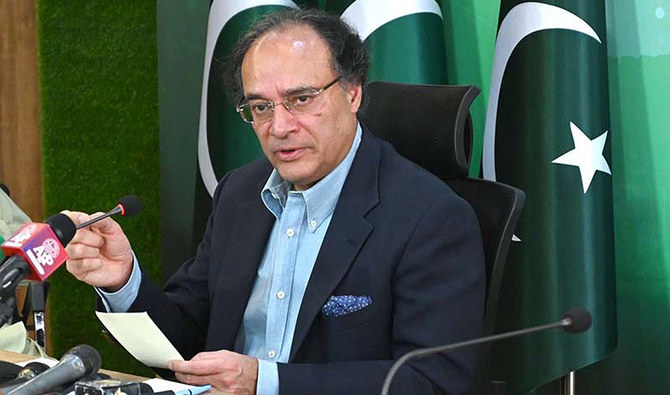
ISLAMABAD: Federal Minister for Finance and Revenue Muhammad Aurangzeb on Tuesday expressed hope the International Monetary Fund (IMF) staff-level agreement would receive the approval of the global lending agency’s executive board by the end of the month, which would provide a boost to Pakistan’s financial stability and growth prospects.
Last month, Pakistan secured a new $7 billion IMF bailout agreement to keep its economy afloat and continue with structural reforms.
The development followed the completion of a short-term $3 billion IMF loan in April this year, with the release of a final tranche of $1.1 billion.
The short-term facility had helped the country avert a sovereign debt default last year.
“We are quite hopeful that the staff-level agreement will be converted into a board approval by the end of the month,” the finance minister said while addressing an event in Islamabad.
He lamented that Pakistan was unable to materialize the international funding pledges amounting to $15 million made in Geneva for reconstruction, rehabilitation and relief activities in flood-affected areas.
In July, the IMF announced the new 37-month loan deal would be used to strengthen fiscal and monetary policy, broaden the tax base, improve the management of state-owned enterprises, enhance competition, secure investment, boost human capital and scale up social protection through increased generosity and coverage in major welfare programs.
The staff-level agreement, which is subject to approval by the IMF executive board, followed the presentation of the first budget by Prime Minister Shehbaz Sharif’s government, which promised a salary increase of up to 25 percent for government employees and set an ambitious tax collection target.
At the time, analysts suggested the new budget of about $68 billion, up from $50 billion the previous year, could pave the way for a longer-term IMF bailout of up to $8 billion to help stabilize the economy.


![]()

Pakistan’s finance minister hopes IMF board will approve $7 billion deal by month’s end
Short Url
https://arab.news/72y37
Pakistan’s finance minister hopes IMF board will approve $7 billion deal by month’s end
- The country successfully negotiated a staff-level agreement for a new loan with the IMF in July
- Muhammad Aurangzeb says Pakistan could not convert $15 million funding pledge after floods
Latest updates


© 2026 SAUDI RESEARCH & PUBLISHING COMPANY, All Rights Reserved And subject to Terms of Use Agreement.