

Oil Updates – prices rebound 1% on concerns wider Middle East conflict may cut supply

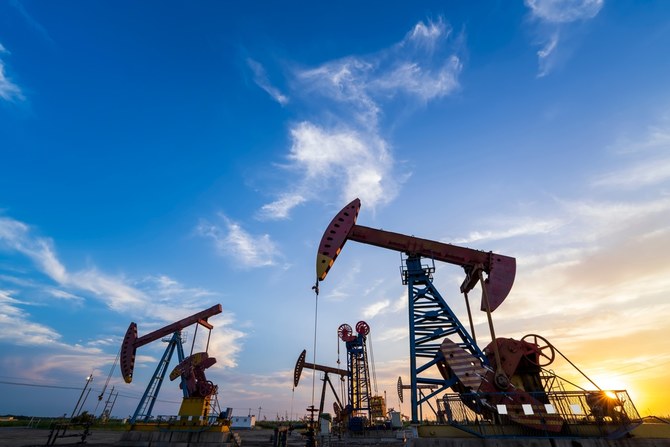
Brent crude futures gained 76 cents, or 1 percent, to $77.06 a barrel by 8:38 a.m. Saudi time. Shutterstock
Short Url
Updated 20 August 2024
Follow

Oil Updates – prices rebound 1% on concerns wider Middle East conflict may cut supply

  • Fear of wider Middle East conflict leads to fresh buying
  • US passes message to Iran not to escalate

TOKYO/SINGAPORE: Oil prices rebounded by 1 percent on Tuesday, paring the previous session’s loss, on supply concern amid an escalating Middle East conflict, stronger US services sector data and a cut in production at Libya’s Sharara oilfield.

Brent crude futures gained 76 cents, or 1 percent, to $77.06 a barrel by 8:38 a.m. Saudi time, while US West Texas Intermediate crude futures climbed 92 cents, or 1.26 percent, to $73.86.

On Monday, both benchmarks fell about 1 percent against a backdrop of falling global stock markets.

Oil’s slide was limited by mounting concern that Iran, a key Middle Eastern producer, may retaliate against Israel and the US for the assassination of a Hamas leader in Tehran and an Israeli attack that killed a Hezbollah commander in Lebanon, potentially leading to a wider regional war.

On Monday, at least five US personnel were injured in an attack against a military base in Iraq, US officials told Reuters. It was unclear whether the attack was linked to the retaliation threats.

The US has been urging countries to convey to Iran that escalation is not in its interest, a State Department spokesperson said on Monday.

“Oil seems to have clawed back some of its losses as broader concerns of a possible escalation in Middle Eastern conflict continue to add (to) apprehensions in (the) oil market. The possibility of an all-out war in (the) Middle East is getting real, threatening global supplies,” Priyanka Sachdeva, a senior market analyst at Phillip Nova in Singapore, said in an email.

Oil was also supported by overnight data showing service sector activity in the US, the world’s biggest oil consumer, rebounded from a four-year low in July.

Price gains also occurred amid a broader rally in Asian equity markets after they plunged on Monday.

“The broad-based recovery in risk sentiments and more resilient US services sector data offer some support for prices,” said IG market strategist Yeap Jun Rong in an email.

“Concerns around US growth risks are eased by resilience in US services activities, but it may have to take more to reassure markets of a stronger global demand outlook for oil.”

Worries over lower production at Libya’s 300,000 barrel-per-day Sharara oil field buoyed prices further. Output at the field, one of the country’s largest, has fallen by around 20 percent due to protests.

These production troubles have offset some of the earlier macro bearishness in the market, said ING analysts in a client note.


First EU–Saudi roundtable on critical raw materials reflects shared policy commitment

Updated 16 January 2026
Follow

First EU–Saudi roundtable on critical raw materials reflects shared policy commitment

RIYADH: The EU–Saudi Arabia Business and Investment Dialogue on Advancing Critical Raw Materials Value Chains, held in Riyadh as part of the Future Minerals Forum, brought together senior policymakers, industry leaders, and investors to advance strategic cooperation across critical raw materials value chains.

Organized under a Team Europe approach by the EU–GCC Cooperation on Green Transition Project, in coordination with the EU Delegation to Saudi Arabia, the European Chamber of Commerce in the Kingdom and in close cooperation with FMF, the dialogue provided a high-level platform to explore European actions under the EU Critical Raw Materials Act and ResourceEU alongside the Kingdom’s aspirations for minerals, industrial, and investment priorities.

This is in line with Saudi Vision 2030 and broader regional ambitions across the GCC, MENA, and Africa.

ResourceEU is the EU’s new strategic action plan, launched in late 2025, to secure a reliable supply of critical raw materials like lithium, rare earths, and cobalt, reducing dependency on single suppliers, such as China, by boosting domestic extraction, processing, recycling, stockpiling, and strategic partnerships with resource-rich nations.

The first ever EU–Saudi roundtable on critical raw materials was opened by the bloc’s Ambassador to the Kingdom, Christophe Farnaud, together with Saudi Deputy Minister for Mining Development Turki Al-Babtain, turning policy alignment into concrete cooperation.

Farnaud underlined the central role of international cooperation in the implementation of the EU’s critical raw materials policy framework.

“As the European Union advances the implementation of its Critical Raw Materials policy, international cooperation is indispensable to building secure, diversified, and sustainable value chains. Saudi Arabia is a key partner in this effort. This dialogue reflects our shared commitment to translate policy alignment into concrete business and investment cooperation that supports the green and digital transitions,” said the ambassador.

Discussions focused on strengthening resilient, diversified, and responsible CRM supply chains that are essential to the green and digital transitions.

Participants explored concrete opportunities for EU–Saudi cooperation across the full value chain, including exploration, mining, and processing and refining, as well as recycling, downstream manufacturing, and the mobilization of private investment and sustainable finance, underpinned by high environmental, social, and governance standards.

From the Saudi side, the dialogue was framed as a key contribution to the Kingdom’s industrial transformation and long-term economic diversification agenda under Vision 2030, with a strong focus on responsible resource development and global market integration.

“Developing globally competitive mineral hubs and sustainable value chains is a central pillar of Saudi Vision 2030 and the Kingdom’s industrial transformation. Our engagement with the European Union through this dialogue to strengthen upstream and downstream integration, attract high-quality investment, and advance responsible mining and processing. Enhanced cooperation with the EU, capitalizing on the demand dynamics of the EU Critical Raw Materials Act, will be key to delivering long-term value for both sides,” said Al-Babtain.

Valere Moutarlier, deputy director-general for European industry decarbonization, and directorate-general for the internal market, industry, entrepreneurship and SMEs at European Commission, said the EU Critical Raw Materials Act and ResourceEU provided a clear framework to strengthen Europe’s resilience while deepening its cooperation with international partners.

“Cooperation with Saudi Arabia is essential to advancing secure, sustainable, and diversified critical raw materials value chains. Dialogues such as this play a key role in translating policy ambitions into concrete industrial and investment cooperation,” she added.