

Flurry of diplomacy to ease Mideast tensions as Israel awaits Iran attack

1 / 7
Men burry bodies that were taken and later released by Israel during a mass funeral at a cemetery in Khan Yunis in the southern Gaza Strip on August 5, 2024, amid the ongoing conflict between Israel and the Palestinian Hamas militant group. (AFP)
2 / 7
A person operates an earth moving machine to put sand over the bodies of unidentified Palestinians during their burial at a mass grave after the bodies were handed over by Israel, amid Israel-Hamas conflict, in Khan Younis, in the southern Gaza Strip August 5, 2024. (REUTERS)
3 / 7
A person buries the bodies of unidentified Palestinians at a mass grave after the bodies were handed over by Israel, amid Israel-Hamas conflict, in Khan Younis, in the southern Gaza Strip August 5, 2024. (REUTERS)
4 / 7
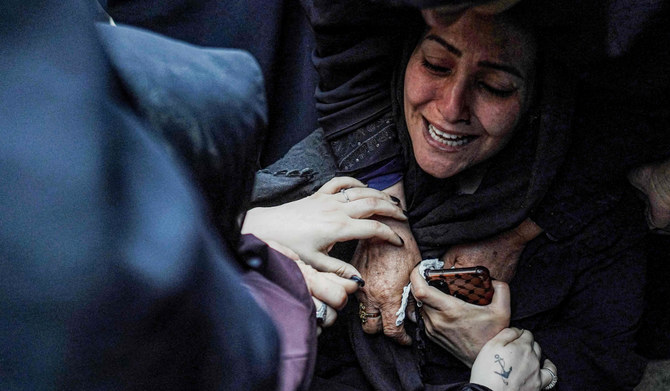
A mother is comforted by other women as she mourns after the recovery of the body of her child from the beneath the rubble of a collapsed building in the aftermath of Israeli bombardment in Nuseirat in the central Gaza Strip on May 14, 2024 amid the ongoing conflict in the Palestinian territory between Israel and Hamas. (AFP)
5 / 7
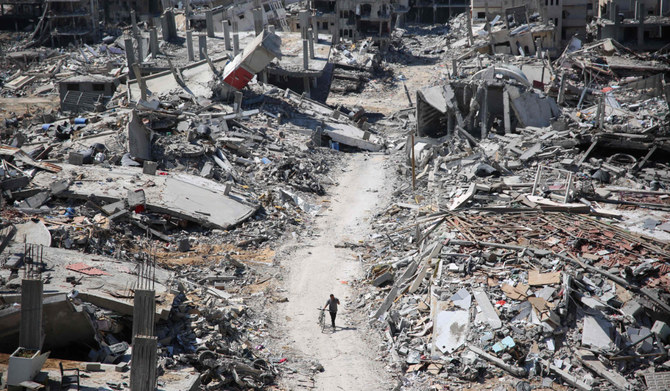
A man pushes a bycicle along as he walks amid building rubble in the devastated area around Gaza's Al-Shifa hospital on April 3, 2024, amid the ongoing conflict between Israel and Hamas. (AFP)
6 / 7
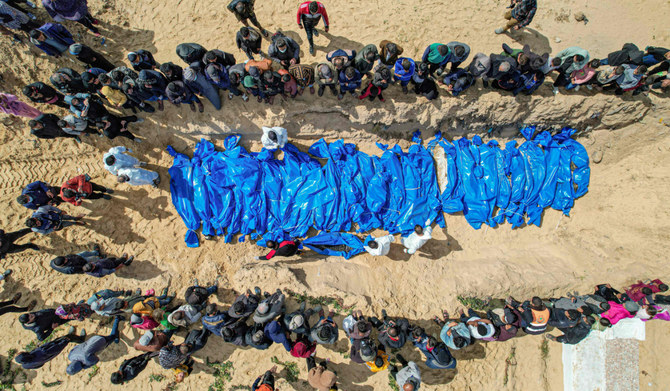
An aerial view shows mourners watching as medical personnel prepare the bodies of 47 Palestinians, that were taken and later released by Israel, during a mass funeral in Rafah in the southern Gaza Strip on March 7, 2024, amid ongoing battles between Israel and Hamas. (AFP)
7 / 7
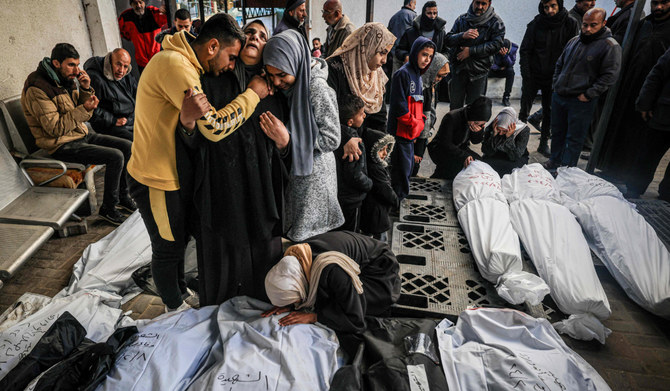
Palestinians mourn after identifying corpses of relatives killed in overnight Israeli bombardment on the southern Gaza Strip at Al-Najjar hospital in Rafah on February 8, 2024. (AFP)
Short Url
Updated 06 August 2024
Follow

Flurry of diplomacy to ease Mideast tensions as Israel awaits Iran attack

  • Tehran said on Monday that “no one has the right to doubt Iran’s legal right to punish the Zionist regime” for Haniyeh’s killing
  • Israel has killed more than 39,623 Palestinians, according to the Hamas-run territory’s health ministry

JERUSALEM: Diplomatic pressure mounted Monday to avert an escalation between Iran and Israel following high-profile killings that have sent regional tensions soaring.
Israeli Prime Minister Benjamin Netanyahu said late Sunday that his country was “determined to stand against” Iran and its allied armed groups “on all fronts.”
As its war against Iran-backed Hamas in Gaza nears the 11th month, Israel has been bracing for retaliation from the Tehran-aligned “Axis of Resistance” for the killing of two senior figures.
Palestinian armed group Hamas’s political leader Ismail Haniyeh was killed in Tehran on Wednesday in an attack blamed on Israel, which has not directly commented on it.
The killing came hours after an Israeli strike on Beirut killed the military chief of Lebanon’s Hezbollah movement, Fuad Shuk.
Tehran said on Monday that “no one has the right to doubt Iran’s legal right to punish the Zionist regime” for Haniyeh’s killing.
United States President Joe Biden, whose country has sent extra warships and fighter jets to the region in support of Israel, held crisis talks on Monday with his national security team.
The head of the US military command covering the Middle East, General Michael Kurilla, arrived in Israel and met Israel’s military chief Lt. General Herzi Halevi for a security assessment, an Israeli military statement said.
Iraqi sources said a base hosting US troops in Iraq came under rocket fire on Monday, after an American strike on July 30 killed four pro-Iran Iraqi fighters.
“Rockets were launched at Ain Assad base” in Anbar province, said a military source, while a commander in a pro-Iran armed group told AFP that at least “two rockets targeted” the base, without saying who had carried out the attack.
US Secretary of State Antony Blinken on Monday urged all sides in the Middle East to avoid “escalation,” his spokesman said.
US news site Axios earlier reported that Blinken told his counterparts from the G7 nations that any attack by Iran and Hezbollah could happen as early as Monday.

A European diplomat in Tel Aviv said “a coordinated response” from Iran and its proxies was expected but de-escalation efforts persisted.
“We’re telling them they have to stop playing with fire, because the risk of flare-ups is higher than at any time since October 7,” he said, declining to be named as he was not authorized to speak on the issue.
The Jeddah-based Organization of Islamic Cooperation is to meet on Wednesday at the request of “Palestine and Iran,” to discuss developments in the region, an OIC official said.
Israeli government spokesman David Mencer said his country is “preparing for any scenario both offensively and defensively.”
In the northern port city of Haifa, shop owner Yehuda Levi, 45, told AFP that Israelis are used to conflict, but facing a multi-pronged attack “is a little tricky.”
“It’s difficult, but we believe we’re a strong country. We’re going to win this war.”
Turkiye on Monday joined multiple nations calling on their citizens to leave Lebanon, where Hezbollah is based.
Numerous airlines have suspended flights to the country or limited them to daylight hours.
Germany’s Lufthansa, which has already suspended flights to the region including Tel Aviv, said its planes would avoid Iraqi and Iranian airspace until at least Wednesday.
Royal Jordanian Airlines said it would be operating three flights this week to transport nationals out of Beirut.

The United Nations’ rights chief Volker Turk called on “all parties, along with those states with influence, to act urgently to de-escalate what has become a very precarious situation.”
Italian Foreign Minister Antonio Tajani and his Iraqi counterpart Fuad Hussein in a joint statement Monday “agreed to make every effort to avoid a regional escalation.” Italy currently holds the rotating presidency of the G7 group of countries.
French President Emmanuel Macron also appealed for “restraint” in the Middle East, during conversations with the leaders of Saudi Arabia and the United Arab Emirates.
The Israel-Hamas war in the Gaza Strip, triggered by the Palestinian group’s October 7 attack on Israel, has already drawn in Iran-backed militants in Syria, Lebanon, Iraq and Yemen.
The Hamas attack resulted in the deaths of 1,197 people, mostly civilians, according to an AFP tally based on Israeli official figures.
Militants also seized 251 hostages, 111 of whom are still held captive in Gaza, including 39 the military says are dead.
In Tel Aviv on Monday thousands of Israelis gathered to mark the fifth birthday of child hostage Ariel Bibas, and to call for the liberation of him and his family.
Netanyahu repeatedly promises to bring the hostages home but is facing a growing chorus of skeptics who worry he’s not interested in a ceasefire and hostage-release deal with Hamas, which US, Egyptian and Qatari mediators have for months been trying to reach.
“The hostages have no time and it seems like some people in Israel, including the prime minister, are taking their time,” said Gil Dickman, whose cousin Carmel Gat is among the captives.
Israel’s retaliatory military campaign in Gaza has killed at least 39,623 people, according to the Hamas-run territory’s health ministry, which does not give details of civilian and militant deaths.
As the region braced for further escalation, Hezbollah and Israel kept up their near-daily exchanges of fire.
The Lebanese health ministry said three people were killed Monday in Israeli strikes on the country’s south. Israel’s military said it had struck militants operating a drone in the Mais Al-Jabal area.
Hezbollah later said two fighters had been killed, one from Mais Al-Jabal.
Tehran has said it expects Hezbollah to hit deeper inside Israel and no longer be confined to military targets.
Far from the Lebanese border, the Israeli military said around 15 rockets had crossed from the southern Gaza Strip into Israel on Monday, with medics reporting one injury.


US military launches strikes in Syria against Daesh fighters after American deaths

Updated 20 min 30 sec ago
Follow

US military launches strikes in Syria against Daesh fighters after American deaths

  • “This is not the beginning of a war — it is a declaration of vengeance,” Defense Secretary Pete Hegseth says
  • President Trump earlier pledged “very serious retaliation” but stressed that Syria was fighting alongside US troops

WASHINGTON: The Trump administration launched military strikes Friday in Syria to “eliminate” Daesh group fighters and weapons sites in retaliation for an ambush attack that killed two US troops and an American interpreter almost a week ago.
A US official described it as “a large-scale” strike that hit 70 targets in areas across central Syria that had Daesh (also known as Islamic State or IS) infrastructure and weapons. Another US official, who also spoke on condition of anonymity to discuss sensitive operations, said more strikes should be expected.
The attack was conducted using F-15 Eagle jets, A-10 Thunderbolt ground attack aircraft and AH-64 Apache helicopters, the officials said. F-16 fighter jets from Jordan and HIMARS rocket artillery also were used, one official said.
“This is not the beginning of a war — it is a declaration of vengeance. The United States of America, under President Trump’s leadership, will never hesitate and never relent to defend our people,” Defense Secretary Pete Hegseth said on social media.


President Donald Trump had pledged “very serious retaliation” after the shooting in the Syrian desert, for which he blamed Daesh. The troops were among hundreds of US troops deployed in eastern Syria as part of a coalition fighting the terrorist group.
Trump in a social media post said the strikes were targeting Daesh “strongholds.” He reiterated his support for Syrian President Ahmad Al-Sharaa, who he said was “fully in support” of the US effort to target the militant group.
Trump also offered an all-caps threat, warning the group against attacking US personnel again.
“All terrorists who are evil enough to attack Americans are hereby warned — YOU WILL BE HIT HARDER THAN YOU HAVE EVER BEEN HIT BEFORE IF YOU, IN ANY WAY, ATTACK OR THREATEN THE USA.,” the president added.
The attack was a major test for the warming ties between the United States and Syria since the ouster of autocratic leader Bashar Assad a year ago. Trump has stressed that Syria was fighting alongside US troops and said Al-Sharaa was “extremely angry and disturbed by this attack,” which came as the US military is expanding its cooperation with Syrian security forces.
Syria’s foreign ministry in a statement on X following the launch of US strikes said that last week’s attack “underscores the urgent necessity of strengthening international cooperation to combat terrorism in all its forms” and that Syria is committed “to fighting Daesh and ensuring that it has no safe havens on Syrian territory and will continue to intensify military operations against it wherever it poses a threat.”


Daesh has not claimed responsibility for the attack on the US service members, but the group has claimed responsibility for two attacks on Syrian security forces since, one of which killed four Syrian soldiers in Idlib province. The group in its statements described Al-Sharaa’s government and army as “apostates.” While Al-Sharaa once led a group affiliated with Al-Qaeda, he has had a long-running enmity with Daesh.
Syrian state television reported that the US strikes hit targets in rural areas of Deir ez-Zor and Raqqa provinces and in the Jabal Al-Amour area near Palmyra. It said they targeted “weapons storage sites and headquarters used by Daesh as launching points for its operations in the region.”

Trump this week met privately with the families of the slain Americans at Dover Air Force Base in Delaware before he joined top military officials and other dignitaries on the tarmac for the dignified transfer, a solemn and largely silent ritual honoring US service members killed in action.

President Donald Trump, from left, Defense Secretary Pete Hegseth and Chairman of the Joint Chiefs Air Force Gen. Dan Caine attend a casualty return ceremony at Dover Air Force Base, Delaware, on Dec. 17, 2025,of soldiers who were killed in an attack in Syria last week. (AP)

The guardsmen killed in Syria last Saturday were Sgt. Edgar Brian Torres-Tovar, 25, of Des Moines, and Sgt. William Nathaniel Howard, 29, of Marshalltown, according to the US Army. Ayad Mansoor Sakat, of Macomb, Michigan, a US civilian working as an interpreter, was also killed.
The shooting nearly a week ago near the historic city of Palmyra also wounded three other US troops as well as members of Syria’s security forces, and the gunman was killed. The assailant had joined Syria’s internal security forces as a base security guard two months ago and recently was reassigned because of suspicions that he might be affiliated with Daesh, Interior Ministry spokesperson Nour Al-Din Al-Baba has said.
The man stormed a meeting between US and Syrian security officials who were having lunch together and opened fire after clashing with Syrian guards.
When asked for further information, the Pentagon referred AP to Hegseth’s social media post.