

Kingdom’s library brings Saudi culture to Chinese readers

1 / 4
2 / 4
King Abdulaziz Public Library is spearheading an initiative to introduce Saudi culture to Chinese-speaking audiences through its publishing program. (Supplied)
3 / 4
King Abdulaziz Public Library is spearheading an initiative to introduce Saudi culture to Chinese-speaking audiences through its publishing program. (Supplied)
4 / 4
King Abdulaziz Public Library is spearheading an initiative to introduce Saudi culture to Chinese-speaking audiences through its publishing program. (Supplied)
Short Url
Updated 05 August 2024
Follow

Kingdom’s library brings Saudi culture to Chinese readers

  • A series of scientific, cultural and literary works in Arabic were selected for translation into various languages, including Chinese
  • Purpose of program is to present comprehensive portrait of contemporary Saudi culture to Chinese readers

RIYADH: King Abdulaziz Public Library in Riyadh is spearheading an initiative to introduce Saudi culture to Chinese-speaking audiences through its publishing program.

A series of scientific, cultural and literary works in Arabic were selected for translation into various languages, including Chinese.

The purpose of the program is to present a comprehensive portrait of contemporary Saudi culture to Chinese readers, an official statement noted.

The first volume of “The Comprehensive Encyclopedia of Saudi Arabia” is one of the most prominent works the library has translated into Chinese, and represents the first step toward translating all 20 volumes of the encyclopedia.

The volumes will cover all regions of the Kingdom with a focus on their history, archeology, culture and geography, economy, social patterns, customs and traditions, tourism, and wildlife.

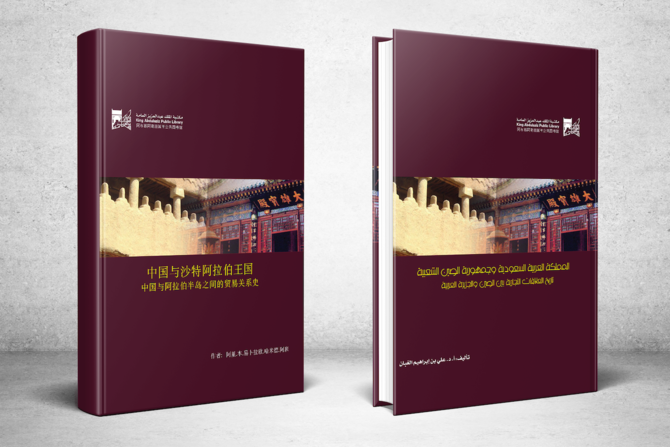
The library also translated the book “The Kingdom of Saudi Arabia and the People’s Republic of China: A History of Trade Relations between China and the Arabian Peninsula,” which highlights the contributions of the Arab-Islamic nation and China, and their scientific achievements in many fields such as astronomy, sciences, geography, agriculture and medicine, among others.

The book also shows their long-standing relations before and after the emergence of Islam, as they exchanged trade and travel via the Silk Road. The book reveals the reality of their cooperation and mutual understanding and is an important source for researchers from both civilizations, the official statement explained.

Among works selected for translation into Chinese is Dr. Abdulaziz Al-Mana’s book “In the Footsteps of Al-Mutanabbi,” which documents the locations the Abbasid-era poet passed through during his journey from Cairo to Kufa.

Some of the books the library is also translating into Chinese include “Modern Woman in the Kingdom of Saudi Arabia: Rights Challenges and Achievements” by Hend Al-Sudairy.

Al-Sudairy’s book places women in a broader cultural context, exploring diverse topics and historical developments and highlighting their social and economic contributions. It allows readers to gain a more comprehensive understanding of the reality on the ground by examining and connecting Saudi women’s past with their present.

Other works to be translated into Chinese include “The Art of Sadu between the Past and the Present,” “Saudi Landmarks and Places,” and “Traditional Jewelry of Women in Central Arabian Peninsula.”

The library has also completed the translation of 11 children’s stories from Arabic to Chinese. These stories cover a wide range of topics, offering young Chinese readers a window into Saudi Arabia’s rich history and culture.

Since establishing its branch at Peking University in China six years ago, the library has been engaged in numerous activities aimed at introducing Chinese audiences to various elements of Saudi, Arab and Islamic culture.

The initiatives include facilitating seminars and workshops on traditional Saudi arts and the Arabic language.


Swedish king awards American Saudi scientist, Omar Yaghi, Nobel Prize in Chemistry 2025

Nobel Prize in Chemistry 2025 laureate US-Saudi chemist Omar M. Yaghi poses with award during the award ceremony in Stockholm.
Updated 10 December 2025
Follow

Swedish king awards American Saudi scientist, Omar Yaghi, Nobel Prize in Chemistry 2025

  • Yaghi will share $1.2m prize with British Australian and Japanese scientists Richard Robson and Susumu Kitagawa
  • He is the 1st Saudi national to be awarded the Nobel Prize and 2nd Arab-born to win in the chemistry category since 1999

STOCKHOLM: King Carl XVI Gustaf of Sweden on Wednesday awarded American Saudi scientist Omar Yaghi the Nobel Prize in Chemistry for his breakthrough development of metal-organic frameworks, a sponge-like structure that could store CO2 or harvest water from the air, alongside the British Australian and Japanese scientists Richard Robson and Susumu Kitagawa.

Yaghi, Robson and Kitagawa have each contributed over the past 50 years to developing scalable, reliable MOF models that can be deployed in industry to address climate-related issues and deliver clean air and water. They will share the $1.2 million prize.

Yaghi, 60, who grew up in a refugee camp in Jordan to a Palestinian family expelled from their property by Zionist militias in 1948, is the second Arab-born laureate to be awarded the Nobel Prize in Chemistry by the Royal Swedish Academy of Sciences.

The Nobel Foundation said that MOFs, which are structures with large internal spaces, “can be used to harvest water from desert air, capture carbon dioxide, store toxic gases or catalyze chemical reactions.”

In 2015, Yaghi received the King Faisal International Prize for Chemistry, and in 2021, King Salman granted him Saudi citizenship for his scientific achievements. He holds the James and Neeltje Tretter Chair in Chemistry at UC Berkeley and is the founding director of the Berkeley Global Science Institute. In addition, Yaghi has branched into entrepreneurial activity since 2018, founding Atoco, which works on water harvesting and carbon capture, and co-founding H2MOF for hydrogen storage and WaHa Inc. for water harvesting with projects in the Middle East.

His focus on harvesting water from the air in arid conditions stems from his upbringing in Jordan, where water reached homes every 14 days. He began field tests in the Arizona desert in the 1990s to capture water from the air using the MOF-303 model he had developed.

Yaghi is the first Saudi national to be awarded the Nobel Prize and the second Arab-born to win in the chemistry category since the Egyptian American chemist and scientist Ahmed Zewail was honored in 1999.

Zewail’s model of the “femtochemistry apparatus” is on display at the Nobel Prize Museum. He used the apparatus to demonstrate the principle behind his method of studying chemical reactions using laser technology, capturing it in a femtosecond, which is to a second what a second is to 32 million years.

He is one of dozens of laureates who donated objects to the museum since its foundation in 2001 to mark the 100th anniversary of the Nobel Prize, which began in 1901, five years after the death of the Swedish chemist Alfred Nobel. Since 2001, it has become tradition that each December the winners of that year bring an item to be displayed that reflects their work, personal life or inspiration, Karl Johan, a curator at the museum, told Arab News.

“Zewail wanted to donate an object that could visualize his work and his experiment. He constructed (the interactive apparatus) specifically for the museum. As one of the first objects to be displayed after 2001, it got lots of attention,” Johan said.

The award ceremony in the Swedish capital is the latest event to wrap up Nobel Week, which, since Friday, has featured Nobel laureates in the fields of literature, chemistry, physics, medicine and economic sciences engaging in public events. The Nobel Peace Prize was awarded in the Norwegian capital of Oslo on Wednesday, where the daughter of the Venezuelan opposition leader, Maria Corina Machado, accepted it in her mother’s name after authorities prevented her from leaving early to attend the ceremony.