PARIS: There were Kelly Cheng and Sara Hughes, trying to wrap their heads around the moment.
These are not some starry-eyed young athletes on a world stage for the first time. Hughes is 29. Cheng is 28. They’re the defending FIVB world champions and one of the greatest duos in college volleyball history. They once rattled off 103 straight wins at the University of Southern California and finished their NCAA career with a 147-4 record and two national titles. They’ve seen some things.
But this was Sunday night in Paris. Cheng and Hughes walked onto the sand for their first match of the 2024 Olympics, waving to a packed house of 12,000 fans, and went through some quick prematch warmups. They tried to treat it like any other night. Then they sat and waited.
The sun had set about an hour earlier in Paris, leaving behind an orange glow blending with a blue-black sky. And in that sky, directly above this beach volleyball stadium, loomed the Eiffel Tower. Right there. Perhaps the single-most known structure in the world — 1,083 feet of iron and trusses and rivets and pillars — staring down at them.
The lights snapped off in the stadium. Out came the phones. All of them. All 12,000. The crowd vibrated with anticipation. Over the speakers, the tick-tock of a clock counted down faster and faster as low lights turned the stadium pink, then purple, then red. The clock struck 10 p.m. Then the Eiffel Tower, as it does every night at the same time, lit up in a glimmer of sparkling lights as fans clapped along.
If there’s a stadium anywhere that can match that view, we’ve yet to see it.
"That was iconic," Cheng said later.
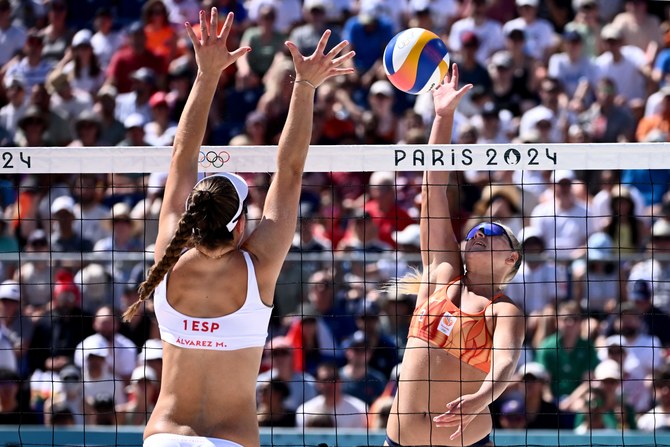
In what rapidly evolved into a Summer Olympic arms race of beach volleyball venues being placed in the boldest locations possible, Paris 2024 organizers walked in and flipped the table over. They decided to place their sandpit directly in the middle of the Champ de Mars, the public green space at the foot of the tower. This prime real estate is typically filled with families, groups of friends, street artists, and young lovers. Of all 32 sports being played in these Olympics, none has a location that rivals beach volleyball. Tickets are hard to come by and will only get harder as the matches advance and fans’ pictures land on Instagram.
You have to feel sorry for Los Angeles organizers. The plan is for 2028 to be played on the beach in Santa Monica. That sounds great, except when you see what Paris has done. Perhaps atop an O on the Hollywood sign might have been better.
Beach volleyball’s Olympic history dates back to 1996 and a simple artificial beach stadium in Clayton County Park outside Atlanta. Things stepped up around 2012, when London placed a 15,000-seat beach volleyball court in the Horse Guards Parade, the ceremonial parade ground in St. Jamess Park in central London. In 2016, Rio organizers went further, building a stadium directly on Copacabana beach, marrying nature and competition, as L.A. will do. Tokyo placed its stadium in Shiokaze Park.
Then came Paris.
“That’s a memory that will be imprinted on my brain forever,” said Kristen Nuss, a member of the other American women duo in the field, winner of a Saturday night match over Canada. “This will be a hard one to top. I am not sure how anyone else would do it.”
Cheng is the lone US beach volleyball player, male or female, competing in these Games to compete in a previous Olympics. She saw clips of the pre-match show before Nuss and teammate Taryn Kloth’s match on Saturday. She knew what was coming on Sunday. Still, when stadium lights went down and the Eiffel Tower lit up, the moment took over.
“So surreal, so special,” she said.
“The best feeling in the world,” Hughes said. “I’ve never experienced anything like that.”
Cheng and Hughes got over the jitters, knocking off the Czech Republic in two sets.
Those jitters, though, are very real. As if competing in the Olympics isn’t enough. The enormity of it all can be overwhelming. It’s easy to feel impossibly small in the shadow of the Eiffel Tower. As you know you look like an ant from the top.
“It is mixed feelings because we are so focused on not getting influenced by that, not having a lot of emotions, doing our job,” said Brazilian Andr Loyola Stien.
No one feels that more than the French. On Sunday, Aline Chamereau and Clmence Vieira were hit by waves of emotion when the crowd broke out singing the French national anthem.
“(The fans) are far from us, but we are so warm, so close to each other,” Chamereau said after a loss to Germany.
The feeling will only grow. There are seven more sunsets over the Eiffel Tower Stadium for beach volleyball. Then the venue will host blind football in the Paralympic Games.
Then it will be gone.
Back to Champ de Mars.


![]()

What’s it like to play beach volleyball in the Eiffel Tower’s shadow? ‘Iconic’
Short Url
https://arab.news/9b54n
What’s it like to play beach volleyball in the Eiffel Tower’s shadow? ‘Iconic’
- Beach volleyball’s Olympic history dates back to 1996 and a simple artificial beach stadium in Clayton County Park outside Atlanta


Latest updates


Recommended


© 2026 SAUDI RESEARCH & PUBLISHING COMPANY, All Rights Reserved And subject to Terms of Use Agreement.