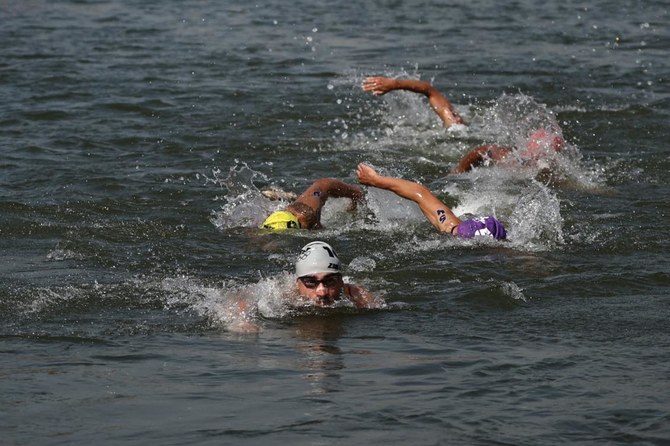
PARIS: Paris Olympics organisers have cancelled training for triathletes in the River Seine again because of poor water quality, leading to more uncertainty over whether the mixed relay will go ahead as planned on Monday.
All training was cancelled in the river last week and the men's individual race had to be delayed by 24 hours because of pollution problems.
It finally took place after the women's event on Wednesday.
A heavy rainstorm on Thursday night is believed to have again dirtied the river's waters, with downpours known to cause discharges from the sewers into the waterway.
Paris 2024 spokeswoman Anne Descamps told reporters that athletes were informed on Saturday evening that training had been cancelled for Sunday.
"It follows the rain that occurred in the last days," she said. "We are expecting improvements regarding the weather forecast... we are hopeful that we can organise the competition tomorrow and we will take the decision as planned tomorrow morning."
She declined to share the latest water quality readings.
The mixed relay triathlon features two men and two women per team in a sprint format, meaning a 300-metre swim, a seven-kilometre (4.3-mile) bike ride and a 1.8km run.
It was introduced at the Tokyo Olympics in 2021, where Britain won gold.
The Seine is also set to be used for marathon swimming -- a 10-kilometre race -- on August 8 for women and August 9 for men.
Many triathletes were surprised by the strength of the Seine's currents last week, while some also complained about the water and delays for training and the men's competition.
"While swimming under the bridge, I felt things and saw things that you shouldn't think about too much," Belgian competitor Jolien Vermeylen told the Parisien newspaper afterwards, without saying more.
Paris organisers said that the water quality was "very good" based on criteria used by World Triathlon.
The levels of E.Coli bacteria -- a key indicator of faecal matter -- were clocked at 192-308 colony-forming units per 100 millilitres (cfu/ml) on the day of the races, well below the upper limit of 1,000 cfu/ml.

Dirty Seine causes fresh suspense at Paris Olympics
https://arab.news/zqcfd
Dirty Seine causes fresh suspense at Paris Olympics
At Olympics, anti-doping watchdog WADA rejects audit demand and calls on US to pay its overdue fees
- WADA President Witold Banka said: “I think it fulfills the expectations or the wishes from the US side, and the most important thing in principle, the contribution is not conditional”
- “That is the thing which is extremely important for us”
MILAN: The World Anti-Doping Agency called on the United States to pay its overdue membership fees Thursday and rejected Washington’s bipartisan demand to submit to an independent audit.
The US has long sought more transparency from WADA, which has been criticized for its handling of politically sensitive doping cases. A government funding bill signed into law this week restricts payment of the $3.7 million in dues until there’s an independent audit.
WADA President Witold Banka, speaking at a news conference at the Milan Cortina Winter Olympics, named a list of audits that his watchdog organization is already subject to and said that’s good enough.
“I don’t know any other international organization with such strong auditing mechanisms, so I think there are no obstacles for our friends from US to fulfill their duties and pay the contributions,” he said.
He added: “I think it fulfills the expectations or the wishes from the US side, and the most important thing in principle, the contribution is not conditional. That is the thing which is extremely important for us.”
Sara Carter, the director of the US Office of National Drug Control Policy, sent a statement to The Associated Press reiterating US President Donald Trump’s strong belief in “supporting US athletes and ensuring fair competition in sports,” along with the drug office’s insistence on the external audit.
“The United States will not be bullied or manipulated into paying dues to WADA until such is achieved,” Carter said.
The US has already withheld dues under Biden in 2024, then again under Trump in 2025 — a rare point of virtually unanimous bipartisan agreement between the US major political parties. The funding spat accelerated after questions emerged about transparency regarding WADA’s clearing of 23 Chinese swimmers after they tested positive for performance enhancers before the Olympics in 2021.
“They should be really careful to go up against the United States Congress,” Rahul Gupta, Carter’s predecessor as drug czar, told AP. “It’s never a good idea to go up against a bipartisan Congress where both sides of the aisle definitely want this to happen.”
The US law restricts the release of the $3.7 million until there’s an audit “by external anti-doping experts and experienced independent auditors” showing that WADA’s Executive Committee and Foundation “are operating consistent with their duties.”
WADA statutes say representatives of countries that don’t pay are not eligible to sit on the agency’s top decision-making panels. Gupta was removed from WADA’s executive committee when the US first refused to pay.
“I hope very soon they’re going to pay the contribution and come back to the executive committee as a member,” Banka said.
Banka said WADA’s budget has grown from $36 million when he started in 2020 to approximately $57 million.
“I wish we could have this money, (these) contributions,” he said of the US fees, “but WADA is financially very stable, so this is not the biggest problem.”
The growing impasse comes at a critical juncture as the United States is set to host major international events, including the 2028 Los Angeles Summer Olympics.
“All of us around the Olympic Movement are trying to work together to come to a resolution of the dispute between WADA and USADA, and we’ve made good progress on that,” said Gene Sykes, the US Olympic and Paralympic Committee president and IOC member.
Sykes had a breakfast meeting with WADA leaders this week but declined to give details.
“We understand the disagreements and the issues,” Sykes said.


