
BEIRUT: Israeli warplanes on Monday broke the sound barrier over Beirut and southern parts of Lebanon, creating a sonic boom that caused terror among residents already anxious about escalating hostilities between the Israeli military and Hezbollah.
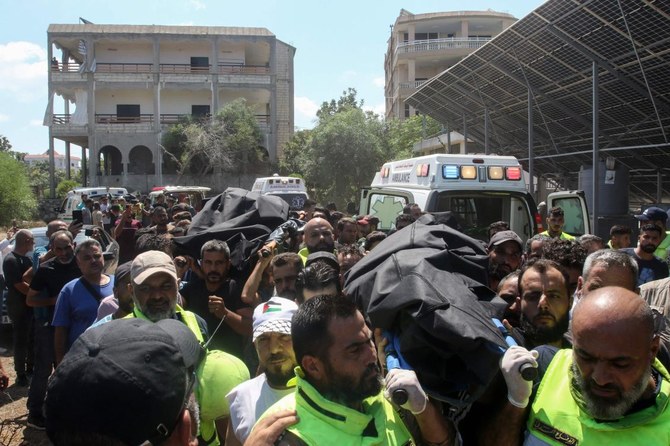
During yet another day of growing uncertainty about the course of the conflict, on Monday morning Israeli military jets attacked the town of Mays Al-Jabal, killing two civilians who were digging a grave in the local cemetery. They were named as town residents Mohammed Fawzi Hammadi, a paramedic affiliated with Lebanon’s Islamic Risala Scout Association, and Ali Ghaleb Shaqir.
Israeli forces also bombed Taloussa, a village in the Marjeyoun district of Nabatieh Governorate, with phosphorous bombs. These weapons are not banned under international law, but their use is heavily restricted and prohibited in populated areas.
Elsewhere, Israeli soldiers raided the town of Rab El-Thalathine. One person was injured and taken to the hospital, where his condition was described as “stable.”
Hezbollah military operations also continued on Monday, following the killing of two of its members by an Israeli airstrike on Houla the day before. The group said it launched an “air attack with a squadron of drones on the headquarters of the newly established 91st Brigade at the elite barracks, targeting the positions and whereabouts of its officers and soldiers, hitting them directly.”
Hezbollah also targeted “Al-Malikiyah site with an attack drone, effectively hitting its intended targets.” The group said it also fired on the Zar’it barracks and Ras Al-Naqoura naval site with heavy artillery.
Israeli Army Radio reported “a drone exploding near a shelter in the Ayelet HaShahar area in Upper Galilee” and “fires erupting in various places in Upper Galilee as a result of intercepting several missiles launched from Lebanon.”
Meanwhile, the Israeli military said “a drone explosion in the Finger of the Galilee caused moderate injuries to an officer and a soldier.” However, Israeli news outlets reported that “the officer was killed.” And alarms reportedly sounded in towns in Western Galilee and around the city of Nahariya after rockets were launched from Lebanon.
Hezbollah Secretary-General Hassan Nasrallah is expected to deliver a speech on Tuesday at a memorial service for the party’s military leader, Fouad Shukr, who was assassinated by Israel in the southern suburbs of Beirut last week.
Lebanese Prime Minister Najib Mikati’s office said that he received a telephone call from Canada’s foreign minister, Melanie Joly, during which there was an “emphasis on the necessity to halt the escalation, resort to peaceful solutions, and implement international resolutions.”
Mikati said when he appeared at a social event on Monday: “We insist on living because despair is forbidden. We will continue to uphold our responsibilities and work to spare the country from any dangers.”
His comments came as a growing number of foreign countries urged their citizens to leave Lebanon immediately. The US embassy reiterated a State Department warning that American citizens should not travel to the country and those already there should depart as soon as possible. The Japanese Ministry of Foreign Affairs and Turkish authorities issued similar advice.
German airline Lufthansa extended its suspension of all flights to Tel Aviv, Tehran and Beirut until Aug. 12.
Meanwhile, Elie Ferzli, a former deputy speaker of the Lebanese parliament questioned whether international calls for calm would be successful in the short term.
He said: “It is early to talk about de-escalation now. This will not happen before we respond … and the situation reaches its peak.
“Everyone today is anticipating Hezbollah and Iran’s response, and all the countries of the axis of resistance might join them in response to Israel’s latest breach of all considerations and rules, as it targeted the southern suburb of Beirut, assassinating Fouad Shukr. It (also) struck deep inside the Iranian capital Tehran and blew up Hamas leader Ismail Haniyeh at his residence.”

keywords