

Mali breaks off diplomatic relations with Ukraine, hits Kyiv’s role in rebels’ battlefield victory

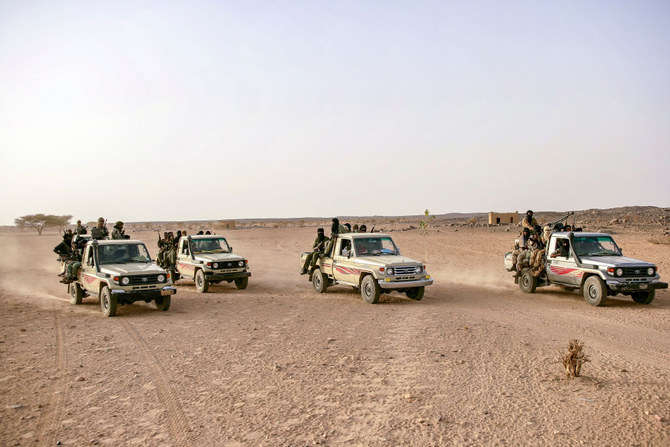
Rebels in their entrenchments at the Tigha base, north of Kidal in the Adrar des Ifora region. The Tuaregs are at war with the Malian Army and government. (Getty Images)
Short Url
Updated 05 August 2024
Follow

Mali breaks off diplomatic relations with Ukraine, hits Kyiv’s role in rebels’ battlefield victory

  • Ukraine’s military intelligence spokesman had earlier admitted Kyiv’s role in a heavy defeat by rebels of Malian troops in a battle last month
  • Tuareg-led separatists said on Thursday they had killed 84 fighters from Russia's mercenary Wagner group and 47 Malian soldiers

DAKAR: Mali said Sunday it was breaking diplomatic relations with Ukraine, accusing a senior Ukrainian official of having admitted Kyiv’s role in a heavy defeat Malian troops suffered in July.
Members of the Russian mercenary group Wagner were among the casualties in the defeat, which happened in late July in the north of the country and which Mali’s military rulers have blamed on “separatists and jihadists.”
Mali will break off relations “with immediate effect,” said government spokesman Col. Abdoulaye Maiga.
Mali’s government had been shocked to learn of remarks by Andriy Yusov, spokesman for Ukraine’s military intelligence agency the GUR, Maiga added.
Yusov had “admitted Ukraine’s involvement in a cowardly, treacherous and barbaric attack by armed terrorist groups” that had led to the deaths of Malian soldiers, Maiga’s statement added.


A photo circulating on social media shows Tuareg-led separatist fighters celebrating their victory in front of a destroyed Malian Army vehicle. (X: @rukigafm)

Speaking on Ukrainian television, Yusov said the whole world was aware that the rebels “had received the necessary data that allowed them to carry out their operation against the Russian war criminals.”
On Saturday, Senegal summoned Ukraine’s ambassador for having published the comments in what it described as a “propaganda video” on its Facebook page.
Ukraine’s actions had violated Malian sovereignty and constituted unacceptable foreign interference and support for international terrorism, said Maiga’s statement.
Three days of intense fighting erupted near the Algerian border on July 25 at a military camp at Tinzaouatene.
Tuareg-led separatists said on Thursday they had killed 84 fighters from Wagner and 47 Malian soldiers.


People gather in front of a makeshift memorial during a commemoration ceremony in Moscow on August 4, 2024, to pay tribute to Wagner mercenaries, who were recently killed in Mali by northern Tuareg rebels. (Reuters)

In a video seen by AFP on Friday, Malian Prime Minister Choguel Kokalla Maiga acknowledged they had lost “a battle” at Tinzaouatene.
Mali’s army has admitted it suffered a “large number” of deaths during the fighting but has not released figures.
This week, Russian Foreign Minister Sergei Lavrov reaffirmed his support for Bamako in a telephone call with his Malian counterpart Abdoulaye Diop.
The West African nation’s military leaders who seized power in a 2020 coup have made it a priority to retake all of the country from separatists and jihadist forces linked to Al-Qaeda and the Daesh group.
Under Col. Assimi Goita, the junta broke off its traditional alliance with former colonial ruler France and has turned toward Russia.


Top Australian writers’ festival canceled after Palestinian author barred

Updated 4 sec ago
Follow

Top Australian writers’ festival canceled after Palestinian author barred

SYDNEY: One of Australia’s top writers’ festivals was canceled on Tuesday, after 180 authors boycotted the event and its director resigned saying she could not ​be party to silencing a Palestinian author and warned moves to ban protests and slogans after the Bondi Beach mass shooting threatened free speech.
Louise Adler, the Jewish daughter of Holocaust survivors, said on Tuesday she was quitting her role at the Adelaide Writers’ Week in February, following a decision by the festival’s board to disinvite a Palestinian-Australian author.
The novelist and academic Randa Abdel-Fattah said the move to bar her was “a blatant and shameless act of anti-Palestinian racism ‌and censorship.”
Prime ‌Minister Anthony Albanese on Tuesday announced a national day ‌of ⁠mourning ​would ‌be held on January 22 to remember the 15 people killed in last month’s shooting at a Jewish Hanukkah celebration on Bondi Beach.
Police say the alleged gunmen were inspired by the Islamic State militant group, and the incident sparked nationwide calls to tackle antisemitism, and prompted state and federal government moves to tighten hate speech laws.
The Adelaide Festival board said on Tuesday its decision last week to disinvite ⁠Abdel-Fattah, on the grounds it would not be culturally sensitive for her to appear at the literary ‌event “so soon after Bondi,” was made “out of respect ‍for a community experiencing the pain ‍from a devastating event.”
“Instead, this decision has created more division and ‍for that we express our sincere apologies,” the board said in a statement.
The event would not go ahead and remaining board members will step down, it added.
Former New Zealand Prime Minister Jacinda Ardern, British author Zadie Smith, Australian author Kathy Lette, Pulitzer Prize-winning American Percival ​Everett and former Greek finance minister Yanis Varoufakis are among the authors who said they would no longer appear at the festival ⁠in South Australia state, Australian media reported.
The festival board on Tuesday apologized to Abdel-Fattah for “how the decision was represented.”
“This is not about identity or dissent but rather a continuing rapid shift in the national discourse around the breadth of freedom of expression in our nation following Australia’s worst terror attack in history,” it added.
Abdel-Fattah wrote on social media that she did not accept the apology, saying she had nothing to do with the Bondi attack, “nor did any Palestinian.”
Adler earlier wrote in The Guardian that the board’s decision to disinvite Abdel-Fattah “weakens freedom of speech and is the harbinger of a less free nation, where lobbying and political ‌pressure determine who gets to speak and who doesn’t.”
The South Australian state government has appointed a new festival board.