

UAE launches program to make agricultural advisory services more efficient

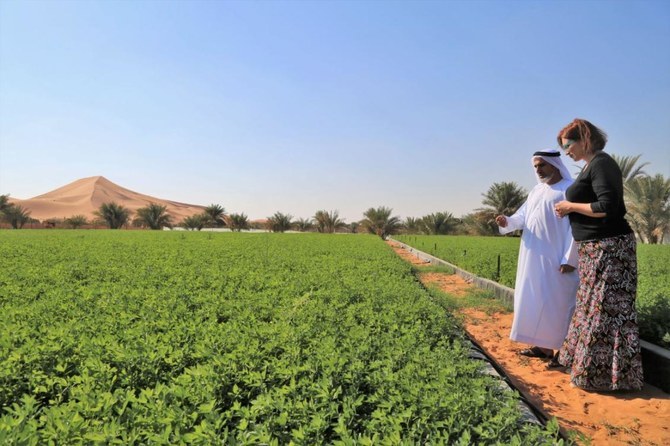
An International Center for Biosaline Agriculture (ICBA) scientist advises a farm owner, in the Al Wagan area, near Al-Ain, UAE. (File/Reuters)
Short Url
Updated 04 August 2024
Follow

UAE launches program to make agricultural advisory services more efficient

  • Program aims to improve the skills and professional capacities of agricultural agents

DUBAI: The UAE Ministry of Climate Change and Environment announced a new initiative to boost the efficiency of agricultural advisory services, state news agency WAM reported on Sunday.

The program is part of the UAE’s broader efforts to enhance agricultural production and strengthen national food security.

It aims to improve the skills and professional capacities of agricultural agents, equipping them with the tools to effectively transfer technology and share modern farming techniques, thereby increasing productivity.

The program includes special training in areas such as soil and irrigation, crop and vegetable production, fruit production, pest prevention and control, and beekeeping and honey production, WAM added.

It also features lectures and workshops to enhance the skills of agricultural agents, alongside field courses that provide practical application of theoretical knowledge, improve communication skills, and boost confidence.

“The agricultural extension efficiency improvement program comes as part of our ongoing commitment to support the sustainability of national farms in the UAE aimed at reinforcing and growing the sector in the future,” said Mohammed Salman Al-Hammadi, assistant undersecretary of the food diversity sector at the ministry.

He added: “The program aims to develop a specialised path for all agricultural extension agents covering the main fields in the sector. Through this, we seek to build capacity and competency of agricultural extension, which in turn, would contribute to enhancing local agricultural production and support the transformation of national food systems into more sustainable systems.”

The program also involves developing an annual plan for agricultural guidance, which will monitor and support farmers in improving crop production and protecting crops from pests.

It will include a timetable for service operations related to trees and cultivation seasons for each crop, focusing on date palms, fruit, vegetables, fodder and honey production. Operations will also cover irrigation, fertilization, and land reclamation.

The program will also prepare technical reports and advisory visit reports to farms, including data analysis, recommendations and documentation of results to ensure continuous improvement and address farmers’ needs.

Al-Hammadi highlighted the importance of enhanced communication between agricultural agents and farmers, with plans for regular farm visits and meetings to discuss challenges. The initiative aims to improve crop yields, set clear standards and objectives for agricultural guidance programs, and ultimately enhance farmers’ satisfaction.


Syria’s growth accelerates as sanctions ease, refugees return

Updated 06 December 2025
Follow

Syria’s growth accelerates as sanctions ease, refugees return

  • Economy grows much faster than World Bank’s 1% estimate, fueling plans for currency’s relaunch

NEW YORK: Syria’s economy is growing much faster than the World Bank’s 1 percent estimate for 2025 as refugees flow back after the end of a 14-year civil war, fueling plans for the relaunch of the country’s currency and efforts to build a new Middle East financial hub, central bank Governor AbdulKader Husrieh has said.

Speaking via video link at a conference in New York, Husrieh also said he welcomed a deal with Visa to establish digital payment systems and added that the country is working with the International Monetary Fund to develop methods to accurately measure economic data to reflect the resurgence. 

The Syrian central bank chief, who is helping guide the war-torn country’s reintegration into the global economy after the fall of Bashar Assad’s regime about a year ago, described the repeal of many US sanctions against Syria as “a miracle.”

The US Treasury on Nov. 10 announced a 180-day extension of the suspension of the so-called Caesar sanctions against Syria; lifting them entirely requires approval by the US Congress. 

Husrieh said that based on discussions with US lawmakers, he expects the sanctions to be repealed by the end of 2025, ending “the last episode of the sanctions.”

“Once this happens, this will give comfort to our potential correspondent banks about dealing with Syria,” he said.

Husrieh also said that Syria was working to revamp regulations aimed at combating money laundering and the financing of terrorism, which he said would provide further assurances to international lenders. 

Syria’s central bank has recently organized workshops with banks from the US, Turkiye, Jordan and Australia to discuss due diligence in reviewing transactions, he added.

Husrieh said that Syria is preparing to launch a new currency in eight note denominations and confirmed plans to remove two zeroes from them in a bid to restore confidence in the battered pound.

“The new currency will be a signal and symbol for this financial liberation,” Husrieh said. “We are glad that we are working with Visa and Mastercard,” Husrieh said.