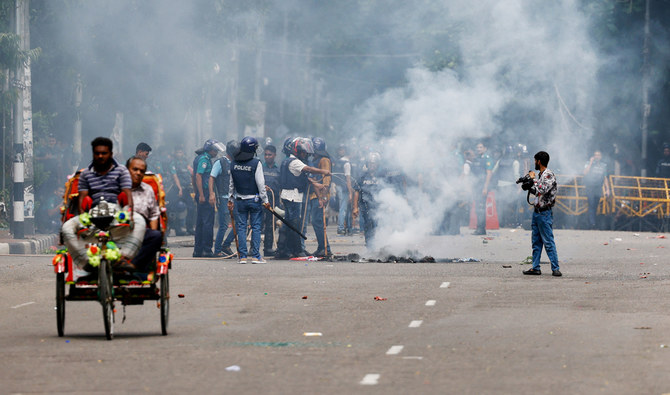
DHAKA: A new round of violence in Bangladesh has left more than 20 people dead and hundreds injured as student protesters clashed with police and ruling party activists on Sunday, officials and media reports said.
The demonstrators were demanding the resignation of Prime Minister Sheikh Hasina after earlier protests in July that began with students calling for an end to a quota system for government jobs escalated into violence that left more than 200 dead.
Authorities in response closed schools and universities across the country, blocked Internet access and imposed a shoot-on-sight curfew. At least 11,000 people have been arrested in recent weeks.
Protesters called for “non-cooperation,” urging people not to pay taxes and utility bills and not show up for work on Sunday, a working day in Bangladesh. Offices, banks and factories opened, but commuters in Dhaka and other cities faced challenges getting to work.
The protesters attacked Bangabandhu Sheikh Mujib Medical University, a major public hospital in Dhaka’s Shahbagh area, torching several vehicles.
In Dhaka’s Uttara neighborhood, police fired tear gas to disperse hundreds of people who blocked a major highway. Protesters attacked homes and vandalized a community welfare office in the area, where hundreds of ruling party activists took up positions. Some crude bombs were detonated and gunshots were heard, witnesses said.
Abu Hena, a hospital official in Munshiganj district near Dhaka, said two people were declared dead after being rushed to a hospital with injuries.
Jamuna TV station reported another 21 deaths in 11 districts including in Bogura, Magura, Rangpur and Sirajganj districts, where the protesters backed by the country’s main opposition Bangladesh Nationalist Party clashed with police and the activists of the ruling Awami League party and its associated bodies.
The country’s leading Bengali-language Prothom Alo daily said at least 18 people died in Sunday’s violence, but more reports of violence were coming. Channel 24 TV station reported at least 21 deaths.
Users complained of disruptions in mobile Internet service on Sunday afternoon and many others faced problems accessing Facebook.
The protests began last month as students demanded an end to a quota system that reserved 30 percent of government jobs for the families of veterans who fought in Bangladesh’s war of independence against Pakistan in 1971. As violence crested, the country’s Supreme Court scaled back the quota system to 5 percent of jobs, with 3 percent for relatives of veterans, but protests have continued demanding accountability for violence the demonstrators blame on the government’s use of excessive force.
The quota system also includes quotas members of ethnic minorities, and disabled and transgender people, which were cut from 26 percent to 2 percent in the ruling.
Hasina’s administration has blamed the main opposition Bangladesh Nationalist Party and now-banned right-wing Jamaat-e-Islami party and their student wings for instigating violence, in which several state-owned establishments were also torched or vandalized.
Mirza Fakhrul Islam Alamgir, secretary-general of the main opposition party, repeated a call for the government to step down to stop the chaos.
Hasina offered to talk with student leaders on Saturday, but a coordinator refused and announced a one-point demand for her resignation.
Hasina repeated her pledges to thoroughly investigate the deaths and punish those responsible for the violence. She said that her doors were open for talks and she was ready to sit down whenever the protesters want.
The protests have become a major challenge for Hasina, who has ruled the country for over 15 years, returning to power for a fourth consecutive term in January in an election that was boycotted by her main opponents.


![]()

Violence in Bangladesh leaves many people dead, hundreds injured as protests continue
Short Url
https://arab.news/5jqkm
Violence in Bangladesh leaves many people dead, hundreds injured as protests continue
- Demonstrators demand resignation of Prime Minister Sheikh Hasina over July protests that killed over 200
- At least 11,000 people have been arrested in recent weeks across the country in student-led protests
Latest updates


© 2026 SAUDI RESEARCH & PUBLISHING COMPANY, All Rights Reserved And subject to Terms of Use Agreement.