Saudi exports to South Korea surged 36% to $2.75bn in May

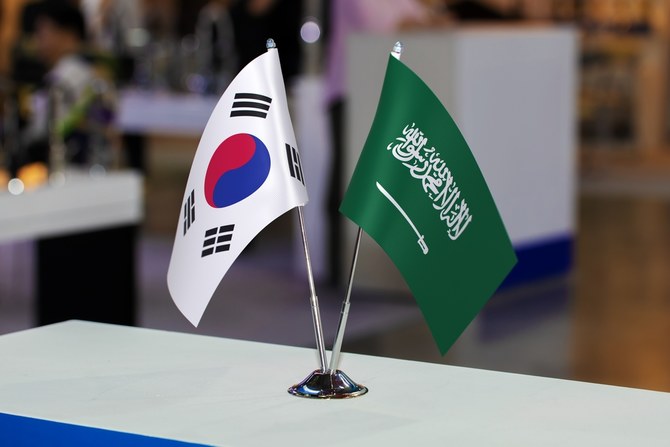
Saudi Arabia and South Korea share a history of strong trade relations. Shutterstock
Short Url
Updated 05 August 2024
Follow

Saudi exports to South Korea surged 36% to $2.75bn in May

  • Kingdom’s outgoing shipments to South Korea rose by 31.50% in May
  • Oil was the main export from Saudi Arabia to South Korea, with shipments totaling SR10.03 billion

RIYADH: Saudi Arabia’s trade with South Korea remains strong, with exports from the Kingdom increasing 36.19 percent year-on-year to SR10.31 billion ($2.75 billion) in May, official data showed. 

It was the second-largest destination for Saudi exports in May behind China, which received goods worth SR15.91 billion, according to the General Authority for Statistics. 

The Kingdom’s outgoing shipments to the East Asian nation also rose by 31.50 percent in May compared to the previous month, reaching SR10.31 billion from SR7.84 billion. 

This comes amid a history of strong trade relations between the two countries, with cumulative trade totaling SR554 billion from 2019 to 2023 and annual values growing from SR93.6 billion to SR129.8 billion, according to the Ministry of Commerce. 

In May, oil was the main export from Saudi Arabia to South Korea, with shipments totaling SR10.03 billion. 

Non-oil exports amounted to SR278 million, with chemicals and allied products leading at SR142.6 million. 

Other notable exports included base metals at SR112.6 million and plastic and rubber products at SR32.4 million. 

On the import side, Saudi Arabia received SR1.39 billion worth of goods from South Korea in May. 

This included transport equipment valued at SR483.5 million, mechanical appliances and electrical equipment at SR391.3 million, base metals at SR149.4 million, and chemicals at SR100.9 million. 

In May, Saudi Arabia also imported beverages and vinegar products worth SR11.7 million, with incoming shipments of mineral products totaling SR9.4 million. 

Affirming the strong ties between the two nations, the Saudi-Korean Business Forum was held in Seoul in July, where 10 agreements were signed across the construction, energy, health, contracting, sustainability, and food industries. 

The forum, attended by over 400 participants from both the public and private sectors, focused on enhancing economic collaboration between both nations. 

South Korea, a signatory of the free trade agreement with the Gulf Cooperation Council — of which Saudi Arabia is a member — has agreed to remove tariffs on nearly 90 percent of all goods, including liquefied natural gas and other petroleum products. 

Under the deal signed in December 2023, GCC countries committed to abolishing levies on over 76 percent of products across 18 categories. 


Arab food and beverage sector draws $22bn in foreign investment over 2 decades: Dhaman 

Updated 28 December 2025
Follow

Arab food and beverage sector draws $22bn in foreign investment over 2 decades: Dhaman 

JEDDAH: Foreign investors committed about $22 billion to the Arab region’s food and beverage sector over the past two decades, backing 516 projects that generated roughly 93,000 jobs, according to a new sectoral report. 

In its third food and beverage industry study for 2025, the Arab Investment and Export Credit Guarantee Corp., known as Dhaman, said the bulk of investment flowed to a handful of markets. Egypt, Saudi Arabia, the UAE, Morocco and Qatar attracted 421 projects — about 82 percent of the total — with capital expenditure exceeding $17 billion, or nearly four-fifths of overall investment. 

Projects in those five countries accounted for around 71,000 jobs, representing 76 percent of total employment created by foreign direct investment in the sector over the 2003–2024 period, the report said, according to figures carried by the Kuwait News Agency. 

“The US has been the region's top food and beverage investor over the past 22 years with 74 projects or 14 projects of the total, and Capex of approximately $4 billion or 18 percent of the total, creating more than 14,000 jobs,” KUNA reported. 

Investment was also concentrated among a small group of multinational players. The sector’s top 10 foreign investors accounted for roughly 15 percent of projects, 32 percent of capital expenditure and 29 percent of newly created jobs.  

Swiss food group Nestlé led in project count with 14 initiatives, while Ukrainian agribusiness firm NIBULON topped capital spending and job creation, investing $2 billion and generating around 6,000 jobs. 

At the inter-Arab investment level, the report noted that 12 Arab countries invested in 108 projects, accounting for about 21 percent of total FDI projects in the sector over the past 22 years. These initiatives, carried out by 65 companies, involved $6.5 billion in capital expenditure, representing 30 percent of total FDI, and generated nearly 28,000 jobs. 

The UAE led inter-Arab investments, accounting for 45 percent of total projects and 58 percent of total capital expenditure, the report added, according to KUNA. 

The report also noted that the UAE, Saudi Arabia, Egypt, and Qatar topped the Arab ranking as the most attractive countries for investment in the sector in 2024, followed by Oman, Bahrain, Algeria, Morocco, and Kuwait. 

Looking ahead, Dhaman expects consumer demand to continue rising. Food and non-alcoholic beverage sales across 16 Arab countries are projected to increase 8.6 percent to more than $430 billion by the end of 2025, equivalent to 4.2 percent of global sales, before exceeding $560 billion by 2029. 

Sales are expected to remain highly concentrated geographically, with Egypt, Saudi Arabia, Algeria, the UAE and Iraq accounting for about 77 percent of the regional total. By product category, meat and poultry are forecast to lead with sales of about $106 billion, followed by cereals, pasta and baked goods at roughly $63 billion. 

Average annual per capita spending on food and non-alcoholic beverages in the region is projected to rise 7.2 percent to more than $1,845 by the end of 2025, approaching the global average, and to reach about $2,255 by 2029. Household spending on these products is expected to represent 25.8 percent of total expenditure in 13 Arab countries, above the global average of 24.2 percent. 

Arab external trade in food and beverages grew more than 15 percent in 2024 to $195 billion, with exports rising 18 percent to $56 billion and imports increasing 14 percent to $139 billion. Brazil was the largest foreign supplier to the region, exporting $16.5 billion worth of products, while Saudi Arabia ranked as the top Arab exporter at $6.6 billion.