BEIRUT: Foreign embassies in Lebanon continued to take precautionary measures on Saturday amid fears of all-out war between Israel and Hezbollah.
Egyptian Foreign Minister Badr Abdelatty expressed his country’s “deep concern over the dangerous escalation” in the region in a phone call with his Lebanese counterpart Abdallah Bou Habib. Abdelatty confirmed Egypt’s support for Lebanon in “confronting the threats surrounding it,” the Egyptian Foreign Ministry said in a statement on Saturday.
The Egyptian statement came as the US and UK urged their citizens in Lebanon to leave the country immediately.
Despite flight suspensions and cancelations, “commercial transportation options to leave Lebanon remain available,” the US Embassy said.
British Foreign Secretary David Lammy said tensions “are high, and the situation could deteriorate rapidly.”
The Swedish Embassy recently announced that it would relocate its staff to Cyprus due to security concerns.
In light of the escalating tension, several airlines have canceled or extended the suspension of their flights to Beirut. The Netherlands’ Transavia Airlines extended the suspension of its flights to and from Beirut until Tuesday, as did Air France. Kuwait Airways will suspend flights to and from Beirut starting Monday.
The Israeli army resumed its assassinations of Hezbollah members in southern Lebanon and on the Beirut-Damascus road on Saturday, as Israel awaits Hezbollah’s response to the killing of its top military commander, Fuad Shukr, on Tuesday.
One Israeli raid targeted a residential building in Beirut’s southern suburbs, killing seven civilians and an Israeli military drone targeted a car on Tyre’s Al-Bazuriyya road, setting it on fire and killing its driver. Hezbollah identified the victim as Nazih Abed Ali from the southern village of Aitit. The victim was reportedly the brother of a paramedic — Mahmoud Abed Ali — who rushed to the attack site. Videos circulating on social media showed Mahmoud at the site, a few kilometers from Aitit, saying that “crying is forbidden” and that he would collect the remains of his brother, “who is a father of three.”
The Public Health Emergency Operations Center confirmed that the attack killed one person and injured two others.
A few hours later, the Syrian Observatory announced the death of a person in an Israeli raid that targeted a car on the Damascus-Beirut road.
Israel also expanded its hostilities toward the Lebanese-Syrian borders on Friday night and Saturday morning. Israeli warplanes targeted the surroundings of Al-Qusayr and the military Al-Dabaa airport.
Israeli forces also raided the Matraba crossing — an illegal crossing used by Hezbollah to transport trucks and members from Lebanon to Syria and vice versa.
Israel also targeted a truck convoy in the surroundings of the Hosh Al-Sayyid Ali area, killing a Syrian driver, according to AFP.
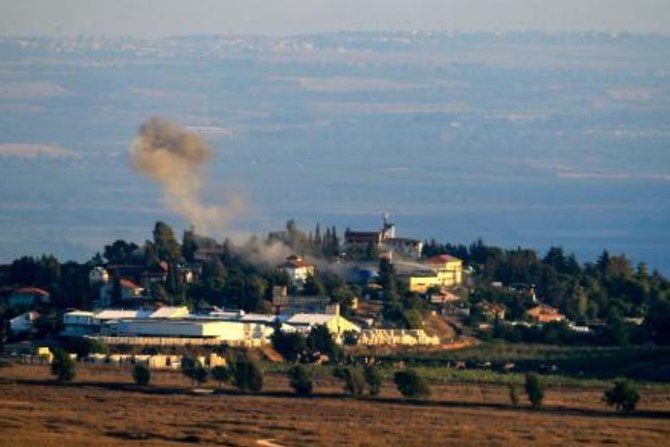
Israeli shelling targeting houses in frontier villages including Rab Al-Thalathin, Houla, Tayr Harfa, Aita Al-Shaab, and Mays Al-Jabal led to destruction of property but no further casualties.
Hezbollah, meanwhile, said they had targeted Israeli military positions with missiles including “the Al-Assi site, the Al-Summaqah site in the occupied Kfarshuba Hills, a military force in the Avivim settlement, and a building used by Israeli soldiers in the Mattat settlement.”
Hezbollah Secretary-General Hassan Nasrallah vowed at Shukr’s funeral to take “decisive action” and warned Israelis that they would be “left in tears instead of laughter.”
Multiple security sources reported that Hezbollah had evacuated sites in the southern suburbs of Beirut, including homes inhabited by party officials, as a precautionary measure.
Since the commencement of hostilities on Oct. 8, the total number of casualties among Hezbollah, its allies, and civilians, both Lebanese and non-Lebanese, is 521.
Israeli media on Saturday reported an “unusual incident in northern Israel, specifically in the settlement of Liman in Upper Galilee, where a man attempted to infiltrate into Lebanon.” The man’s identity was not disclosed.


![]()

Foreign embassies announce precautionary measures amid fears of all-out Israel-Hezbollah war
Short Url
https://arab.news/68mag
Foreign embassies announce precautionary measures amid fears of all-out Israel-Hezbollah war
- Israel resumes killing of Hezbollah members and pursues them to the Syrian border
- The Egyptian statement came as the US and UK urged their citizens in Lebanon to leave the country immediately


Latest updates



© 2026 SAUDI RESEARCH & PUBLISHING COMPANY, All Rights Reserved And subject to Terms of Use Agreement.