BEIRUT: Hezbollah forces on Friday resumed rocket and artillery attacks against Israel, ending the lull along the border following Israel's killing of the Lebanese group's military commander in Beirut.
Hezbollah said it had fired a surface-to-air missile at an Israeli warplane flying in Lebanese airspace overnight and forced it to turn back. Its forces also carried out two artillery attacks and two rocket strikes at military positions in northern Israel, it said.
The Israeli military said in a statement it had successfully intercepted an aerial target coming from Lebanon into the Israeli-occupied Golan Heights.
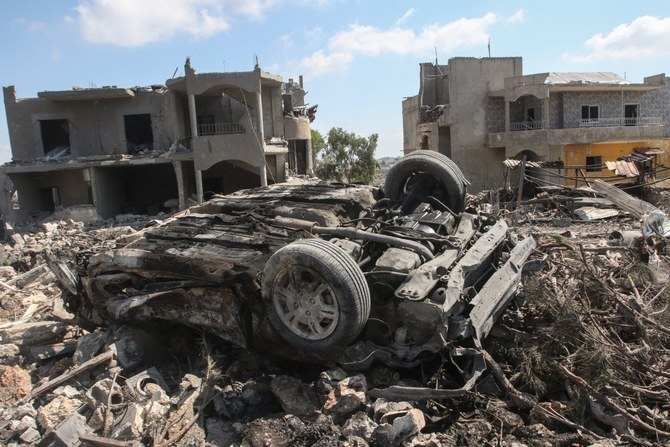
Israeli airstrikes and artillery fire hit several villages in southern Lebanon on Friday, according to Lebanese state media, a day after an Israeli strike killed at least five Syrian migrant workers in southern Lebanon, according to medics.
The Israeli military also said it had hit two Hezbollah fighters in southern Lebanon.
Hezbollah leader Sayyed Hassan Nasrallah said in an address on Thursday that he had ordered calm along the border following the Israeli airstrike in Beirut on Tuesday that killed military commander Fuad Shukr out of respect for the victims and to consider what the next steps should be.
The strike on the Hezbollah stronghold of Dahiyeh in Beirut's southern suburbs also killed an Iranian military adviser and five civilians.
Nasrallah said Hezbollah would retaliate but it would need to study what their response would be, and would otherwise resume its usual military operations against Israel.
Hezbollah and the Israeli military have been trading fire for nearly 10 months in parallel with the Gaza war, with exchanges mostly limited to the border area.
But strikes since last week have threatened to tip the conflict into a full-scale regional war.
Israel and the United States have accused Hezbollah of killing 12 youths in a July 27 rocket attack on the Israeli-occupied Golan Heights, a claim Hezbollah has denied.
The United Nations peacekeeping force in Lebanon, known as UNIFIL, told Reuters on Friday it had not investigated the incident as the Israeli-occupied Golan is outside its mandated area of operations.

Hezbollah resumes steady rocket, artillery fire against Israel
Short Url
https://arab.news/p2wjq
Hezbollah resumes steady rocket, artillery fire against Israel
- Hezbollah said it had fired a surface-to-air missile at an Israeli warplane flying in Lebanese airspace overnight and forced it to turn back
- Its forces also carried out two artillery attacks and two rocket strikes at military positions in northern Israel
Israel-backed militia kill two Hamas operatives in Gaza
- Popular Forces said it had carried out a raid in Rafah, killing two Hamas members who refused to surrender
CAIRO: An Israeli-backed Palestinian militia said on Wednesday it had killed two Hamas operatives in southern Gaza, marking a renewed challenge to Hamas after Israel empowered its rivals in areas under Israeli military control.
The armed group, known as the Popular Forces, said in a statement it had carried out a raid in Rafah, killing two Hamas members who refused to surrender and detaining a third. It shared a photo that it said depicted one of the slain men.
Hamas, which brands such groups as “collaborators,” declined to comment on the claim, which Reuters couldn’t independently authenticate. Rafah sits in territory under Israeli control under the terms of an October Israel-Hamas deal.
The Popular Forces, founded by an anti-Hamas armed Bedouin leader, Yasser Abu Shabab, is believed to be the largest group operating in Israel-controlled areas.
Abu Shabab was killed in December in what the group described as a family feud. He was replaced by his deputy Ghassan Duhine, who vowed no let up in the fight against Hamas. The Popular Forces and others have reported more recruits since the October deal took effect.
The emergence of the groups, though they remain small and localized, has added to pressures on Islamist Hamas and could complicate efforts to stabilize and unify a divided Gaza, shattered by two years of war. The groups remain unpopular among the local population, as they operate under Israeli control.
Nearly all of Gaza’s two million people live in Hamas-held areas, where the group has been reestablishing its grip and where four Hamas sources said it continues to command thousands of men despite suffering heavy blows during the war.
But Israel still holds well over half of Gaza — areas where Hamas’ foes operate beyond its reach. With President Donald Trump’s plan for Gaza moving slowly, there is no immediate prospect of further Israeli withdrawals.
Prime Minister Benjamin Netanyahu acknowledged Israeli backing for anti-Hamas groups in June, saying Israel had “activated” clans. Israel has given little detail since then.
The Popular Forces deny receiving support from Israel.
The armed group, known as the Popular Forces, said in a statement it had carried out a raid in Rafah, killing two Hamas members who refused to surrender and detaining a third. It shared a photo that it said depicted one of the slain men.
Hamas, which brands such groups as “collaborators,” declined to comment on the claim, which Reuters couldn’t independently authenticate. Rafah sits in territory under Israeli control under the terms of an October Israel-Hamas deal.
The Popular Forces, founded by an anti-Hamas armed Bedouin leader, Yasser Abu Shabab, is believed to be the largest group operating in Israel-controlled areas.
Abu Shabab was killed in December in what the group described as a family feud. He was replaced by his deputy Ghassan Duhine, who vowed no let up in the fight against Hamas. The Popular Forces and others have reported more recruits since the October deal took effect.
The emergence of the groups, though they remain small and localized, has added to pressures on Islamist Hamas and could complicate efforts to stabilize and unify a divided Gaza, shattered by two years of war. The groups remain unpopular among the local population, as they operate under Israeli control.
Nearly all of Gaza’s two million people live in Hamas-held areas, where the group has been reestablishing its grip and where four Hamas sources said it continues to command thousands of men despite suffering heavy blows during the war.
But Israel still holds well over half of Gaza — areas where Hamas’ foes operate beyond its reach. With President Donald Trump’s plan for Gaza moving slowly, there is no immediate prospect of further Israeli withdrawals.
Prime Minister Benjamin Netanyahu acknowledged Israeli backing for anti-Hamas groups in June, saying Israel had “activated” clans. Israel has given little detail since then.
The Popular Forces deny receiving support from Israel.
© 2026 SAUDI RESEARCH & PUBLISHING COMPANY, All Rights Reserved And subject to Terms of Use Agreement.


