UK police urged to protect mosques ahead of far-right rallies

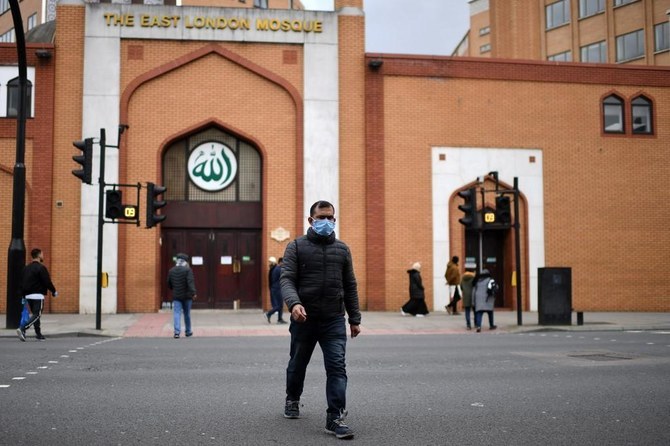
Police in the UK have been asked to increase protection for mosques amid fears they could be targeted by the far right. (AFP/File)
Short Url
Updated 02 August 2024
Follow

UK police urged to protect mosques ahead of far-right rallies

  • Mosques targeted after false information online blamed stabbing of 3 children on Muslim asylum-seeker
  • Tell Mama director: ‘We ask communities to keep calm, look out for each other and to remain vigilant’

LONDON: Police in the UK have been asked to increase protection for mosques amid fears they could be targeted by the far right.
It comes after mosques were targeted by mobs in Southport and Hartlepool in the north of England earlier this week, and violence flared in other cities across the country.
The violence broke out after three children were stabbed to death in Southport on Monday. Information circulated online falsely claimed that the perpetrator had been a Muslim asylum-seeker.
He was later identified by a court on Thursday as 17-year-old Axel Rudakubana, born in Wales to Rwandan parents.
The judge hearing the case, Andrew Menary KC, said reporting restrictions on Rudakubana’s identity due to his age should be lifted to stop people “who are up to mischief to continue to spread disinformation in a vacuum.”
However, fears abound in communities across the country that the spread of misinformation has already gone too far, putting more mosques, as well as asylum-seekers, at further risk.
Iman Atta, director of Tell Mama, an organization that studies Islamophobia in the UK, told The Guardian: “We absolutely need to see the police organize and step up their patrols around mosques and asylum-seeker accommodation.
“It would be good to see neighborhood teams change their patrol times to provide additional reassurance to the communities.”
Subsequent demonstrations in Manchester and Aldershot saw migrant accommodation targeted by protesters holding signs saying “deport them, don’t support them” and “no apartments for illegals.”
Meanwhile, in London at least 110 people were arrested after flares were thrown at a protest near Downing Street.
Shaukat Warraich, a director at Mosque Security, told The Guardian that his company had been contacted by numerous people in recent days for advice, and that its online security recommendations had been downloaded by “hundreds” due to “the false anti-Muslim narrative being peddled following the Southport murders.”
The Guardian also reported that it believes 19 far-right rallies will take place in the coming days across England, with counter-demonstrations also planned in London and Liverpool.
Atta told the newspaper: “Last week has demonstrated how the far right can organize online and promote hate and misinformation toward Muslim communities, refugees and asylum-seekers. We ask communities to keep calm, look out for each other and to remain vigilant.”
Nahella Ashraf, of Stand Up to Racism Manchester, said: “Before the election, with all the attacks on asylum-seekers, it’s not surprising we’re seeing this unleashed.
“We’ve had years where people are feeling angry and neglected and the cost of living crisis feeds into it. It’s the climate the politicians have set.”


Nigeria signals more strikes likely in ‘joint’ US operations

Updated 53 min 50 sec ago
Follow

Nigeria signals more strikes likely in ‘joint’ US operations

  • Nigeria on Friday signalled more strikes against jihadist groups were expected after a Christmas Day bombardment by US forces against militants in the north of the country

LAGOS: Nigeria on Friday signalled more strikes against jihadist groups were expected after a Christmas Day bombardment by US forces against militants in the north of the country.
The west African country faces multiple interlinked security crises in its north, where jihadists have been waging an insurgency in the northeast since 2009 and armed “bandit” gangs raid villages and stage kidnappings in the northwest.
The US strikes come after Abuja and Washington were locked in a diplomatic dispute over what Trump characterised as the mass killing of Christians amid Nigeria’s myriad armed conflicts.
Washington’s framing of the violence as amounting to Christian “persecution” is rejected by the Nigerian government and independent analysts, but has nonetheless resulted in increased security coordination.
“It’s Nigeria that provided the intelligence,” the country’s foreign minister, Yusuf Tuggar, told broadcaster Channels TV, saying he was on the phone with US State Secretary Marco Rubio ahead of the bombardment.
Asked if there would be more strikes, Tuggar said: “It is an ongoing thing, and we are working with the US. We are working with other countries as well.”
Targets unclear
The Department of Defense’s US Africa Command, using an acronym for the Daesh group, said “multiple Daesh terrorists” were killed in an attack in the northwestern state of Sokoto.
US defense officials later posted video of what appeared to be the nighttime launch of a missile from the deck of a battleship flying the US flag.
Which of Nigeria’s myriad armed groups were targeted remains unclear.
Nigeria’s jihadist groups are mostly concentrated in the northeast of the country, but have made inroads into the northwest.
Researchers have recently linked some members from an armed group known as Lakurawa — the main jihadist group located in Sokoto State — to Islamic State Sahel Province (ISSP), which is mostly active in neighboring Niger and Mali.
Other analysts have disputed those links, though research on Lakurawa is complicated as the term has been used to describe various armed fighters in the northwest.
Those described as Lakurawa also reportedly have links to Al-Qaeda affiliated group for the Support of Islam and Muslims (JNIM), a rival group to ISSP.
While Abuja has welcomed the strikes, “I think Trump would not have accepted a ‘No’ from Nigeria,” said Malik Samuel, an Abuja-based researcher for Good Governance Africa, an NGO.
Amid the diplomatic pressure, Nigerian authorities are keen to be seen as cooperating with the US, Samuel told AFP, even though “both the perpetrators and the victims in the northwest are overwhelmingly Muslim.”
Tuggar said that Nigerian President Bola Tinubu “gave the go-ahead” for the strikes.
The foreign minister added: “It must be made clear that it is a joint operation, and it is not targeting any religion nor simply in the name of one religion or the other.”