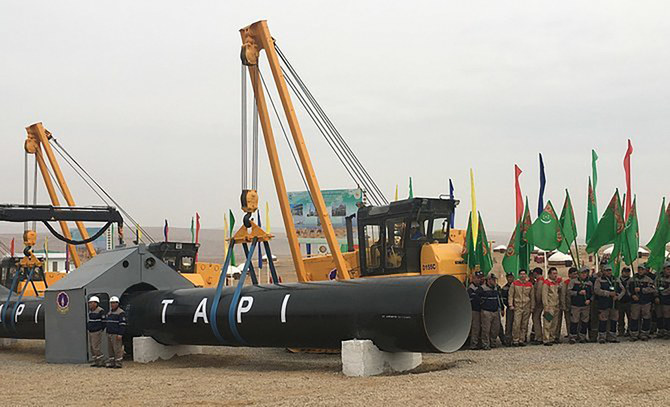
ISLAMABAD: Pakistan and Turkmenistan have decided to accelerate work on the TAPI pipeline project linking the energy-rich Central Asian country through Afghanistan to Pakistan and India, Radio Pakistan said on Friday.
The pipeline is expected to carry 33 billion cubic meters (bcm) of natural gas each year along a route stretching 1,800 km (1,125 miles) from Galkynysh, the world’s second-biggest gas field, to the Indian city of Fazilka near the Pakistan border.
The project was launched in Afghanistan in 2018, when the Taliban was fighting the Western-backed government in Kabul, but it pledged its cooperation for a project it hailed as a key future element of the economic infrastructure.
Afghanistan, which suffers chronic energy shortages, is expected to take 5 percent of the gas itself, with the rest divided equally between Pakistan and India.
“Pakistan and Turkmenistan have decided to accelerate work on TAPI gas pipeline project,” Radio Pakistan reported after Minister for Petroleum Musadik Malik met the Minister of Foreign Affairs of the Cabinet of Turkmenistan, Rashid Meredow, who was on a two-day visit to Pakistan.
“Substantial progress has been made through collaboration on the TAPI Gas Pipeline project aimed at promoting economic integration and energy security,” Musadik was quoted as saying by Radio Pakistan.
The CEO of TAPI Pipeline Company who was also at the meeting said the pipeline project had made “significant progress and was on the right track due to the interest of Pakistan’s Ministry of Petroleum and Special Investment Facilitation Council.”
Minister of Foreign Affairs of Turkmenistan Rashid Meredow said that a “roadmap” would be prepared for enhancing cooperation between Pakistan and Turkmenistan.
Turkmenistan, a former Soviet republic sitting on 4 percent of the world’s natural gas reserves, plans to triple gas output to 230 billion cubic meters (bcm) over the next 20 years. With a population of only 5 million, it will export nearly 80 percent.
Turkmenistan traditionally sends its gas north to Soviet-era master Russia but is becoming an increasingly important supplier to China, Iran and Europe. India and Pakistan, via the TAPI pipeline, would also offer potentially large new export markets.
Pakistan wants to position itself as a regional trade hub and to leverage its strategic geopolitical position and enhance its role as a pivotal trade and transit hub connecting the landlocked Central Asian reoublics with the rest of the world. In recent months, there has been a flurry of visits, investment talks, and economic activity between Pakistan and Central Asian states and meetings with leaders from Uzbekistan, Azerbaijan, Tajikistan, and Turkmenistan.


![]()

Pakistan, Turkmenistan to accelerate work on trans-Afghan gas pipeline
Short Url
https://arab.news/jz646
Pakistan, Turkmenistan to accelerate work on trans-Afghan gas pipeline
- TAPI pipeline will link energy-rich Central Asian country through Afghanistan to Pakistan and India
- India and Pakistan, via TAPI pipeline, will offer potentially large new export markets to Turkmenistan
Latest updates


© 2026 SAUDI RESEARCH & PUBLISHING COMPANY, All Rights Reserved And subject to Terms of Use Agreement.