

Pakistan’s cultural capital sees record rainfall, flooding streets and affecting daily life

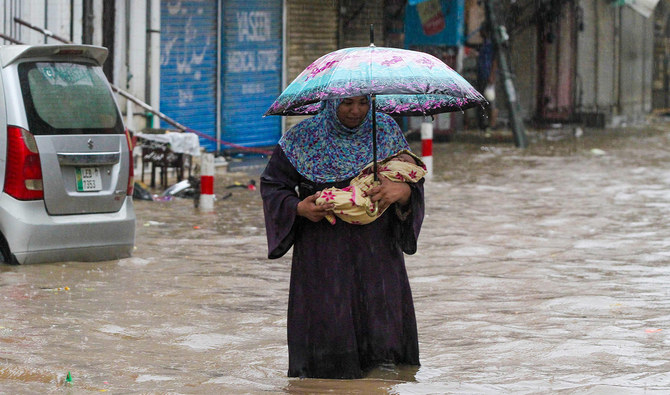
A woman carries her infant as she wades through a flooded street during heavy rainfall in Lahore on August 1, 2024. (AFP/File)
Short Url
Updated 02 August 2024
Follow

Pakistan’s cultural capital sees record rainfall, flooding streets and affecting daily life

  • In July, 99 people died in rain-related incidents and most of the deaths were reported in eastern Punjab and northwestern Khyber Pakhtunkhwa provinces
  • The latest spell of downpours started before dawn on Thursday and is expected to continue for a week at intervals, disaster management authorities say

LAHORE: Pakistan’s cultural city of Lahore saw record-high rainfall early Thursday, leaving at least three people dead, while flooding streets, disrupting traffic and affecting daily life, officials said, as the death toll from rain-related incidents over the past month surpassed 100.

In July, 99 people died in rain-related incidents and most of the deaths were reported in eastern Punjab and northwestern Khyber Pakhtunkhwa provinces, the National Disaster Management Authority said.

The latest spell of downpours started before dawn and is expected to continue for a week at intervals, according to the NDMA. In an advisory, it said the rains are likely to cause flash flooding and landslides.

The monsoon rains also lashed Pakistan’s capital, Islamabad, and other areas.

The latest spell of rains in Lahore was so heavy that it quickly flooded many streets and rainwater entered some wards in the Jinnah and Services hospitals in the capital of Punjab province, causing problems for patients undergoing treatment there.

At least one person died after being electrocuted in the Nishat Colony neighborhood. A 14-year-old boy drowned in a flooded street and a 5-year-old girl died after falling from the roof of her house, police said.

Some areas in the city received a record-high 353 millimeters (14 inches) of rainfall in a few hours, breaking a 44-year-old record in Lahore, according to the water and sanitation agency. In a statement, it said efforts were underway to pump rainwater off of main roads.

Drainage systems quickly became overwhelmed after the rains, flooding several residential areas, officials said. The rainwater entered scores of homes in various parts of the city, residents said.

Monsoon rains have returned to Pakistan as the country is still struggling to recover from devastating 2022 floods that affected 33 million people and killed 1,739. But weather forecasters say the country will receive less heavy rains compared to 2022, when climate-induced downpours swelled rivers.

Pakistan recorded its wettest April since 1961, with more than double the usual rainfall for the month. Weather forecasters and scientists have blamed climate change for the unusually heavy monsoon rains.

In neighboring Afghanistan, authorities on Thursday were dealing with a different kind of weather event, warning people against leaving their homes because of high temperatures.

Fawad Ayoubi, a forecast officer at the country’s aviation department, said people should go out before 10 a.m. and after 4 p.m. if they needed to leave the house.

“The temperature will increase in northern and northwestern provinces as well as southwestern provinces,” said Ayoubi. “The reasons are the monsoon or hot weather from India that is affecting Afghanistan.”

The World Health Organization also shared advice on how Afghans could protect themselves in the warmer weather. It said people should wear a wide-brimmed hat or hat and sunglasses, to eat small meals and more often, and to avoid leaving children in parked cars.



IMF hails Pakistan privatization drive, calls PIA sale a ‘milestone’

Updated 10 January 2026
Follow

IMF hails Pakistan privatization drive, calls PIA sale a ‘milestone’

  • Fund backs sale of national airline as key step in divesting loss-making state firms
  • IMF has long urged Islamabad to reduce fiscal burden posed by state-owned entities

KARACHI: The International Monetary Fund (IMF) on Saturday welcomed Pakistan’s privatization efforts, describing the sale of the country’s national airline to a private consortium last month as a milestone that could help advance the divestment of loss-making state-owned enterprises (SOEs).

The comments follow the government’s sale of a 75 percent stake in Pakistan International Airlines (PIA) to a consortium led by the Arif Habib Group for Rs 135 billion ($486 million) after several rounds of bidding in a competitive process, marking Islamabad’s second attempt to privatize the carrier after a failed effort a year earlier.

Between the two privatization attempts, PIA resumed flight operations to several international destinations after aviation authorities in the European Union and Britain lifted restrictions nearly five years after the airline was grounded following a deadly Airbus A320 crash in Karachi in 2020 that killed 97 people.

“We welcome the authorities’ privatization efforts and the completion of the PIA privatization process, which was a commitment under the EFF,” Mahir Binici, the IMF’s resident representative in Pakistan, said in response to an Arab News query, referring to the $7 billion Extended Fund Facility.

“This privatization represents a milestone within the authorities’ reform agenda, aimed at decreasing governmental involvement in commercial sectors and attracting investments to promote economic growth in Pakistan,” he added.

The IMF has long urged Islamabad to reduce the fiscal burden posed by loss-making state firms, which have weighed public finances for years and required repeated government bailouts. Beyond PIA, the government has signaled plans to restructure or sell stakes in additional SOEs as part of broader reforms under the IMF program.

Privatization also remains politically sensitive in Pakistan, with critics warning of job losses and concerns over national assets, while supporters argue private sector management could improve efficiency and service delivery in chronically underperforming entities.

Pakistan’s Cabinet Committee on State-Owned Enterprises said on Friday that SOEs recorded a net loss of Rs 122.9 billion ($442 million) in the 2024–25 fiscal year, compared with a net loss of Rs 30.6 billion ($110 million) in the previous year.