

Germany’s ‘deal with the devil’ in Russia prisoner swap

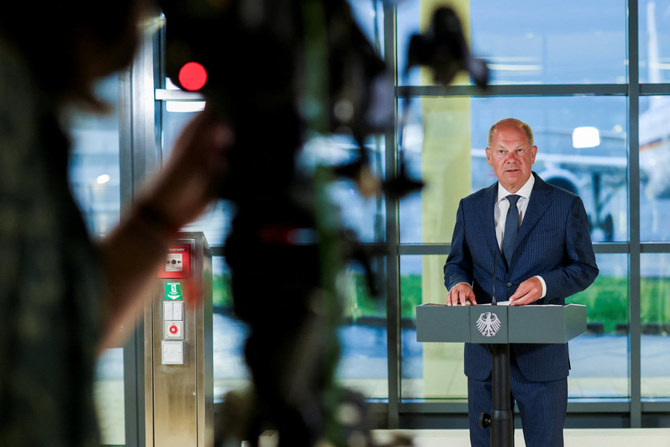
Following the largest prisoner exchange between Russia and the West in decades German Chancellor Olaf Scholz speaks during a news conference at the military area of Cologne Bonn Airport in Cologne, Germany, on August 1, 2024. (Pool via REUTERS)
Short Url
Updated 02 August 2024
Follow

Germany’s ‘deal with the devil’ in Russia prisoner swap

  • Germany received 12 of the freed prisoners, including Russian dissidents and some German nationals
  • Germany has had to pay a particularly high price, setting free a man who committed murder in broad daylight in the center of Berlin

BERLIN: Germany’s release of a convicted murderer in order to facilitate the biggest East-West prisoner swap since the Cold War has garnered praise from Washington but stirred controversy at home.
Those freed in the deal include US journalist Evan Gershkovich, several high-profile Russian opposition figures and five German nationals who were being held in Russia and Belarus.
But of the countries who released Russian prisoners in return, Germany has had to pay a particularly high price, setting free a man who committed murder in broad daylight in the center of Berlin.
Russian citizen Vadim Krasikov had been serving a life sentence for the brazen assassination of a former Chechen rebel commander in the German capital in 2019, a case which shocked the country.
In his press conference celebrating the exchange, US President Joe Biden acknowledged that he “particularly” owed “a great sense of gratitude to Chancellor” Olaf Scholz.
The deal “required me to get some significant concessions from Germany, which they originally concluded they could not do because of the person in question,” Biden said.

But speaking later, Scholz acknowledged the decision to release Krasikov, who was convicted in December 2021, had been “difficult.”
After a “moving” meeting with some of the prisoners on their arrival Cologne airport, Scholz however insisted the swap was “the right decision, and if you had any doubts, you will lose them after talking to those who are now free.”
“Many of the prisoners feared for their health and even their lives,” he added.
Germany is receiving 12 of the freed prisoners, including Russian dissidents and some German nationals.
German TV channel NTV reported that there had been rows between Scholz’s office and the justice ministry over Krasikov’s case.
According to other reports in the German press, the justice ministry eventually ordered prosecutors to suspend Krasikov’s sentence to enable his deportation.
Some in judicial circles reportedly felt this was a case of inappropriate political meddling in the legal process.
The German section of human rights organization Amnesty International condemned the “bitter taste” of the deal and the fact that it had created an equivalence between “a murderer... convicted in a fair trial” and “people who have just exercised their right to free speech.”
It raised the spectre of the exchange “broadening impunity” and emboldening Russian President Vladimir Putin, who previously said Krasikov acted out of “patriotic sentiments” by “eliminating a bandit.”
An opinion piece in Germany’s Bild tabloid said that while the release of rights activists and German citizens in Russia was to be welcomed, “the perverse message given to the Russian people is that Putin is a hero” for “saving murderers.”

However, German officials have insisted the freedom and welfare of the prisoners have been safeguarded by the deal and that Berlin has a duty of care toward the German citizens involved.
Michael Roth, the head of the German’s parliament’s foreign affairs committee and member of Scholz’s Social Democrats, summed up Berlin’s decision on X: “Sometimes for reasons of humanity you have to do a deal with the devil.”
Biden trumpeted the concessions he was able to win from his allies, describing them as “bold and brave decisions” to release prisoners such as Krasikov “who were justifiably being held.”
The Spiegel weekly reported that Thursday’s swap came after “several months” of negotiations between the CIA, Germany’s BND intelligence agency and the Kremlin.
The swap was originally envisioned to include Russian opposition leader Alexei Navalny, who died in an Arctic prison in February, before the focus fell on Gershkovich and former Marine Paul Whelan.
Diplomatic contacts at the highest level were also brought to bear in securing the deal.
US National Security Adviser Jake Sullivan told reporters that conversations between Biden and Scholz led up to Vice President Kamala Harris sitting “face-to-face with Chancellor Scholz” to “talk through the elements of this” at the Munich security conference earlier this year.


‘I admire Vision 2030’: Bangladesh’s new PM aims for stronger Saudi, GCC ties

Updated 4 sec ago
Follow

‘I admire Vision 2030’: Bangladesh’s new PM aims for stronger Saudi, GCC ties

  • Saudi Arabia congratulates Tarique Rahman on assuming Bangladesh’s top office
  • Relations between Bangladesh and Kingdom were formalized during his father’s rule

DHAKA: After 17 years in exile, Tarique Rahman has taken office as prime minister of Bangladesh, inheriting his parents’ political legacy and facing immediate economic and political challenges.

Rahman led his Bangladesh Nationalist Party to a landslide victory in the Feb. 12 general election, winning an absolute majority with 209 of 300 parliamentary seats and marking the party’s return to power after two decades.

The BNP was founded by his father, former President Ziaur Rahman, a 1971 Liberation War hero. After his assassination in 1981, Rahman’s mother, Khaleda Zia, took over the party’s helm and served two full terms as prime minister — in 1991 and 2001.

Rahman and his cabinet, whose members were sworn in alongside him on Tuesday, take over from an interim administration which governed Bangladesh for 18 months after former premier Sheikh Hasina — the BNP’s archrival who ruled consecutively for 15 years — was toppled in the 2024 student-led uprising.

As he begins his term, the new prime minister’s first tasks will be to rebuild the economy — weakened by uncertainty during the interim administration — and to restore political stability. Relations with the Middle East, particularly Saudi Arabia and other GCC states, are also high on his agenda.

“Saudi Arabia is one of our long-standing friends,” Rahman told Arab News at his office in Dhaka, two days before his historic election win.

“I admire the Saudi Vision 2030, and I am sincerely looking forward to working with the leadership of the Kingdom of Saudi Arabia. BNP always had a great relationship with the Muslim world, especially GCC nations — UAE, Qatar, Bahrain, Kuwait and Oman — and I look forward to working closely with GCC countries and their leadership to build a long-term trusting partnership with mutual interest,” Rahman said.

The Saudi government congratulated him on assuming the top office on Tuesday, wishing prosperity to the Bangladeshi people. 

Bangladesh and Saudi Arabia established formal diplomatic relations in August 1975, and the first Bangladeshi ambassador presented his credentials in late 1976, after Rahman’s father rose to power. That year, Bangladesh also started sending laborers, engineers, doctors, and teachers to work in the Kingdom.

Today, more than 3 million Bangladeshis live and work in Saudi Arabia — the largest expat group in the Kingdom and the biggest Bangladeshi community outside the country.

“I recall that when my father, President Ziaur Rahman, was in office, bilateral relations between our two nations were initiated,” Rahman said. “During the tenure of my mother, the late Begum Khaleda Zia, as prime minister, those relations became even stronger.”

Over the decades, Saudi Arabia has not only emerged as the main destination for Bangladesh’s migrant workers but also one of its largest development and emergency aid donors.

Weeks after Rahman’s mother began her first term as prime minister in 1991, Bangladesh was struck by one of the deadliest tropical cyclones in its history. Riyadh was among the first who offered assistance, and Zia visited Saudi Arabia on her earliest foreign tour and performed Hajj in June 1991.

For Rahman, who had been living in London since 2008 and returned to Bangladesh in December — just days before his mother’s death — the Kingdom will also be one of the first countries he plans to visit.

“I would definitely like to visit Saudi Arabia early in my term,” he said. “Personally, I also wish to visit the holy mosque, Al-Masjid Al-Haram, Makkah, to perform Umrah.”