NEW YORK: Donald Trump has found tremendous success from the very first moment he stepped onto the presidential stage by stoking racial animus.
Democrats expressed new outrage this week at the former president’s derisive and false charge that Vice President Kamala Harris, who is of Jamaican and Indian heritage, only recently “turned Black” for political gain. Some Republicans — even from within Trump’s own campaign — seemed to distance themselves from the comment.
But Trump’s rhetoric this week, and his record on race since he entered politics nearly a decade ago, indicate that divisive attacks on race may emerge as a core GOP argument in the three-month sprint to Election Day — whether his allies want them to or not.
A Trump adviser, granted anonymity Thursday to discuss internal strategy, said the campaign doesn’t need to focus on “identity politics” because the case against Harris is that she is “so liberal it’s dangerous.” The adviser pointed to Harris’ record on the Southern border, crime, the economy and foreign policy.
In a sign that Trump may not be coordinating his message with his own team, the Republican presidential nominee doubled down on the same day with a new attack on Harris’ racial identity. He posted on his social media site a picture of Harris donning traditional Indian attire in a family photo.
Sen. Cynthia Lummis, a Wyoming Republican who has endorsed Trump, was among a number of lawmakers on Capitol Hill who said Thursday that the rhetoric around race and identity is not “helpful to anyone” this election cycle.
“People’s skin color doesn’t matter one iota,” Lummis said in an interview.
Trump turned to an old tactic against Harris
It’s been less than two weeks after President Joe Biden ended his reelection bid and endorsed Harris. Trump has had to pivot from campaigning against an 81-year-old white president showing signs of decline to facing a 59-year-old biracial vice president who is drawing much larger crowds and new enthusiasm from Democratic donors.
Trump went to the National Association of Black Journalists convention on Wednesday. In an appearance carried live on cable news and shared widely online, he falsely suggested Harris misled voters about her race.
“I didn’t know she was Black until a number of years ago when she happened to turn Black and now she wants to be known as Black. So, I don’t know, is she Indian or is she Black?” Trump said Wednesday.
At a Pennsylvania rally hours later, Trump’s team displayed years-old news headlines describing Harris as the “first Indian-American senator” on the big screen in the arena. And Ohio Sen. JD Vance, Trump’s running mate, told reporters traveling with him that Harris was a “chameleon” who changed her identity when convenient.
Harris attended Howard University, the historically Black institution where she pledged the Alpha Kappa Alpha sorority, and has often talked throughout her career about being both about being Black and Indian American.
Some Republicans argued that Trump’s message on race is part of a broader pitch that may appeal to some Black voters.
“We’re focused on policy and how we can actually make waves and changes in the Black community. Economics, education, inflation, lowering costs. That’s what the message is,” said Diante Johnson, president of the Black Conservative Federation, which supports Trump’s efforts to win over more Black voters and hosted him at a gala in February.
Veteran Republican pollster Frank Luntz said he explored the issue during a Wednesday focus group with swing voters almost immediately after Trump’s interview. He found that Harris may be vulnerable to criticism based on her gender, but race-based attacks could hurt Trump among the voters that matter most this fall.
Much has changed, Luntz said, since Trump rose to prominence by questioning the citizenship of Barack Obama, the nation’s first Black president.
“Trump seems to think that he can criticize her for how she’s dealt with her race. Well, no one’s listening to that criticism. It simply doesn’t matter,” Luntz said. “If it’s racially driven, it will backfire.”
Eugene Craig, the former vice chair of the Maryland Republican Party, said that Trump “got what he wanted” at the NABJ convention but that the substance of his argument risked being more offensive than appealing.
“The one thing that Black folks will never tolerate is disrespecting Blackness, and that goes for Black Republicans too,” said Craig, who is Black and worked as a staffer for conservative pundit Dan Bongino’s 2012 Senate campaign. He is now supporting Harris.
Trump has a long history of racist attacks
Trump has frequently used race to go after his opponents since he stepped into presidential politics nearly a decade ago.
Trump was perhaps the most famous member of the so-called “birther” movement questioning where Obama was born. He kicked off his first campaign by casting Mexican immigrants as “rapists” and drug traffickers and later questioned whether a US federal judge of Mexican heritage could be fair to him.
While in the White House, Trump defended a white supremacist march in Charlottesville, Virginia, and suggested that the US stop accepting immigrants from “shithole” countries including Haiti and parts of Africa. In August 2020, he suggested Harris, who was born in California, might not meet the Constitution’s eligibility requirements to be vice president.
And just two weeks after formally entering the 2024 campaign, he dined with notorious white supremacist Nick Fuentes at his Mar-a-Lago residence.
Trump won in 2016 but lost reelection in 2020 to Biden by close margins in several swing states. He swept the 2024 Republican primary even while facing a raft of criminal charges.
Some Trump critics worried that his racial strategy might resonate with a significant portion of the electorate anyway. Voters will decide in November whether to send a Black woman to the Oval Office for the first time in the nation’s nearly 250-year history.
“I hope Trump’s attacks on Harris are just him flailing about ineffectively. But put together Trump’s shamelessness, his willingness to lie, his demagogic talent, and the issue of race — and a certain amount of liberal complacency that Trump is just foolish — and I’m concerned,” Bill Kristol, a leading conservative anti-Trump voice, posted on social media Thursday.
The Harris campaign thinks there’s little upside for Trump
A Harris adviser described the moment as an opportunity to remind voters of the chaos and division that Trump breeds. But the adviser, granted anonymity to discuss internal strategy, said it would be a mistake for Democrats to engage with Trump’s attacks on race at the expense of the campaign’s broader focus on key policies.
So long as the campaign does not get distracted, the adviser said, Harris’ team believes there is little political upside for Trump to continue attacking Harris’ racial identity.
Harris told a gathering of a historically Black sorority on Wednesday that Trump’s attack was “the same old show: the divisiveness and the disrespect.”
On the ground in at least one swing state, however, there were signs that Trump’s approach may be resonating — at least among the former president’s white male base.
Jim Abel, a 65-year-old retiree who attended a rally for Vance in Arizona on Wednesday, said he agreed with Trump’s focus on Harris’ racial identity.
“She’s not Black,” Abel said. “I’ve seen her parents. I’ve pictures of her and her family and she’s not Black. She’s looking for the Black vote.”
But several high-profile Republican voices disagreed.
Conservative commentator Ben Shapiro posted on X a picture of a road sign with two directions. One led to, “Attack Kamala’s record, lies and radicalism,” while the other, “Is she really black?”
“I dunno guys, I just think that maybe winning the 2024 election might be more important than having this silly and meaningless conversation,” Shapiro wrote.

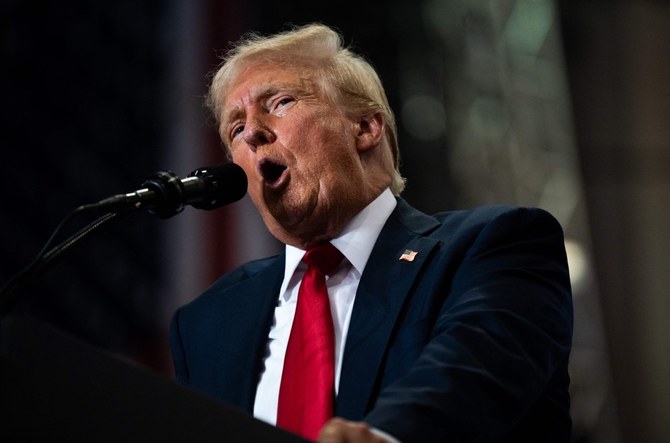
Trump is making his 2024 campaign about Harris’ race, whether Republicans want him to or not
Short Url
https://arab.news/rpspp
Trump is making his 2024 campaign about Harris’ race, whether Republicans want him to or not
Teenage preacher to alleged mass killer: Bondi attack suspect’s background emerges
SYDNEY/MANILA: Standing in the rain outside a suburban Sydney train station, seventeen-year-old Naveed Akram stares into the camera and urges those watching to spread the word of Islam.
“Spread the message that Allah is One wherever you can ... whether it be raining, hailing or clear sky,” he said.
Another since-deleted video posted in 2019 by Street Dawah Movement, a Sydney-based Islamic community group, shows him urging two young boys to pray more frequently.
Authorities are now trying to piece together what happened in the intervening six years that led a teenager volunteering to hand out pamphlets for a non-violent community group to allegedly carry out Australia’s worst mass shooting in decades.
Akram, who remains under heavy guard in hospital after being shot by police, was briefly investigated by Australia’s domestic intelligence agency in 2019 for links to individuals connected to Islamic State, but authorities found he did not have extremist tendencies at the time.
“In the years that followed, that changed,” Home Affairs Minister Tony Burke said on Tuesday.
Police have not formally identified Naveed Akram, 24, as one of the alleged gunmen who killed 15 people at a Jewish event on a Sydney beach on Sunday. His father Sajid Akram, 50, is the other gunman who was shot and killed by police, local media reported.
Officials have said the second gunman is the deceased man’s son and is in a critical condition in hospital.
MOTIVATED BY DAESH
Prime Minister Anthony Albanese said on Tuesday the attack was likely motivated by the ideology of Daesh, but that the two men appeared to have acted alone.
Homemade Daesh flags were found in the suspects’ car after Sunday’s attack, and police said on Tuesday the pair had last month visited the Philippines, where offshoots of the militant group have a presence.
A spokesperson for the Philippines Bureau of Immigration said Akram, an Australian national, arrived in the country on November 1 with his father, who was traveling on an Indian passport.
Both reported Davao as their final destination, the main city on Mindanao island, which has a history of Islamist insurgency. A months-long conflict on the island in 2017 between armed forces and two militant groups linked to IS left over a thousand dead and a million displaced, though the country’s military says these groups are now fragmented and weakened.
The pair left the Philippines on November 28, two weeks before Sunday’s attack using high-powered shotguns and rifles.
’NEVER DID ANYTHING UNUSUAL’
Local media reported that Akram, an unemployed bricklayer, attended high school in Cabramatta, a suburb around 30 kilometers by road from Sydney’s central business district and close to the family’s current home in Bonnyrigg, which was raided by police after the attacks.
“I could have never imagined in 100 years that this could be his doing,” former classmate Steven Luong told The Daily Mail.
“He was a very nice person. He never did anything unusual. He never even interrupted in class.”
After leaving school, Akram showed a keen interest in Islam, seeking tutoring and attending several Street Dawah Movement events. The group confirmed he appeared in the videos.
“We at Street Dawah Movement are horrified by his actions and we are appalled by his criminal behavior,” the group said in a statement, adding Akram had attended several events in 2019 but was not a member of the organization.
Months after the videos were posted, Akram approached tutor Adam Ismail seeking tuition in Arabic and the Qur'an, studying with him for a combined period of one year.
Ismail’s language institute posted a photo in 2022, since deleted, showing Akram smiling while holding a certificate in Qur'anic recitation.
“Not everyone who recites the Qur'an understands it or lives by its teachings, and sadly, this appears to be the case here,” Ismail said in a video statement late on Monday.
“I condemn this act of violence without hesitation.”
EARLIER TIES TO DAESH NOT PROVEN
Two of the people he was associated with in 2019 were charged and went to jail but Akram was not seen at that time to be a person of interest, Albanese said.
However he was radicalized, Akram’s journey from a teenager interested in Islam to one of Australia’s worst alleged killers has taken not just the public, but also law enforcement by surprise.
“We are very much working through the background of both persons,” New South Wales Police Commissioner Mal Lanyon told reporters on Monday.
“At this stage, we know very little about them.”
“Spread the message that Allah is One wherever you can ... whether it be raining, hailing or clear sky,” he said.
Another since-deleted video posted in 2019 by Street Dawah Movement, a Sydney-based Islamic community group, shows him urging two young boys to pray more frequently.
Authorities are now trying to piece together what happened in the intervening six years that led a teenager volunteering to hand out pamphlets for a non-violent community group to allegedly carry out Australia’s worst mass shooting in decades.
Akram, who remains under heavy guard in hospital after being shot by police, was briefly investigated by Australia’s domestic intelligence agency in 2019 for links to individuals connected to Islamic State, but authorities found he did not have extremist tendencies at the time.
“In the years that followed, that changed,” Home Affairs Minister Tony Burke said on Tuesday.
Police have not formally identified Naveed Akram, 24, as one of the alleged gunmen who killed 15 people at a Jewish event on a Sydney beach on Sunday. His father Sajid Akram, 50, is the other gunman who was shot and killed by police, local media reported.
Officials have said the second gunman is the deceased man’s son and is in a critical condition in hospital.
MOTIVATED BY DAESH
Prime Minister Anthony Albanese said on Tuesday the attack was likely motivated by the ideology of Daesh, but that the two men appeared to have acted alone.
Homemade Daesh flags were found in the suspects’ car after Sunday’s attack, and police said on Tuesday the pair had last month visited the Philippines, where offshoots of the militant group have a presence.
A spokesperson for the Philippines Bureau of Immigration said Akram, an Australian national, arrived in the country on November 1 with his father, who was traveling on an Indian passport.
Both reported Davao as their final destination, the main city on Mindanao island, which has a history of Islamist insurgency. A months-long conflict on the island in 2017 between armed forces and two militant groups linked to IS left over a thousand dead and a million displaced, though the country’s military says these groups are now fragmented and weakened.
The pair left the Philippines on November 28, two weeks before Sunday’s attack using high-powered shotguns and rifles.
’NEVER DID ANYTHING UNUSUAL’
Local media reported that Akram, an unemployed bricklayer, attended high school in Cabramatta, a suburb around 30 kilometers by road from Sydney’s central business district and close to the family’s current home in Bonnyrigg, which was raided by police after the attacks.
“I could have never imagined in 100 years that this could be his doing,” former classmate Steven Luong told The Daily Mail.
“He was a very nice person. He never did anything unusual. He never even interrupted in class.”
After leaving school, Akram showed a keen interest in Islam, seeking tutoring and attending several Street Dawah Movement events. The group confirmed he appeared in the videos.
“We at Street Dawah Movement are horrified by his actions and we are appalled by his criminal behavior,” the group said in a statement, adding Akram had attended several events in 2019 but was not a member of the organization.
Months after the videos were posted, Akram approached tutor Adam Ismail seeking tuition in Arabic and the Qur'an, studying with him for a combined period of one year.
Ismail’s language institute posted a photo in 2022, since deleted, showing Akram smiling while holding a certificate in Qur'anic recitation.
“Not everyone who recites the Qur'an understands it or lives by its teachings, and sadly, this appears to be the case here,” Ismail said in a video statement late on Monday.
“I condemn this act of violence without hesitation.”
EARLIER TIES TO DAESH NOT PROVEN
Two of the people he was associated with in 2019 were charged and went to jail but Akram was not seen at that time to be a person of interest, Albanese said.
However he was radicalized, Akram’s journey from a teenager interested in Islam to one of Australia’s worst alleged killers has taken not just the public, but also law enforcement by surprise.
“We are very much working through the background of both persons,” New South Wales Police Commissioner Mal Lanyon told reporters on Monday.
“At this stage, we know very little about them.”
© 2025 SAUDI RESEARCH & PUBLISHING COMPANY, All Rights Reserved And subject to Terms of Use Agreement.


