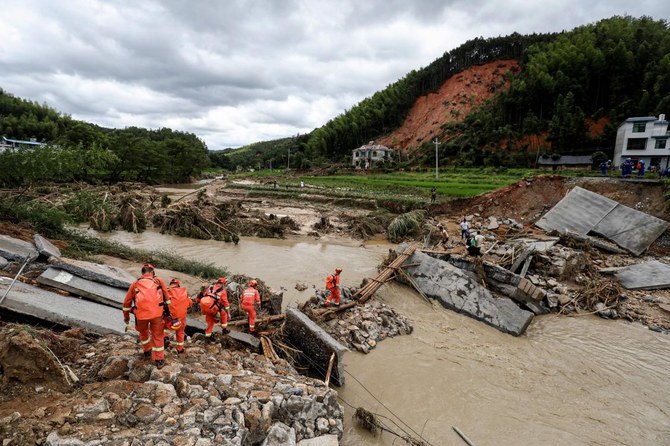
BEIJING: Torrential rains in China have killed at least 30 people and left dozens more missing, state media said on Thursday, as the country grinds through another summer of extreme weather.
Confirmation of the deaths came the same day that weather authorities said July was China’s hottest month since records began six decades ago.
China is the world’s biggest emitter of the greenhouse gases that scientists say are driving climate change and making extreme weather more frequent and intense.
Heatwaves this summer have scorched parts of northern China, while heavy rain has triggered floods and landslides in central and southern areas.
This week’s downpours were triggered by Typhoon Gaemi, which moved on from the Philippines and Taiwan to make landfall in eastern China a week ago, with hilly, landlocked Hunan province hit particularly hard.
More than 11,000 people were evacuated from the city of Zixing after some areas endured record rainfall of 645 millimeters (25 inches) in just 24 hours, state news agency Xinhua said on Tuesday.
Many roads connecting townships in the Zixing area were temporarily cut off, which also affected the power supply and communications infrastructure.
State broadcaster CCTV said on Thursday the disruption was mostly over.
“Initial findings show that there have been 30 deaths and 35 are missing,” the report said, adding that search and rescue efforts were still ongoing.
Xinhua said on Tuesday four people had been killed and three people were missing in Zixing.
Three people were killed in Hunan’s Yongxing county, Xinhua also said Tuesday, while a landslide on Sunday killed 15 people elsewhere in the province.
Last month was “the hottest July since complete observations began in 1961, and the hottest single month in the history of observation,” the national weather office said Thursday.
It said the average July air temperature in China was 23.21 degrees Celsius (73.78 degrees Fahrenheit), exceeding the previous record of 23.17C (73.71F) in 2017.
The mean temperature in every province was also “higher than the average for previous years,” with the southwestern provinces of Guizhou and Yunnan logging their highest averages, the weather office said.
It forecast that the mercury would continue to climb in eastern regions this week, including Shanghai, where a red alert for extreme heat was in place on Thursday.
“Next week will be more of the same. It’s like being on an iron plate,” wrote one user of the Weibo social media platform in response to the megacity’s heat warning.
Another quipped: “It’s so hot. Did Shanghai do something to anger the gods?“
The nearby city of Hangzhou may hit 43C (109F) on Saturday, which would break its all-time record, the weather office said.
Middle and lower reaches of the Yangtze River would likely see daily temperatures fall no lower than 30C (86F), it said.
The news came little more than a week after Earth experienced its warmest day in recorded history.
Preliminary data from the Copernicus Climate Change Service showed the daily global average temperature was 17.15C (62.9F) on July 22.
That was 0.06C hotter than the day before, which itself broke the all-time high temperature set a year earlier by a small margin.
China has pledged to bring emissions of carbon dioxide to a peak by 2030, and to net zero by 2060, but has resisted calls to be bolder.
It long depended on highly polluting coal power to fuel its massive economy but has emerged as a renewable energy leader in recent years.
Research showed last month that China is building almost twice as much wind and solar energy capacity than every other country combined.


![]()

30 dead, dozens missing after torrential rain in central China
Short Url
https://arab.news/m9vyj
30 dead, dozens missing after torrential rain in central China
- Confirmation of the deaths came the same day that weather authorities said July was China’s hottest month since records began six decades ago
- Heatwaves this summer have scorched parts of northern China, while heavy rain has triggered floods and landslides in central and southern areas


Latest updates





© 2026 SAUDI RESEARCH & PUBLISHING COMPANY, All Rights Reserved And subject to Terms of Use Agreement.