

Pakistan’s deputy PM sees mineral sector as key to repaying foreign debts

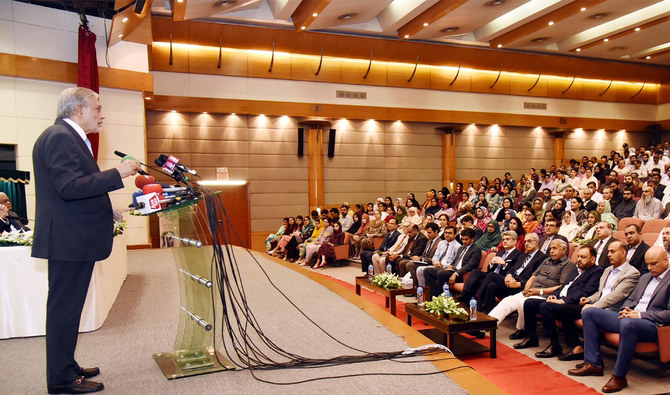
Pakistan's Deputy Prime Minister Ishaq Dar (left) is addressing the groundbreaking ceremony of the head office of the Securities & Exchange Commission of Pakistan in Islamabad, Pakistan, on August 1, 2024. (PID)
Short Url
Updated 01 August 2024
Follow

Pakistan’s deputy PM sees mineral sector as key to repaying foreign debts

  • Ishaq Dar calls for streamlining gemstone sector, saying it has a proven worth of $10 trillion
  • Dar emphasizes structural economic reforms that can help the country to join G-20 states

ISLAMABAD: Pakistan’s Deputy Prime Minister Ishaq Dar said on Thursday the country’s mineral sector could help generate a parallel revenue stream, reducing its reliance on external loans and enabling it to pay off foreign debts.

A $350 billion economy, Pakistan faces a chronic balance of payments crisis, requiring nearly $24 billion to repay in debt and interest over the next fiscal year, which is substantially more than the central bank’s current foreign currency reserves of $14.64 billion.

Last month, Pakistan reached a staff-level agreement with the International Monetary Fund (IMF) for a new $7 billion bailout after completing a short-term, $3 billion loan program in April this year.

The $3 billion facility helped Islamabad avert a sovereign debt default last year. The government says it seeks a fresh loan to keep its ongoing economic reforms on track.

“Pakistan has an abundance of tested and certified natural reservoirs of minerals, which have a proven cost of $10,000 billion,” the deputy PM said while addressing a ceremony at the Securities and Exchange Commission of Pakistan in Islamabad. “So, a $130 billion dollars liability is no challenge.”

Highlighting that Pakistan was an asset-solvent country, he called for streamlining the gemstone sector and make sure it was “properly exploited and explored” for sustainable economic development in the country.

Dar said Pakistan faced twin deficits in the shape of both fiscal and foreign accounts in the past, though he maintained they were manageable through comprehensive planning and economic reforms.

He noted the incumbent government’s main focus included structural reforms, bilateral trade and foreign direct investment, terming them imperative to get rid of dependence on foreign institutions.

“Pakistan has huge potential to join G-20 countries through structural reforms in the country’s economy,” he said.

In June this year, Pakistani exporters and traders of gemstones and jewelry items urged the government to adopt modern technological methods and remove restrictions to boost exports of these goods from the South Asian country.

Earlier, in May, Prime Minister Shehbaz Sharif emphasized the importance of developing Pakistan’s gems and precious stones sector, urging authorities to take steps to grant it industry status.

Sharif highlighted that Pakistan possesses immense natural resources, particularly in the regions of Khyber Pakhtunkhwa, Gilgit-Baltistan and Azad Jammu and Kashmir.

According to a report by Pakistan’s commerce ministry, the country’s exports of pearls and precious stones to China saw a 47 percent increase in 2023, reflecting a rising demand for these resources in China.


Oman’s trade surplus narrows to $12bn as exports decline 

Updated 6 sec ago
Follow

Oman’s trade surplus narrows to $12bn as exports decline 

RIYADH: Oman’s trade surplus narrowed to 4.69 billion rials ($11.9 billion) by the end of October as weaker oil and gas shipments weighed on exports, even as imports rose, according to official data.

The surplus compares with 7.31 billion rials in the same period of 2024, the Oman News Agency reported, citing preliminary figures from the National Centre for Statistics and Information. Total merchandise exports fell 8 percent year on year to 19.3 billion rials, while imports increased 6.8 percent to 14.6 billion rials.

This comes as Fitch Ratings last month upgraded Oman to investment-grade status, raising its long-term foreign-currency rating from BB+ to BBB-, citing stronger public finances, an improved external position, and a continued commitment to prudent fiscal management. 

The agency noted that Oman has successfully strengthened fiscal discipline, reducing government debt to around 36 percent of gross domestic product in 2025, down from about 68 percent in 2020.   

“The decline in the value of Oman’s merchandise exports is primarily attributed to a decrease in the value of oil and gas exports, which reached 12.1 billion rials by the end of October 2025, a 16.3 percent decrease compared to 14.4 billion rials at the end of October 2024,” the ONA report stated.   

It added: “Conversely, the value of Oman’s non-oil merchandise exports increased by 9.9 percent, reaching 5.61 billion rials by the end of October 2025, compared to 5.1 billion rials during the same period in 2024.”  

The value of re-exports also increased, reaching 1.6 billion rials by the end of October, up 11.6 percent year on year. 

The UAE was the leading destination for Oman’s non-oil exports, with shipments valued at 1.07 billion rials, marking a 27.6 percent increase compared to the same period in 2024. 

The UAE also topped the list for re-exports, at 532 million rials, and for exports to Oman, at 3.49 billion rials. 

Saudi Arabia ranked second among destinations for Oman’s non-oil exports, with a value of 920 million rials, followed by India at 597 million rials. 

In re-exports, Iran ranked second with 324 million rials, followed by the UK with 179 million rials. 

On the import side, China ranked second, with imports valued at 1.55 billion rials, followed by Kuwait at 1.25 billion rials.