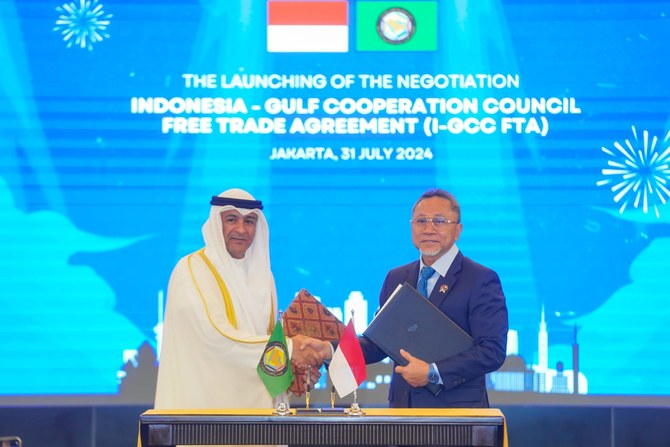
GCC, Indonesia launch talks for free trade agreement

GCC Secretary-General Jassim Mohammed Al-Budaiwi and Indonesian Trade Minister Zulkifli Hasan pose for a photo at the launching of negotiations for Indonesia-GCC free trade agreement in Jakarta on July 31, 2024. (Indonesian Ministry of Trade)
Short Url
Updated 31 July 2024
Follow

GCC, Indonesia launch talks for free trade agreement

  • GCC secretary-general arrives in Jakarta to start negotiations
  • First round of discussions set to take place in September 

JAKARTA: The Gulf Cooperation Council and Indonesia signed a deal on Wednesday to start long-awaited talks for a free trade agreement, which the Indonesian government expects to increase the country’s commercial presence in the Middle East. 
Indonesia already has a Comprehensive Economic Partnership Agreement with one GCC member, the UAE, its first with a Gulf nation.
After the pact entered into force last September, Indonesian officials have been working to enhance trade ties with other members of the group — Saudi Arabia, Oman, Qatar, Bahrain, Kuwait, and the UAE.
The agreement to start the talks was signed in Jakarta by GCC Secretary-General Jassim Mohammed Al-Budaiwi and Indonesia’s Trade Minister Zulkifli Hasan.
“This is historic. GCC comprises countries with strong economy, high purchasing power. We have relations that go way back, but our trade is small,” Hasan told reporters.  
“Hopefully, we will conclude negotiations in two years. This is just the launch, so it’s going to be a marathon and we will start negotiating in September … It’s been years since we first started proposing an agreement, but it’s only today that we are launching the talks.”
The first round of talks is planned to take place in September, he said.
Indonesia’s trade with GCC countries was valued at around $15.7 billion last year, with its main export commodities including palm oil, coffee, jewelry and motor vehicles. 
A free trade agreement with the group is expected to help Indonesia expand its ties with the region, which have traditionally revolved around domestic workers, and Hajj and Umrah pilgrimages. 
“There have been many trade barriers,” Hasan said. “We want to send doctors, but we have different standards. We want to send seafood, but our health standards are not the same, so it’s been very hard because we don’t have any agreement regarding trade.”
Al-Budaiwi told reporters in Jakarta that the Gulf countries are also interested in greater cooperation with Indonesia.
“Trade with Indonesia is multifaceted and very developed. The most important thing from our meeting today is that we want to open up new sectors,” he said. 
“We are certain that this launch will pave the way to increase the trade volume even further.”



Ethiopia accuses Eritrea of arming rebels in escalating war of words

Updated 15 January 2026
Follow

Ethiopia accuses Eritrea of arming rebels in escalating war of words

  • The charge by Ethiopia’s federal police escalates a feud between Ethiopia and Eritrea
  • The two countries fought a three-year border war that broke out in 1998

ADDIS ABABA: Ethiopian police said they had seized thousands of rounds of ammunition sent by Eritrea to rebels in Ethiopia’s Amhara region, an allegation Eritrea dismissed as a falsehood intended to justify starting a war.
The charge by Ethiopia’s federal police escalates a feud between Ethiopia and Eritrea, longstanding foes who reached a peace deal in 2018 that has since given way to renewed threats and acrimony.
The police said in a statement late on Wednesday they had seized 56,000 rounds of ⁠ammunition and arrested two suspects this week in the Amhara region, where Fano rebels have waged an insurgency since 2023.
“The preliminary investigation conducted on the two suspects who were caught red-handed has confirmed that the ammunition was sent by the Shabiya government,” the statement said, using a term for Eritrea’s ruling party.
Eritrea’s Information Minister Yemane Gebremeskel told Reuters that Ethiopian Prime ⁠Minister Abiy Ahmed’s Prosperity Party (PP) was looking for a pretext to attack.
“The PP regime is floating false flags to justify the war that it has been itching to unleash for two long years,” he said.
In an interview earlier this week with state-run media, Eritrean President Isaias Afwerki said the Prosperity Party had declared war on his country. He said Eritrea did not want war, but added: “We know how to defend our nation.”
The two countries fought a three-year border war that broke out in 1998, five years after Eritrea won its independence from Ethiopia. They ⁠signed a historic agreement to normalize relations in 2018 that won Ethiopia’s Abiy the Nobel Peace Prize the following year. Eritrean troops then fought in support of Ethiopia’s army during a 2020-22 civil war in Ethiopia’s northern Tigray region.
But relations soured after Asmara was frozen out of the peace deal that ended that conflict. Since then, Eritrea has bristled at repeated public declarations by Abiy that landlocked Ethiopia has a right to sea access — comments many in Eritrea, which lies on the Red Sea, view as an implicit threat of military action.
Abiy has said Ethiopia does not seek conflict with Eritrea and wants to address the issue of sea access through dialogue.