

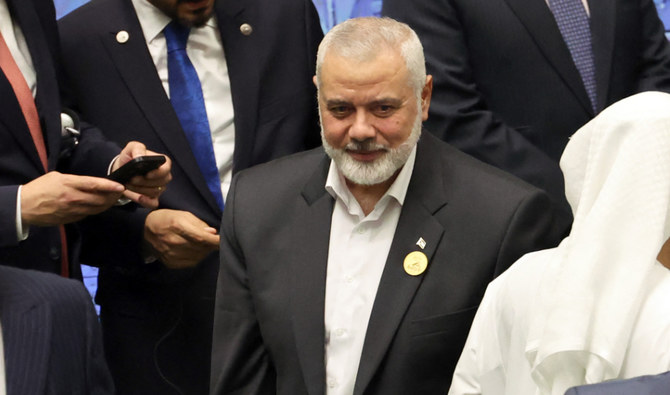

TEHRAN: Hamas said Wednesday its political leader Ismail Haniyeh was killed in an Israeli strike in Iran, where he was attending the swearing-in of the new president, and vowed the act “will not go unanswered.”
Iran’s supreme leader Ayatollah Ali Khamenei too threatened “harsh punishment” for Haniyeh’s killing, saying: “We consider it our duty to seek revenge for his blood as he was martyred in the territory of the Islamic Republic of Iran.”
Iran’s new President Masoud Pezeshkian echoed him, saying: “The Zionists will soon see the consequences of their cowardly and terrorist act.” Israeli policies “have reached a dead end,” he added.
Israel declined to comment on the Tehran strike, which came after it struck a Hezbollah stronghold in south Beirut on Tuesday, killing a senior commander of the Lebanese militant group it blamed for a deadly weekend rocket strike on the Israeli-annexed Golan Heights.
Speaking in a televised address on Wednesday evening, Israeli Prime Minister Benjamin Netanyahu avoided directly mentioning Haniyeh but said Israel had “delivered crushing blows to all our enemies” in recent days.
The UN Security Council was preparing on Wednesday to hold an emergency meeting, requested by Iran and supported by others including China and Russia, following Haniyeh’s killing.
In a letter to the Security Council, Iran’s UN envoy Amir Saeid Iravani called on members to “condemn unequivocally” Israeli actions, and urged it to “ensure accountability” including potential sanctions.
Qatar, which has been spearheading efforts with Egypt and the United States to broker a ceasefire in Gaza, said the killing of Haniyeh, Hamas’s lead negotiator, threw the whole process into doubt.
“Brother leader, mujahid Ismail Haniyeh, the head of the movement, died in a Zionist strike on his residence in Tehran after he participated in the inauguration of the new (Iranian) president,” the Palestinian militant group said in a statement.
Hamas political bureau member Musa Abu Marzuk, who analysts say could succeed Haniyeh, vowed the group would retaliate. “The assassination of leader Ismail Haniyeh is a cowardly act and will not go unanswered,” he said.
Iran’s Revolutionary Guards also announced the death, saying Haniyeh’s residence in Tehran was hit and he was killed along with a bodyguard.
Iranian media said the 2:00 am (2230 GMT) strike targeted “the special residences for war veterans in north Tehran” where Haniyeh was staying.
Haniyeh had traveled to Tehran to attend Tuesday’s swearing-in of Pezeshkian.
The government, following the news of the killing, declared three days of national mourning.
An “official and public” funeral ceremony for Haniyeh will be held in Tehran on Thursday before his body is flown to Qatar, his base in recent years, for burial on Friday, Hamas said.
Hundreds of demonstrators waving Palestinian flags rallied Wednesday in Tehran’s Palestine Square, chanting “Death to Israel, Death to America!,” AFP correspondents said.
There were also protests in Amman, where thousands of Jordanians gathered outside the Israeli embassy to protest the death of the Hamas leader, and in Palestinian refugee camps in Lebanon.
Palestinian president Mahmud Abbas condemned Haniyeh’s killing as a “cowardly act.” Palestinian factions in the Israeli-occupied West Bank called for a general strike and protest marches across the territory.
UN Secretary-General Antonio Guterres said the strikes on Tehran and southern Beirut represented a “dangerous escalation.”
All efforts, he said, should be “leading to a ceasefire” in Gaza, and the release of hostages taken there from Israel.
US Secretary of State Antony Blinken also said Wednesday that a ceasefire in Gaza was still the “imperative.”
Later, the White House said the twin killings “don’t help” regional tensions. “We’re obviously concerned about escalation,” said National Security Council spokesman John Kirby, although he added that Washington saw “no signs that an escalation is imminent.”
Netanyahu has vowed to destroy Hamas in retaliation for its October 7 attacks on Israel, which sparked the war in Gaza.
The attacks resulted in the deaths of 1,197 people, mostly civilians, according to an AFP tally based on official Israeli figures.
Militants also seized 251 hostages, 111 of whom are still held captive in Gaza, including 39 the military says are dead.
Israel’s retaliatory campaign against Hamas has killed at least 39,445 people in Gaza, according to the Hamas-run territory’s health ministry, which does not provide details on civilian and militant deaths.
Regional tensions have soared during the war, drawing in Iran-backed militant groups in Syria, Lebanon, Iraq and Yemen.
Qatar’s prime minister, who has spearheaded efforts to broker a truce and hostage release deal between Israel and Hamas, said Haniyeh’s killing threw the whole mediation process into doubt.
“How can mediation succeed when one party assassinates the negotiator on the other side?” Sheikh Mohammed bin Abdulrahman Al-Thani asked in a post on social media site X.
“Peace needs serious partners.”
Egyptian, Qatari and US mediators had met with Israeli negotiators in Rome on Sunday in their efforts at a deal.
Concern grew among Israelis over the fate of the dozens of hostages still held captive in Gaza.
Haniyeh’s killing “was a mistake as it threatens the possibility of having a hostage deal,” said Anat Noy, a resident of the coastal city of Haifa.
The Tehran strike which killed Haniyeh came hours after Israel said it had killed senior Hezbollah military commander Fuad Shukr in a strike on the group’s stronghold in Beirut’s southern suburbs.
Hezbollah said Wednesday that Shukr was inside the building hit by Israel. His body was later found under the rubble.
The Israeli military said its Tuesday strike had “eliminated” Shukr, a top Hezbollah commander it blamed for carrying out a weekend rocket attack on the annexed Golan Heights that killed 12 children in a Druze Arab town.


