

Who is the Hezbollah commander targeted by Israel in Beirut?

1 / 2
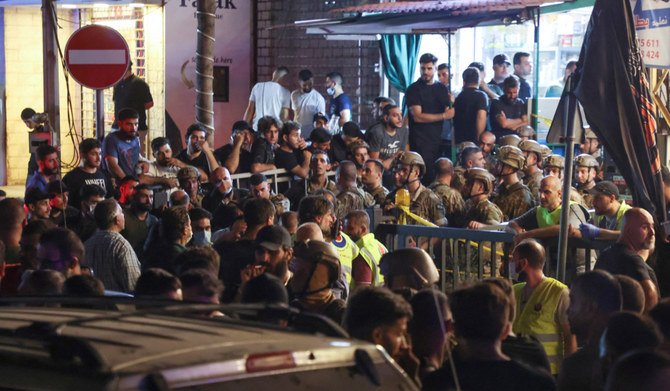
Members of the Lebanese army and people gather near a damaged site after what security sources said was a strike on Beirut's southern suburbs, Lebanon July 30, 2024. (REUTERS)
2 / 2
A man inspects a destroyed building that was hit by an Israeli airstrike in the southern suburbs of Beirut, Lebanon, Tuesday, July 30, 2024. (AP)
Short Url
Updated 31 July 2024
Follow

Who is the Hezbollah commander targeted by Israel in Beirut?

  • Two security sources in Lebanon earlier named the target as Shukr, describing him as head of Hezbollah’s operations center

BEIRUT: Fuad Shukr, a Hezbollah commander whom Israel believes it killed in an airstrike in Beirut on Tuesday, has been one of the group’s leading military figures since it was established by Iran’s Revolutionary Guards more than four decades ago.
Part of the generation of Lebanese Shiites who founded Hezbollah during the Israeli invasion of Lebanon in 1982, Shukr was a friend of the group’s late military commander Imad Mughniyeh, who was assassinated in Damascus in 2008, Hezbollah sources said.
The United States says Shukr, believed to be in his 60s, played a central role in the 1983 bombing of the US Marine barracks in Beirut, which killed 241 US military personnel, and had put a bounty of up to $5 million on his head, according to the US government’s Rewards for Justice website.
He was hit in what the Israeli army has said was a targeted strike against the Hezbollah commander responsible for an attack in the Israeli-occupied Golan Heights that killed 12 children and teenagers at the weekend. Hezbollah denied any role.
An Israel broadcast report said the commander was killed.
Two security sources in Lebanon earlier named the target as Shukr, describing him as head of Hezbollah’s operations center. They said he was critically injured in the attack around Hezbollah’s Shoura Council in the Haret Hreik neighborhood.
Also known as Al-Hajj Mohsin, Hezbollah sources said Shukr is a special adviser to Hezbollah leader Sayyed Hassan Nasrallah and a member of the Shoura Council, a decision-making body.
The sources said he became more prominent in Hezbollah after the assassination of Mughniyeh — a shadowy figure remembered in Hezbollah as a military mastermind who was on the US list of most wanted terrorists, accused of plotting attacks on Western interests including the Marines barracks.
Referring to those attacks and hostage-taking in Lebanon in the 1980s, Hezbollah leader Nasrallah said in a 2022 interview with an Arabic broadcaster they were carried out by small groups not linked to Hezbollah.
The Hezbollah sources said Shukr fought Israeli troops during Israel’s 1982 invasion alongside both Mughniyeh and Mustafa Badreddine, another of Hezbollah’s veteran commanders who was killed in Syria in 2016.
Announcing the bounty on his head in 2017, the US Rewards for Justice program said he was a senior Hezbollah military commander of the group’s forces in southern Lebanon and a member of Hezbollah’s highest military body, the Jihad Council.
It also said he played a key role in its military operations in Syria, where Hezbollah deployed fighters in support of President Bashar Assad in the early years of the Syrian civil war.
Hezbollah at the time dismissed the accusations against Shukr and another Hezbollah operative for whom a bounty was offered, Talal Hamiyah, saying they were “rejected and void.”


Sudan defense minister dismisses ‘intelligence document’ as fabrication after convoy strike

Updated 12 February 2026
Follow

Sudan defense minister dismisses ‘intelligence document’ as fabrication after convoy strike

  • Gen. Hassan Kabroun tells Arab News claims that army hid weapons in aid convoy are “completely false”

RIYADH: Sudan’s defense minister has firmly denied reports attributed to Sudanese intelligence alleging that a convoy targeted in North Kordofan was secretly transporting weapons under the cover of humanitarian aid.

Gen. Hassan Kabroun described the claims as “false” and an attempt to distract from what he called a militia crime.

The controversy erupted after news reports emerged that a document attributed to Sudan’s General Intelligence Service claimed the convoy struck in Al-Rahad on Friday was not a purely humanitarian mission, but was instead carrying “high-quality weapons and ammunition” destined for Sudanese Armed Forces units operating in the state.

The report further alleged that the convoy had been outwardly classified as humanitarian in order to secure safe passage through conflict zones, and that the Rapid Support Forces had destroyed it after gathering intelligence on its route and cargo.

Kabroun categorically rejected the narrative.

“First of all, we would like to stress the fact that this news is false,” he told Arab News. “Even the headline that talks about the security of the regions, such as Al-Dabbah, is not a headline the army would use.”

He described the document as fabricated and politically motivated, saying it was designed to “cover up the heinous crime they committed.”

The minister affirmed that the area targeted by drones is under full control of the Sudanese Armed Forces and does not require any covert military transport.

“Second, we confirm that the region that was targeted by drones is controlled by the army and very safe,” Kabroun said. “It does not require transporting any military equipment using aid convoys as decoys because it is a safe area controlled by the army, which has significant capabilities to transport humanitarian aid.”

According to the minister, the Sudanese military has both the logistical capacity and secure routes necessary to move equipment openly when needed.

“The army is professional and does not need to deliver anything to Kadugli or Dalang on board aid convoys,” he said. “The road between Dalang and Kadugli is open. The Sudanese forces used that road to enter and take control of the region. The road is open and whenever military trucks need to deliver anything, they can do so without resorting to any form of camouflage.”

Kabroun further rejected any suggestion that the military uses humanitarian operations as cover.

“Aid is transported by dedicated relief vehicles to the areas in need of this assistance,” he said. “Aid is not transported by the army. The army and security apparatus do not interfere with relief efforts at all, and do not even accompany the convoys.”

He stressed that the Sudanese Armed Forces maintains a clear institutional separation between military operations and humanitarian work, particularly amid the country’s crisis.

“These are false claims,” he said. “This fake news wanted to cover up the heinous crime they committed.”

Sudan has been gripped by conflict since April 2023, when fighting broke out between the Sudanese Armed Forces and the Rapid Support Forces, plunging the country into what the United Nations has described as one of the world’s worst humanitarian disasters.

The latest dispute over the convoy comes amid intensified fighting in South Kordofan, a strategically sensitive region linking central Sudan with the contested areas of Darfur and Blue Nile.

The false report suggested that intelligence monitoring had enabled the RSF to strike what it described as a military convoy disguised as humanitarian aid. But Kabroun dismissed that version outright.

“The intelligence agency is well aware of its duties,” he said. “The Sudanese Army has enough weapons and equipment to use in the areas of operations. These claims are completely false.”

He argued that the narrative being circulated seeks to shift blame for attacks on civilian infrastructure and humanitarian movements.

“This shows that they are trying to cover up the atrocities,” he added, referring to the militia.

Kabroun maintained that the army has regained momentum on multiple fronts and remains fully capable of sustaining its operations without resorting to deception.

“The region is secure, the roads are open, and the army does not need camouflage,” he said. “We are operating professionally and transparently.”

“These claims are completely false,” Kabroun said. “The Sudanese Army does not use humanitarian convoys for military purposes.”