Despite escalating tension between Israel and Hezbollah, it’s business as usual at Beirut airport

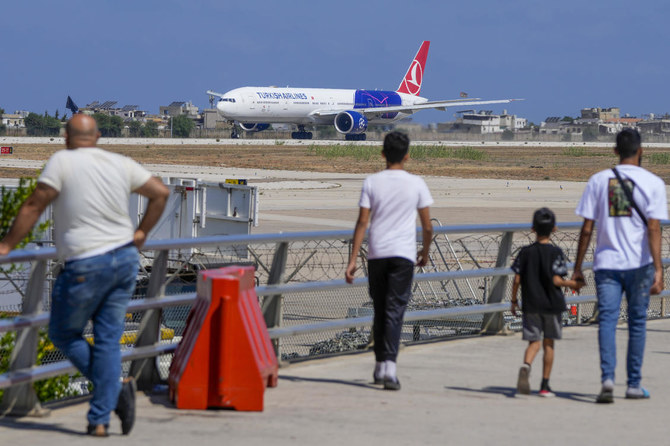
A Turkish Airlines plane takes off from Rafik Hariri International Airport in Beirut on Jul. 30, 2024. (AP)
Short Url
Updated 30 July 2024
Follow

Despite escalating tension between Israel and Hezbollah, it’s business as usual at Beirut airport

  • “As far as the threats, they didn’t influence me at all to not come to Lebanon,” Sharqawi said. “Even if there are threats, we will still come”
  • Even before the deadly incident, rhetoric and fears of a full-blown conflict had been intensifying, but it has had relatively little impact on the summer tourist season

BEIRUT: Fears of an escalation in the simmering conflict between Hezbollah and Israel have prompted some airlines to cancel flights to Lebanon, but business appeared to be proceeding as usual Tuesday at the Beirut airport, where many travelers greeted the warnings with a shrug.
Hadi Sharqawi, 24, a Lebanese student in Italy, arrived Tuesday after two days of flight cancelations, to spend a month and a half with his family as he normally does in the summer. He is from the town of Kharayeb, which is in southern Lebanon although relatively far from the border where clashes have been ongoing for 10 months.
“As far as the threats, they didn’t influence me at all to not come to Lebanon,” Sharqawi said. “Even if there are threats, we will still come.”
Seventy-one-year-old Mohammad Mokhaled, from the southern town of Jarjouh, who was waiting to pick up his daughter Tuesday, agreed.
“We are not scared of the situation, because we are used to this,” he said. “We hear airstrikes regularly and the breaking of the sound barrier, and it doesn’t affect us.”
Lebanon is bracing for a retaliatory strike from Israel after a missile hit a soccer field in the town of Majdal Shams in the Israeli-annexed Syrian Golan over the weekend, killing 12 children and adolescents. Israel accused the Lebanese militant group Hezbollah of carrying out the strike, to which Hezbollah issued a rare denial.
Even before the deadly incident, rhetoric and fears of a full-blown conflict had been intensifying, but it has had relatively little impact on the summer tourist season, during which tens of thousands of Lebanese working or studying abroad typically come to visit their families, filling up restaurants and beach clubs.
Israel and the Lebanese militant group have traded near-daily strikes since the war in Gaza erupted on Oct.7 following Hamas’ surprise attack on southern Israel.
The Beirut airport reported that 406,396 passengers arrived in June compared to 427,854 arrivals in the same period in 2023, a decrease of 5 percent. It also recorded 300,362 departed the country in June, compared to 280,366, an increase of 7 percent.
Amal Ahmadieh, 23, was leaving Tuesday to return to Qatar, where she works in a restaurant, after a vacation in Lebanon. Ahmadieh said she was leaving as originally scheduled and had not pushed up her flight due to security concerns.
“Honestly everyone was telling me that the situation was not good but I wanted to come to see my friends and my family,” she said. “Whatever happens, at the end of the day, this is my country.”
Some European airlines have canceled flights in light of the increased tensions. Frankfurt-based Lufthansa Group said Monday that three of its airlines — Lufthansa, Swiss and Eurowings — decided to suspend flights to and from Beirut “up to and including” August 5. Air France also suspended some of its flights, while other airlines changed their flight schedules.
Lebanon’s Middle East Airlines delayed some flights to arrive Tuesday morning instead of at night, the carrier said, “due to technical reasons related to the distribution of insurance risks.”
MEA chief Mohamad El-Hout, however, downplayed fears. Following a meeting Tuesday with caretaker Prime Minister Najib Mikati, the state-run National News Agency said Hout had “denied that Rafik Hariri Airport had received any threats or information from any source that the airport would be attacked.”
He pointed out that Lufthansa Group had also canceled flights to Lebanon in the early months of the war in Gaza and border conflict in Lebanon, “and nothing happened then.”
What happened in Majdal Shams has kicked off a flurry of diplomatic efforts to prevent the situation from spiraling.
A Western diplomat whose country is involved in those efforts said that he anticipates Israel will keep its retaliation within boundaries that would not lead to an all-out war — similar to the exchange of strikes between Iran and Israel after Israel struck an Iranian consular building in Syria. He spoke on condition of anonymity because he was not authorized to speak publicly on the matter.
“It’s clear that they (Israel) want to take a stance but without leading to a generalized conflict,” he said. “It’s sure that there will be a retaliation. It will be symbolic. It may be spectacular, but it will not be a reason for both parties to engage in a general escalation.”


Israel plans large camp for Palestinians in southern Gaza, retired general says

Updated 7 sec ago
Follow

Israel plans large camp for Palestinians in southern Gaza, retired general says

  • Avivi said the camp would be used to house Palestinians who wish to leave Gaza and cross into Egypt as well as those who wish to stay

JERUSALEM, Jan 27 : Israel has cleared land in southern Gaza for the construction of a camp for Palestinians potentially equipped with surveillance and facial recognition technology at its entrance, a retired Israeli general who advises the military said on Tuesday.
Retired reservist Brig.-General Amir Avivi told Reuters in ​an interview that the camp would be built in an area of Rafah cleared of tunnels built by Hamas, with entry and exit tracked by Israeli personnel.
Avivi is founder of the influential Israel Defense and Security Forum, a group representing thousands of Israeli military reservists. He does not speak on behalf of Israel’s military, which declined to comment. The Israeli prime minister’s office did not immediately provide comment on any plans to build a camp in Rafah.
Avivi said the camp would be used to house Palestinians who wish to leave Gaza and cross into Egypt as well as those who wish to stay.
His comments come as Israel prepares for a “limited reopening” of Gaza’s Rafah border crossing with Egypt, a key requirement under US President Donald Trump’s plan to end the Gaza war.
Sources told Reuters this month that Israel wants to ensure more Palestinians leave ‌Gaza than are allowed ‌in. Israeli officials have spoken in the past about encouraging Gazans to emigrate, though they deny ‌intending ⁠to ​transfer the ‌population out by force — a highly sensitive issue for Palestinians.
“There are no Gazans, almost at all, in Rafah,” Avivi said. The area fell under complete Israeli military control following an October Israel-Hamas ceasefire, and most Palestinians fled for areas held by Hamas.
“You need to build infrastructure in Rafah that can host them, and then they can choose if they want to go or not,” Avivi said. He said the structure would likely be “a big, organized camp” capable of hosting hundreds of thousands of people that could enforce ID checks including facial recognition.
In July, Israel’s Defense Minister Israel Katz told Israeli media that he had ordered troops to prepare a camp in Rafah to house Gaza’s population. Officials have not spoken publicly about such plans since then.
Ismail Al-Thawabta, head ⁠of the Hamas-run Gaza government media office, told Reuters in a statement that the idea amounted to cover for “forced displacement.”

POTENTIAL RETURN TO WAR
Palestinians in Gaza, shattered by two years of Israeli attacks ‌in the enclave, have long faced restrictions on their movement and monitoring of their ‍online activity and phone calls by Israeli surveillance agencies.
Nearly all of Gaza’s ‍2 million people have been forced into a narrow coastal strip from which Israeli forces withdrew under the ceasefire and where Hamas ‍has retained control.
Trump’s plan for Gaza, now in its second phase, calls for Gaza’s reconstruction to start in Rafah and for Hamas to lay down its arms in exchange for further Israeli troop withdrawals from the territory.
Avivi said Israel’s military was preparing for a new offensive against Hamas if it refuses to give up its weapons. This could include relaunching attacks on Gaza City, the enclave’s largest.
The camp in Gaza could be used to house Palestinians fleeing a renewed Israeli ​assault, Avivi said.
“Plans are set. The army is ready to get the command from the government, from the cabinet to renew its maneuvers in Gaza,” Avivi said.
Israel’s military says it has continued to carry out operations in Gaza since ⁠the ceasefire to thwart what it describes as planned attacks by militants and destroy Hamas’ tunnel network under Gaza.
Israeli attacks since the ceasefire have killed more than 480 Palestinians in Gaza, health authorities there say, while the military says four soldiers have been killed in militant attacks.
Avi Dichter, a minister in Israeli Prime Minister Benjamin Netanyahu’s cabinet and former head of Israel’s domestic intelligence service, said disputes over disarmament could lead Israel back into war in Gaza.
“We have to get prepared for the war in Gaza,” Dichter told Reuters, adding that the disarmament issue “will have to be solved by Israeli troops, the hard way.”

DEMILITARIZATION GOAL
Hamas has publicly refused to lay down its weapons. Two Hamas officials told Reuters this week that neither Washington nor the mediators had presented the group with any detailed or concrete disarmament proposal.
According to a document shared by the White House last week, the Trump administration wants to see heavy weapons decommissioned immediately, with “personal arms registered and decommissioned by sector” as the police under an interim technocratic administration in Gaza “become capable of guaranteeing personal security.”
Trump has repeatedly warned Hamas that it would have “hell to pay” if it does not lay down its weapons.
A US official said on Tuesday that disarmament ‌could come along with some sort of amnesty for Hamas members.
Speaking to Israel’s parliament on Monday night, Netanyahu said the next phase of the ceasefire would not include reconstruction of Gaza.
“The next phase is demilitarization of the Strip and disarming Hamas,” Netanyahu said.