

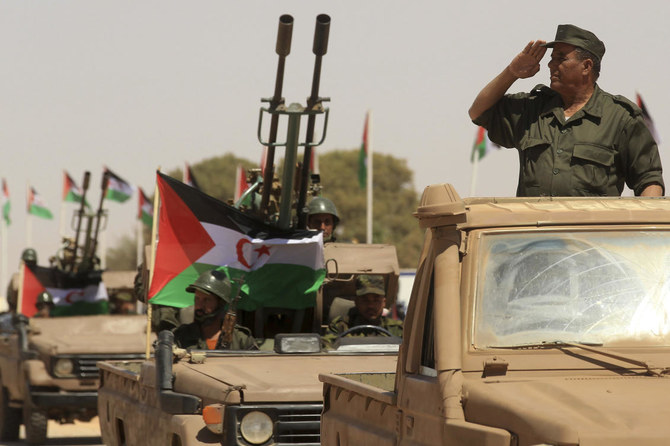

RABAT, Morocco: France has thrown its support behind Morocco’s autonomy plan for the disputed Western Sahara, shifting a decades-old position and adding itself to a growing list of countries to align with Morocco as a United Nations-mediated peace process remains stalled.
In a letter to King Mohammed VI, France’s President Emmanuel Macron called the plan that Morocco proposed in 2007 to offer the region limited autonomy under its sovereignty the “only basis” to solve the conflict. The shift deals a blow to the pro-independence Polisario Front, which has for decades claimed to be the legitimate representative of the indigenous Sahrawi people.
“The present and future of Western Sahara fall within the framework of Moroccan sovereignty,” Macron wrote in a letter made public on Tuesday. “France intends to act consistently with this position at both national and international level.”
Macron’s move is unlikely to change the key tenets of the territorial dispute but could deepen France ties with Morocco, which has long blamed it for drawing the colonial borders it sees as the root of the conflict. France signaled earlier this year that it was open to investing in Moroccan projects in the disputed territory.
The move could strain diplomatic relations in North Africa, further alienating both France and Morocco from Algeria, which supports the Polisario Front’s claims and allows it to operate as a self-declared government in exile from refugee camps within its borders.
It follows similar shifts from the United States, Israel, Spain and a growing list of African nations that have established consulates in the territory.
In a statement, Moroccan King Mohammed VI’s Royal Cabinet called France’s shift “a significant development.” A high-ranking Moroccan official who spoke on the condition of anonymity noted France’s role as a permanent member of the United Nations Security Council and called it “a game-changer” amid an international shift toward Morocco’s position.
The move was preemptively rebuked by both Algeria and the Polisario Front in the days leading up to the publication of letter, which Algeria said it was made aware of by France in the days prior.
The Polisario’s Mohamed Sidati accused France of acting at odds with international law and backing Moroccan expansionism as its influence wanes throughout Africa.
“Whatever hardships Morocco tries to impose on us with the support of France, the Sahrawi people will continue to stubbornly defend their rights until they obtain the definitive departure of the Moroccan aggressor from their territory and general recognition of the legitimacy of their struggle for self-determination and independence,” Sidati, the Foreign Minister of the self-declared Sahrawi Arab Democratic Republic, said in a statement on Monday.
Algeria called Morocco and France “colonial powers, new and old” and announced it would withdraw its ambassador from Paris.
“The French decision is clearly the result of a dubious political calculation, a morally questionable judgment and legal interpretations that are neither supported nor justified,” Algeria’s Ministry of Foreign Affairs said in a statement last week.
Western Sahara is roughly the size of Colorado, encompassing a stretch of desert rich in phosphates and sitting along an Atlantic coastline rich in fish. Morocco annexed the former Spanish colony in 1975, sparking a regional conflict and putting it at odds with the pro-independence Polisario Front over the region that the United Nations considers a “non-self-governing territory.”
Morocco quickly moved to occupy the majority of the land, fighting off guerilla warfare from the Polisario until the UN brokered a 1991 ceasefire and established a peacekeeping mission to monitor the truce and help prepare a referendum on the territory’s future. Disagreements over who is eligible to vote prevented the referendum from taking place.
Morocco has long sought political recognition of its claim from its other nations, while the Polisario has prioritized fighting legal battles to assert the people of the region’s right to self-determination.
Sporadic violence has ensued since the Polisario renewed armed conflict in 2020, ending a 29-year truce. Morocco has since embarked on expansive economic development efforts, constructing ports, highways and hotels.


