

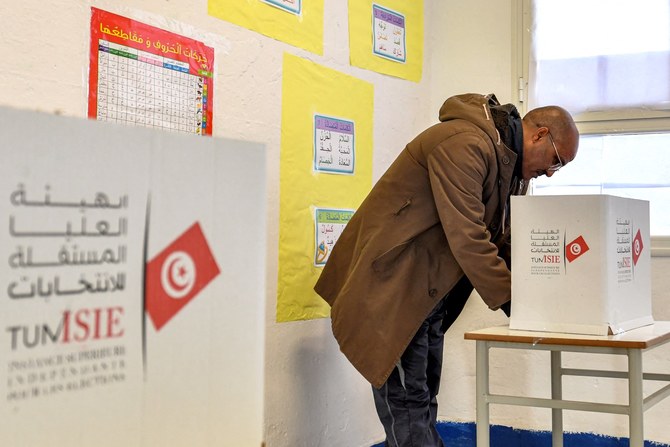

TUNIS: Tunisia has kicked off candidacy submissions for its upcoming presidential election on October 6, amid what experts say are significant constraints on hopefuls challenging incumbent President Kais Saied.
A number of conditions and requirements to run for office have changed under Saied, 66, who was democratically elected in 2019 but orchestrated a sweeping power grab in 2021.
To qualify to appear on the ballot, candidates are required to gather “an enormous number” of signatures, said Amine Kharrat, a political analyst at independent observatory Al Bawsala.
“The conditions have been hardened,” Isabelle Werenfels, North Africa expert at the German Institute for International and Security Affairs, told AFP.
Not to mention, a number of would-be candidates will not be able to even obtain the initial candidacy form because they are in prison.
Among them are Issam Chebbi, leader of centrist party Al Joumhouri, and Ghazi Chaouchi, head of the social-democrat party Democratic Current.
Detained for “plotting against the state,” the two politicians are among over 20 of Saied’s opponents held since a flurry of arrests in February 2023.
Abir Moussi, a vocal critic of Saied and head of the Free Destourian Party, has also been detained on similar charges since October last year.
Amnesty International labelled the arrests a “politically motivated witch hunt.”
An expert speaking on condition of anonymity told AFP “everything has been set up to push aside credible candidates who can represent a real danger” for Saied.
Candidates vs. Saied’s rule
In 2022, Saied led a revision of the constitution, concentrating executive power firmly in the presidency’s hands and reversing hard-won rights in the birthplace of the Arab Spring uprisings.
Kharrat said many factors are “reducing the credibility” of the upcoming election, referring to the candidacy criteria, the delayed announcement of the election day, and a 2022 law punishing “spreading false news.”
The law, Decree 54, has been used to prosecute more than 60 journalists, lawyers and opposition figures, according to the National Syndicate of Tunisian Journalists (SNJT).
Amnesty International Secretary General Agnes Callamard said last week that since Saied’s power grab, “violations that we thought part of Tunisia’s past are becoming more and more discernible and systematic.”
“Instead of the vibrant debates of a pluralist political scene, I observed government repression, fueling fear and dread about what’s to come.”
Yet many still aspire to submit their candidacies.
Key would-be candidates include Kamel Akrout, a retired military admiral, and Mondher Zenaidi, 74, a former minister who has presented his experience as an asset for debt-stricken Tunisia.
Last week, K2 Rhym, a famous 43-year-old Tunisian rapper, also announced his intention to run.
The country is meanwhile still grappling with an economic crisis that has seen many Tunisians join mostly sub-Saharan African migrants seeking to cross the Mediterranean to Europe.
If Akrout or Zenaidi are pushed out of the race, it would be a referendum on Saied’s rule, said the anonymous expert.
The expert added that the vote “will define the nature of the (next) regime.”
“If Saied wins by a wide margin in the first round, he will become even more authoritarian. Otherwise, he will be more inclined to compromise.”
“Much will depend on the opposition and its ability to unite behind an alternative candidate to Saied,” said Werenfels.
“If one or more candidates get 15 or 20 percent of the vote, there will be a second round.”
Left-wing movements and Ennahdha, the Islamist-inspired party that had dominated Tunisian politics following the 2011 uprising, still hesitate to boycott the election, seeing it as “an opportunity to challenge Kais Saied,” said Kharrat.
It remains difficult to measure support for Saied or any other hopeful prior to the vote, amid a ban on political polls.
While Saied’s popularity among working-class Tunisians endures, experts believe he is far below the 72 percent he secured in the 2019 vote.
Recent rallies in support of Saied have seen low turnout.
I Watch, a Tunisian watchdog, said last week in a report that Saied had “failed to keep 87.5 percent of his electoral promises” over the past five years.
But Saied has stepped up his campaign, declaring that he was driven by “a sacred duty toward the homeland” when announcing his intention to seek a second term.
In the past few weeks, he has multiplied his famed surprise visits, addressing issues such as pollution and water cuts, all while blaming “conspirators” and “traitors” working under “foreign influence.”


