

In Afghanistan, Taliban ban on girls’ education leaves thousands of classrooms empty

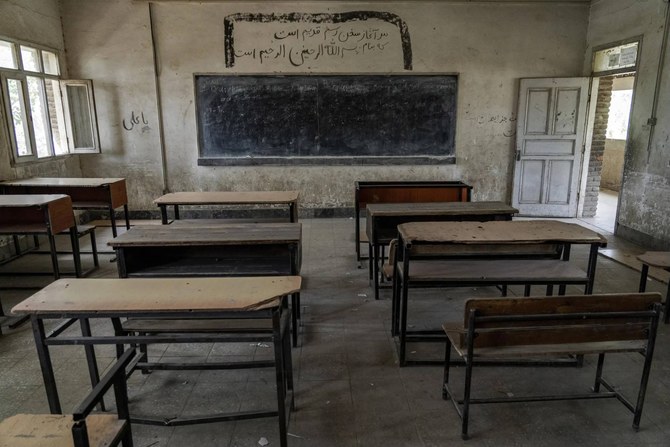
This file photo shows an empty classroom of a school in Kabul, Afghanistan on July 31, 2022. (AP Photo)
Short Url
Updated 28 July 2024
Follow

In Afghanistan, Taliban ban on girls’ education leaves thousands of classrooms empty

  • About 1.1 million girls denied access to formal education since Taliban ban in 2021
  • Afghanistan had about 4,000 secondary and high schools for girls

KABUL: Before the Taliban suspended secondary education for girls, some of Salma’s friends had attended her school in Kabul with their older sisters. But after the ban was imposed almost three years ago, they stopped going to classes altogether.

“They didn’t want to come alone. It’s sad to lose my friends,” Salma, who is now in the fifth grade, told Arab News.

She also recalled visiting the classrooms for older girls, located on the second floor, with her friends back then — something she no longer does because the level has been empty since the ban. It reminded the 12-year-old of the future that lies ahead for her.

“It’s even more upsetting to think that we will not be able to come to our school after two years. We will graduate after grade six and then there will be no future for us after that,” she said.

Since September 2021 — a month after the Taliban took control of Afghanistan — girls have been prohibited from attending secondary school, resulting in about 1.1 million girls being denied access to formal education and leaving thousands of classrooms and buildings empty.

“Girls’ schools are active only up to the sixth grade. The rest of the classes — seventh through 12th grades — are … not being used,” an official from the Afghan Ministry of Education told Arab News. “The remaining buildings are non-functional.”

Afghanistan officially recognized about 20,000 schools as of August 2022, of which only about half had functional buildings and about 5,000 were damaged after the war, data from the education ministry showed. Meanwhile, according to official estimates, there were about 4,000 secondary and high schools for girls in the country before the education ban was put in place.

With classrooms and buildings that once housed the older girls now empty, they could instead be used to accommodate more girls in lower grades, said Najla Ahmadzai, a public school teacher in Kabul.

“Previously, we didn’t have sufficient space to admit more girl students. We had very low admission rates. Now that we have more space, we can admit more girls, especially in grades one to three,” she told Arab News, adding that the unused spaces can bring about “positive change.”

But even then, the empty classrooms previously used by girls in higher grades “makes my heart ache,” she said.

“It’s painful and unbelievable for me as a teacher and as a mother. I think about my own daughters but also about the daughters of the country. They have the right to get an education and deserve to be a part of society.”

The abandoned buildings are painful reminders of what was taken from girls like Bibi Laila, who, at 16, is among those who are not allowed to attend school.

“Instead of using the buildings to educate girls, especially older girls, they are just empty and turning into scary spaces because no one has gone there for the past three years,” Laila said.

“We have schools, we have buildings, we have teachers, books and everything. We can go to school starting tomorrow. But the (Taliban) policy is stopping me and thousands of other girls from becoming educated and achieving our dreams and hopes.”

Neither appeals at home nor international pressure on the Taliban administration have helped to lift the ban, which authorities have repeatedly said was an “internal matter.” The ban was later extended to universities also, with more than 100,000 female students blocked from completing their degrees.

“If we don’t go back to school we are becoming illiterate,” Laila said. “We are very sad but we can’t do anything. I think people in the country and the world are forgetting us.”


Progress for Ukraine talks in Paris uncertain with US focus shifting to Venezuela

Updated 5 sec ago
Follow

Progress for Ukraine talks in Paris uncertain with US focus shifting to Venezuela

  • Ukraine’s allies are meeting in Paris to discuss security guarantees after a potential ceasefire with Russia. The Trump administration’s focus on Venezuela could complicate progress
  • France and the UK lead efforts to strengthen post-ceasefire defenses for Ukraine, possibly with European forces

PARIS: Ukraine’s allies are meeting Tuesday in Paris for key talks that could help determine the country’s security after a potential ceasefire with Russia. But prospects for progress are uncertain with the Trump administration’s focus shifting to Venezuela.
Before the US capture of Venezuelan leader Nicolás Maduro, French President Emmanuel Macron had expressed optimism about the latest gathering of so-called “coalition of the willing” nations. For months, they have been exploring how to deter any future Russian aggression should it agree to stop fighting Ukraine.
In a Dec. 31 address, Macron said that allies would “make concrete commitments” at the summit “to protect Ukraine and ensure a just and lasting peace.”
Macron’s office said Tuesday’s meeting will gather an unprecedented number of officials attending in person, with 35 participants including 27 heads of state and government. The US will be represented by President Donald Trump’s envoys, Steve Witkoff and Jared Kushner.
Macron’s office said the US delegation was initially set to be led by Secretary of State Marco Rubio, who changed his plans for reasons related to the military intervention in Venezuela.
Participants seek concrete outcomes on five key priorities once fighting ends: ways to monitor a ceasefire; support for Ukraine’s armed forces; deployment of a multinational force on land, at sea and in the air; commitments in case there’s another Russian aggression; and long-term defense cooperation with Ukraine.
But whether that’s still achievable Tuesday isn’t so clear now, as Trump deals with the aftermath of his decision to effect leadership change in Venezuela.
Ukraine seeks firm guarantees from Washington of military and other support seen as crucial to securing similar commitments from other allies. Kyiv has been wary of any ceasefire that it fears could provide time for Russia to regroup and attack again.
Recent progress in talks
Before the US military operation targeting Maduro, Witkoff had indicated progress in talks about protecting and reassuring Ukraine.
In a Dec. 31 post, Witkoff tweeted that “productive” discussions with him, Rubio, and Kushner on the US side and, on the other, national security advisers of Britain, France, Germany and Ukraine had focused on “strengthening security guarantees and developing effective deconfliction mechanisms to help end the war and ensure it does not restart.”
France, which with the United Kingdom has coordinated the monthslong, multination effort to shore up a ceasefire, has only given broad-brush details about the plan’s scope. It says Ukraine’s first line of defense against a Russian resumption of war would be the Ukrainian military and that the coalition intends to strengthen it with training, weaponry and other support.
Macron has also spoken of European forces potentially being deployed away from Ukraine’s front lines to help deter future Russian aggression.
Important details unfinalized
Ukraine’s President Volodymyr Zelensky said during the weekend that potential European troop deployments still face hurdles, important details remain unfinalized, and “not everyone is ready” to commit forces.
He noted that many countries would need approval from parliament even if leaders agreed to military support for Ukraine. But he recognized that support could come in forms other than troops, such as “through weapons, technologies and intelligence.”
Zelensky said that post-ceasefire deployments in Ukraine by Britain and France, Western Europe’s only nuclear-armed nations, would be “essential” because some other coalition members ”cannot provide military assistance in the form of troops, but they do provide support through sanctions, financial assistance, humanitarian aid and so on.”
“Speaking frankly as president, even the very existence of the coalition depends on whether certain countries are ready to step up their presence,” Zelensky said. “If they are not ready at all, then it is not really a ‘coalition of the willing.’”