

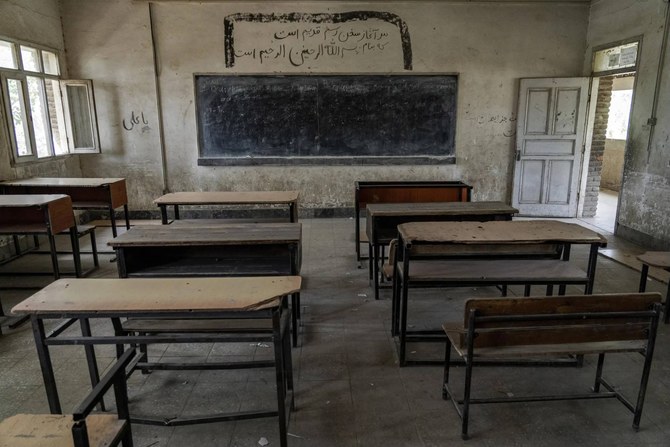

KABUL: Before the Taliban suspended secondary education for girls, some of Salma’s friends had attended her school in Kabul with their older sisters. But after the ban was imposed almost three years ago, they stopped going to classes altogether.
“They didn’t want to come alone. It’s sad to lose my friends,” Salma, who is now in the fifth grade, told Arab News.
She also recalled visiting the classrooms for older girls, located on the second floor, with her friends back then — something she no longer does because the level has been empty since the ban. It reminded the 12-year-old of the future that lies ahead for her.
“It’s even more upsetting to think that we will not be able to come to our school after two years. We will graduate after grade six and then there will be no future for us after that,” she said.
Since September 2021 — a month after the Taliban took control of Afghanistan — girls have been prohibited from attending secondary school, resulting in about 1.1 million girls being denied access to formal education and leaving thousands of classrooms and buildings empty.
“Girls’ schools are active only up to the sixth grade. The rest of the classes — seventh through 12th grades — are … not being used,” an official from the Afghan Ministry of Education told Arab News. “The remaining buildings are non-functional.”
Afghanistan officially recognized about 20,000 schools as of August 2022, of which only about half had functional buildings and about 5,000 were damaged after the war, data from the education ministry showed. Meanwhile, according to official estimates, there were about 4,000 secondary and high schools for girls in the country before the education ban was put in place.
With classrooms and buildings that once housed the older girls now empty, they could instead be used to accommodate more girls in lower grades, said Najla Ahmadzai, a public school teacher in Kabul.
“Previously, we didn’t have sufficient space to admit more girl students. We had very low admission rates. Now that we have more space, we can admit more girls, especially in grades one to three,” she told Arab News, adding that the unused spaces can bring about “positive change.”
But even then, the empty classrooms previously used by girls in higher grades “makes my heart ache,” she said.
“It’s painful and unbelievable for me as a teacher and as a mother. I think about my own daughters but also about the daughters of the country. They have the right to get an education and deserve to be a part of society.”
The abandoned buildings are painful reminders of what was taken from girls like Bibi Laila, who, at 16, is among those who are not allowed to attend school.
“Instead of using the buildings to educate girls, especially older girls, they are just empty and turning into scary spaces because no one has gone there for the past three years,” Laila said.
“We have schools, we have buildings, we have teachers, books and everything. We can go to school starting tomorrow. But the (Taliban) policy is stopping me and thousands of other girls from becoming educated and achieving our dreams and hopes.”
Neither appeals at home nor international pressure on the Taliban administration have helped to lift the ban, which authorities have repeatedly said was an “internal matter.” The ban was later extended to universities also, with more than 100,000 female students blocked from completing their degrees.
“If we don’t go back to school we are becoming illiterate,” Laila said. “We are very sad but we can’t do anything. I think people in the country and the world are forgetting us.”


