US-Japan security talks focus on bolstering military cooperation amid rising China threat

1 / 2
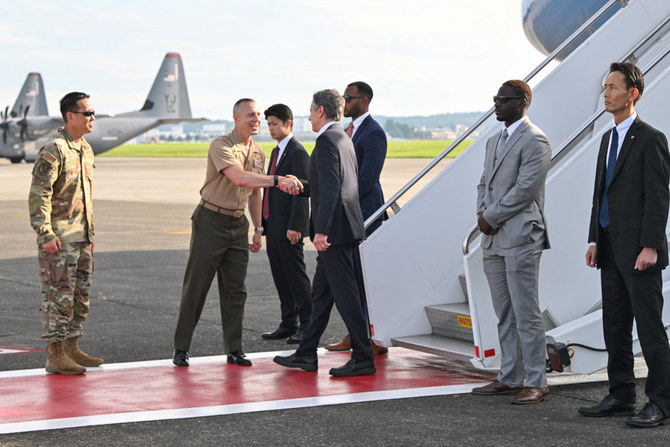
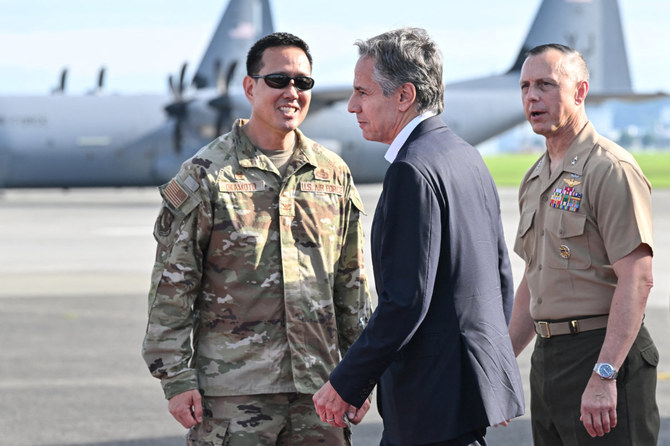
US Secretary of State Antony Blinken (C) is welcomed upon arrival at Yokota Air Base in Fussa, western Tokyo, on July 28, 2024, for a two-day visit. (Pool via REUTERS)
2 / 2
US Secretary of State Antony Blinken (C) is welcomed upon arrival at Yokota Air Base in Fussa, western Tokyo, on July 28, 2024, for a two-day visit. (Pool via REUTERS)
Short Url
Updated 28 July 2024
Follow

US-Japan security talks focus on bolstering military cooperation amid rising China threat

  • Talks include deploying atomic weapons amid growing nuclear threats from Russia and China
  • Japan has been accelerating its military buildup and has increased joint operations with the US, as well as with South Korea

TOKYO: Japanese and US defense chiefs and top diplomats will meet in Tokyo on Sunday for talks aimed at further bolstering their military cooperation, including by upgrading the command and control of US forces and strengthening American-licensed missile production in Japan, amid a rising threat from China.
Secretary of State Antony Blinken and Defense Secretary Lloyd Austin will join their Japanese counterparts, Yoko Kamikawa and Minoru Kihara, at the Japan-US Security Consultative Committee, known as “2+2” security talks, to reaffirm their alliance following President Joe Biden ‘s withdrawal from the November presidential race.
For the first time, the ministers will hold separate talks to reaffirm the US commitment to “extended deterrence,” which includes atomic weapons — a shift from Japan’s earlier reluctance to openly discuss the sensitive issue in the world’s only country to have suffered nuclear attacks — amid growing nuclear threats from Russia and China.
The ministers are expected to discuss plans to upgrade command and control structures for US forces in Japan by bringing in higher-ranked officers with commanding authority to create a US counterpart for Japan’s unified command currently set for inauguration in March.
Japan is home to more than 50,000 US troops, but a commander for the US Forces Japan headquartered in Yokota in the western suburbs of Tokyo, tasked with managing their bases, has no commanding authority. Instead that comes from the Indo-Pacific Command in Hawaii. The plan to upgrade USFJ’s command and control capability is designed to help smooth joint exercises and operations, officials say.
Ahead of the 2+2 talks, Kihara was to meet with South Korean Defense Minister Shin Won-sik in their first bilateral defense ministerial talks in Japan in 15 years. Austin will later join them for three-way talks.
Japan has been accelerating its military buildup and has increased joint operations with the US, as well as with South Korea, while trying to strengthen its largely domestic defense industry.
Japan has significantly eased its arms export restrictions and in December accommodated a US request for shipment of surface-to-air PAC-3 missile interceptors produced in Japan under an American license to replenish US inventories, which have decreased due to its support for Ukraine.
The ministers are also expected to discuss increased Japanese production of PAC-3 interceptors for export to the United States.
Japan and the US have been accelerating arms industry cooperation following an April agreement between Japanese Prime Minister Fumio Kishida and Biden. The two sides have set up working groups for missile co-production and for the maintenance and repair of US Navy ships and Air Force aircraft in the region.
While Japan’s role is largely designed to help US weapons supply and keep its deterrence credible in the Indo-Pacific amid continuing conflicts in the Middle East and Ukraine, Japanese officials say it will help strengthen the Japanese defense industry.


Thousands in Kosovo march against war crimes trials on 18th anniversary of independence declaration

Updated 42 min 14 sec ago
Follow

Thousands in Kosovo march against war crimes trials on 18th anniversary of independence declaration

  • Protesters, many wrapped in red and black Albanian flags, braved cold and snowy weather in the capital, Pristina, to voice their opposition to the proceedings in The Hague
  • PM Albin Kurti added that ‘the KLA-led war was pure, liberation (struggle) and an anti-colonial war ... a just struggle of an occupied and oppressed people under apartheid’

PRISTINA, Kosovo: An air of defiance marked Kosovo’s independence celebrations on Tuesday as thousands of people joined a march in support of former fighters who are facing trial at a Netherlands-based court for alleged war crimes during a 1998-1999 separatist war from Serbia.
Protesters, many wrapped in red and black Albanian flags, braved cold and snowy weather in the capital, Pristina, to voice their opposition to the proceedings in The Hague against former president and rebel leader Hashim Thaci and three others accused of atrocities during and after the conflict that killed some 13,000 people.
Earlier on Tuesday, Kosovo’s security forces paraded in Pristina as part of the independence ceremonies, and Parliament held a special session.
The war started in 1998 when the rebel Kosovo Liberation Army launched its struggle for independence and Serbia responded with a brutal crackdown. The war ended after NATO bombed Serbia for 78 days in 1999, eventually forcing it to pull out its troops from the territory.
Serbia still does not recognize the 2008 declaration of independence of Kosovo and this has been a source of persistent tension in the volatile Balkan region. As both Kosovo and Serbia seek European Union membership, they have been told they must normalize ties before joining.
Prosecutors at the Kosovo Specialist Chambers in The Hague — which formally is part of Kosovo’s judicial system although seated abroad — have asked for a maximum 45-year prison sentence for Thaci and the other defendants. Thaci also faces a separate trial on charges of intimidating witnesses that will begin later this month.
Officials and protesters in Kosovo have criticized the proceedings as political and designed to strike a false balance with Serbia whose political and military leaders previously had been tried and convicted of war crimes in Kosovo by a separate UN court.
Protesters at Tuesday’s march held banners reading “History cannot be rewritten” and “Freedom for the liberators.” They arranged metal fences around a landmark independence monument and placed a sign reading ”Kosovo in Prison” on top of it.
President Vjosa Osmani said in a statement that “truth cannot be changed by attempts to rewrite history or to tarnish and devalue the struggle of Kosovo’s people for freedom.”
Prime Minister Albin Kurti added that “the KLA-led war was pure, liberation (struggle) and an anti-colonial war ... a just struggle of an occupied and oppressed people under apartheid.”
In Belgrade, a Serbian government liaison office for Kosovo described the independence declaration 18 years ago as a “flagrant violation of international law.” The statement alleged “systematic terror” and persecution against minority Serbs in Kosovo.
The United States and most EU countries are among more than 100 nations that have recognized Kosovo’s independence while Russia and China have backed Serbia’s claim on the territory.
Thaci resigned from office in 2020 to defend himself against the 10 charges of crimes against humanity and war crimes.
The court and an associated prosecutor’s office were created after a 2011 report by the Council of Europe, a human rights body, following allegations that KLA fighters trafficked human organs taken from prisoners and killed Serbs and fellow ethnic Albanians. The organ harvesting allegations haven’t been included in indictments issued by the court.