

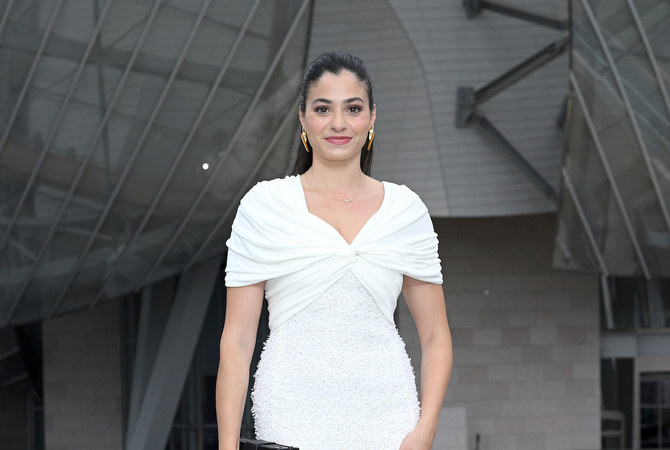
Yusra Mardini champions Refugee Olympic Team in Paris

Yusra Mardini attended the Olympics Games to champion the Refugee Olympic Team. Getty Images
Short Url
Updated 28 July 2024
Follow

Yusra Mardini champions Refugee Olympic Team in Paris

DUBAI: Syrian Olympic swimmer Yusra Mardini will champion the Refugee Olympic Team at the Olympic Games in Paris this week.

She took to Instagram to post a message encouraging support for the team.

In a video shared with her 804,000 followers, Mardini said: “I am here to introduce you to a very special team that have fought harder and traveled further to be here tonight. They are the Refugee Olympic Team.


“Please support them with all your hearts, and when you see them, show your support by sharing your heart with them.”

The Olympian also gave fans a behind-the-scenes glimpse of her career highlights. One snap shows her posing next to a sign reading “Brazil,” with the caption: “Where it all started eight years ago,” a nod to her participation in the 2016 Rio Olympics.

On Wednesday, Mardini carried the Olympic flame while representing the Refugee Olympic Team.


The Olympic torch tradition dates back to the 1936 Berlin Olympics when Carl Diem, secretary-general of the Olympic organizing committee, proposed the idea of a relay carrying the symbol from the founding site of the ancient Olympics to the Games.

Yusra and her sister Sarah’s journey from Syrian war refugees to Olympic athletes has been chronicled in the BAFTA-nominated film “The Swimmers.”


The sisters fled their war-torn home in 2015, making a perilous journey to Europe that included swimming for three hours to push a sinking boat to safety. Settling in Germany, Yusra resumed her training and joined the Refugee Olympic Team, competing in the 2016 Rio Olympics and 2020 Tokyo Olympics.

She is also a UNHCR Goodwill Ambassador, and focuses on her Yusra Mardini Foundation, which facilitates education and sports opportunities for refugees.


Art Cairo spotlights pioneering artist Inji Efflatoun

Updated 23 January 2026
Follow

Art Cairo spotlights pioneering artist Inji Efflatoun

CAIRO: Art Cairo 2026 returned to Egypt’s bustling capital from Jan. 23-26, with visitors treated to gallery offerings from across the Middle East as well as a solo museum exhibition dedicated to pioneering Egyptian artist Inji Efflatoun.

While gallery booths hailed from across the Arab world, guests also had the chance to explore the oeuvre of the politically charged artist, who died in 1989.

Many of the pieces in the 14-work exhibition were drawn from the collection of the Egyptian Museum of Modern Art and cover four main periods of the artist’s work, including her Harvest, Motherhood, Prison and Knoll series.

While gallery booths hailed from across the Arab world, guests also had the chance to explore the oeuvre of the politically charged artist, who died in 1989. (Supplied)

Efflatoun was a pivotal figure in modern Egyptian art and is as well known for her work as her Marxist and feminist activism.

“This is the third year there is this collaboration between Art Cairo and the Ministry of Culture,” Noor Al-Askar, director of Art Cairo, told Arab News.

“This year we said Inji because (she) has a lot of work.”

Born in 1924 to an affluent, Ottoman-descended family in Cairo, Efflatoun rebelled against her background and took part heavily in communist organizations, with her artwork reflecting her abhorrence of social inequalities and her anti-colonial sentiments.

Many of the pieces in the 14-work exhibition were drawn from the collection of the Egyptian Museum of Modern Art and cover four main periods of the artist’s work, including her Harvest, Motherhood, Prison and Knoll series. (Supplied)

One untitled work on show is a barbed statement on social inequalities and motherhood, featuring a shrouded mother crouched low on the ground, working as she hugs and seemingly protects two infants between her legs.

The artist was a member of the influential Art et Liberte movement, a group of staunchly anti-imperialist artists and thinkers.

In 1959, Efflatoun was imprisoned under Gamal Abdel Nasser, the second president of Egypt. The artist served her sentence for four years across a number of women’s prisons in the deserts near Cairo — it was a period that heavily impacted her art, leading to her post-release “White Light” period, marked dynamic compositions and vibrant tones.

Grouped together, four of the exhibited works take inspiration from her time in prison, with powerful images of women stacked above each other in cell bunkbeds, with feminine bare legs at sharp odds with their surroundings.

Art Cairo 2026 returned to Egypt’s bustling capital from Jan. 23-26. (Supplied)

The bars of the prison cells obstruct the onlooker’s view, with harsh vertical bars juxtaposed against the monochrome stripes of the prison garb in some of her works on show.

“Modern art, Egyptian modern art, most people, they really don’t know it very well,” Al-Askar said, adding that there has been a recent uptick in interest across the Middle East, in the wake of a book on the artist by UAE art patron Sultan Sooud Al-Qassemi.

“So, without any reason, all the lights are now on Inji,” Al-Askar added.

Although it was not all-encompassing, Art Cairo’s spotlight on Efflatoun served as a powerful starting point for guests wishing to explore her artistic journey.