

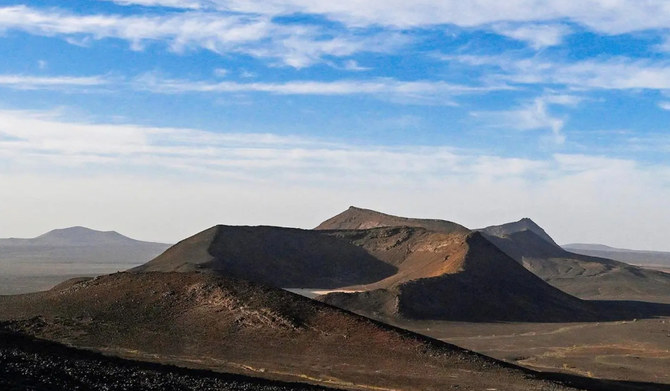
Saudi Arabia’s fire forts, lava fields reflect features of the past

The black lava fields are stone volcanic structures that have transformed into natural oasis museums due to weathering. (SPA)
Short Url
Updated 26 July 2024
Follow

Saudi Arabia’s fire forts, lava fields reflect features of the past

  • The most prominent volcanic sites include Hafir Kishb and Al-Malsa volcano on the northern and southern edges of Harrat Rahat in the southeast of Madinah

TAIF: Fire forts or lava fields, known in the Kingdom as harrat, are archaeological sites that reveal the past.

The lava fields contain features from the civilizational development of past peoples, giving hints of behaviors, culture, customs and traditions.

The black lava fields in the Kingdom, especially north of Taif — Hafir Kishb, Turbah, Al-Khurma, and Al-Muwayh — are stone volcanic structures that have transformed into natural oasis museums due to weathering.
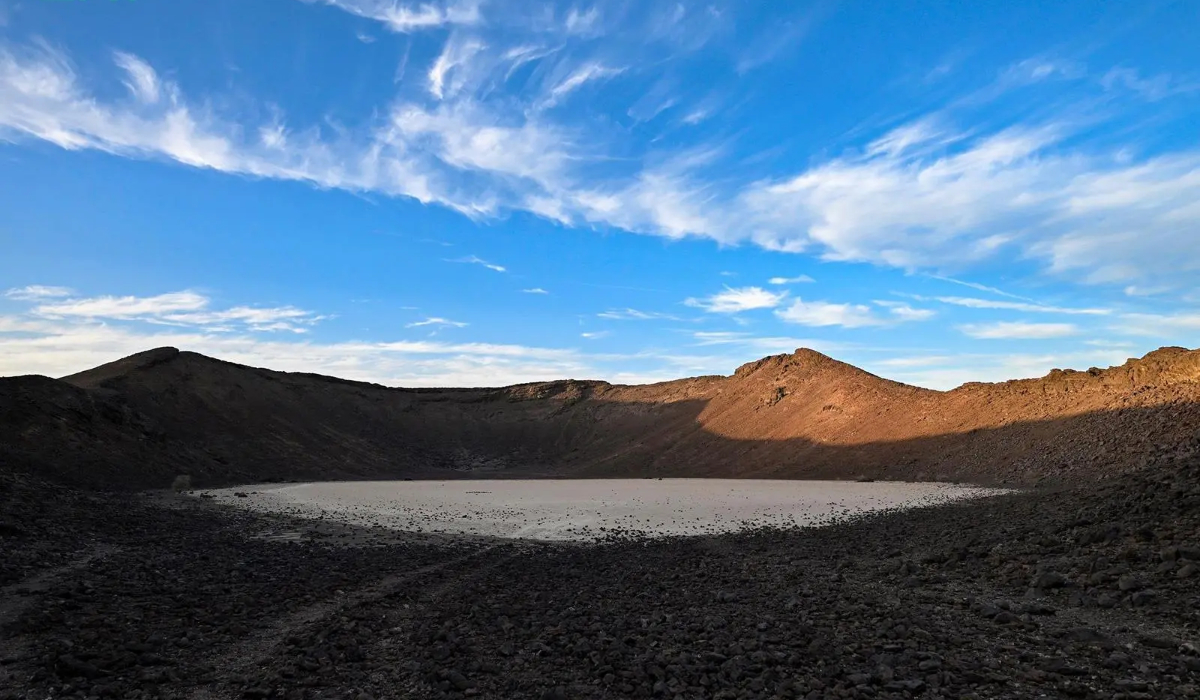


The black lava fields are stone volcanic structures that have transformed into natural oasis museums due to weathering. (SPA)

Dr. Hammad Al-Ruwaili, a professor of history and archaeology, said that the history of volcanoes in the Kingdom dates back about 30 million years.

“They formed in two phases. The first phase coincided with the basaltic lava flows and the opening of the Red Sea, and the second phase began with volcanic activity in the Arabian Peninsula about 10 million years ago,” he added.

The most prominent volcanic sites include Hafir Kishb and Al-Malsa volcano on the northern and southern edges of Harrat Rahat in the southeast of Madinah.

Harrat Rahat is the largest volcano by area, followed by Harrat Khaybar, Harrat Al-Harrah, Harrat Nawasif and Harrat Hafir Kishb, which contains the Wahbah Crater, the deepest volcanic crater in the Kingdom with a diameter of 2 km and a depth of more than 220 meters. The site is a popular destination for locals and attracts tourists from around the world.

SPEEDREAD

The most prominent volcanic sites include Hafir Kishb and Al-Malsa volcano on the northern and southern edges of Harrat Rahat in the southeast of Madinah.

In Arabic, Harrat refers to “a land with black stones that seem to have been burned by fire.” The lava fields are named after the intense heat of rocks.

Al-Ruwaili said that volcanoes are classified into several types, including domed, scoria, shield and cratered.

He added that the Hafir Kishb derives its name from Mount Kishb, located about 260 km from the northeastern part of Taif Governorate. The black mountain is visible to the right of those traveling on the Riyadh Road after Al-Muwayh. The area is mostly scattered black rocks interspersed with sandy areas known as Al-Qee’an.

Other notable areas include Dughaybjah, Khawarah, Hafar, Al-Mashubah, Qia, Mraan and Al-Muwayh.

Al-Ruwaili added that east of Hafir Kishb lies a rough harrat which is very difficult to traverse.


Wrapping up Year of Handicrafts at AlUla’s Winter at Tantora

Updated 9 sec ago
Follow

Wrapping up Year of Handicrafts at AlUla’s Winter at Tantora

  • Annual festival takes place until Jan. 10

ALULA: AlUla’s Old Town has sprung into life with Winter at Tantora — the annual festival which runs until Jan. 10 — as cooler temperatures settle over the region.

The three-week event contains workshops, concerts and gastronomic experiences which have transformed the historic landscape into a vibrant cultural gathering point, catering to locals and visitors alike.

Winter at Tantora takes its name from the traditional sundial, or the tantora, once used to mark the agricultural calendar.

The actual tantora is still perched atop what is now Dar Tantora The House Hotel, which was named as one of Time magazine’s “World’s Greatest Places” in 2024.

One of the festival’s most atmospheric offerings is Shorfat Tantora, where live music fills Al-Jadidah Arts District as musicians perform from balconies, blending traditional rhythms with contemporary beats.

The open-air experience invites audiences to gather and witness music’s unifying power on Thursday and Friday nights between 8:30 p.m. and 10:30 p.m. It ends on Jan. 2.

Since this year’s festival also highlights Saudi Arabia’s rich artisanal heritage — in line with the Ministry of Culture’s designation of 2025 as the Year of Handicrafts — there are plenty of crafts to be seen.

The festival spirit was also reflected this week at the outdoor Thanaya venue, a short drive from Old Town, where Emirati superstar Ahlam Al-Shamsi, who is known as Ahlam, took to the stage.

Her name, which means “dream” in Arabic, felt particularly fitting as the audience was immersed in her craft on the crisp, cool night with AlUla’s ancient rock formations as a backdrop. With wind billowing over the sky, she was perhaps the brightest star of the night.

Ahlam told the crowd: “In the Year of Handicrafts we celebrate human creativity through the hands that craft and the spirit that creates.

“The weather has been chilly over the last two days, but you (the audience) radiate warmth.”

With craft stations and food trucks nearby, Ahlam represented a modern twist weaved into the ongoing oral storytelling tradition.

Back in Old Town, people enjoyed the Art Walk tour and snaked through the labyrinth of painted mudbrick homes, murals and traditions while being guided by a local storyteller.

The Old Town Culinary Voyage merges storytelling and tasting. It spotlights traditional flavors and culture through aromas, spices and tastings.

Walking through the dusty, uneven rocky ground, visitors come across the ancient “Incense Road,” a well-known trade route central to pre-Islamic history and a main stage for global exchange.

A key stop in a network of ancient caravan routes, the road connected southern parts of Arabia, where frankincense and myrrh were produced, to the Mediterranean world.

These routes made incense one of the most valuable commodities of the ancient world. Parts of the route are now UNESCO World Heritage Sites.