TOKYO: Depending on who you ask, the bones that have been sitting in a Tokyo repository for decades could be either leftovers from early 20th century anatomy classes, or the unburied and unidentified victims of one of the country’s most notorious war crimes.
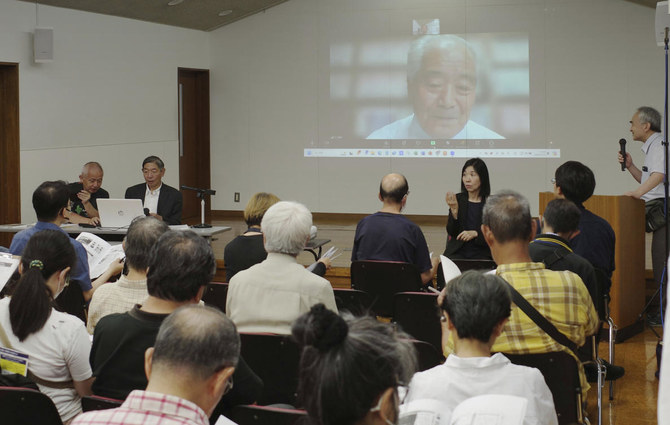
A group of activists, historians and other experts who want the government to investigate links to wartime human germ warfare experiments met over the weekend to mark the 35th anniversary of their discovery and renew a call for an independent panel to examine the evidence.
Japan’s government has long avoided discussing wartime atrocities, including the sexual abuse of Asian women known as “comfort women” and Korean forced laborers at Japanese mines and factories, often on grounds of lack of documentary proof. Japan has apologized for its aggression in Asia, since the 2010s its been repeatedly criticized in South Korea and China for backpedalling.
Around a dozen skulls, many with cuts, and parts of other skeletons were unearthed on July 22, 1989, during construction of a Health Ministry research institute at the site of the wartime Army Medical School. The school’s close ties to a germ and biological warfare unit led many to suspect that they could be the remains of a dark history that the Japanese government has never officially acknowledged.
Headquartered in then-Japanese-controlled northeast China, Unit 731 and several related units injected prisoners of war with typhus, cholera and other diseases, according to historians and former unit members. They also say the unit performed unnecessary amputations and organ removals on living people to practice surgery and froze prisoners to death in endurance tests. Japan’s government has acknowledged only that Unit 731 existed.
Top Unit 731 officials were not tried in postwar tribunals as the US sought to get ahold of chemical warfare data, historians say, although lower-ranked officials were tried by Soviet tribunals. Some of the unit’s leaders became medical professors and pharmaceutical executives after the war.
A previous Health Ministry investigation said the bones couldn’t be linked to the unit, and concluded that the remains were most likely from bodies used in medical education or brought back from war zones for analysis, in a 2001 report based on questioning 290 people associated with the school.
It acknowledged that some interviewees drew connections to Unit 731. One said he saw a head in a barrel shipped from Manchuria, northern China, where the unit was based. Two others noted hearing about specimens from the unit being stored in a school building, but had not actually seen them. Others denied the link, saying the specimens could include those from the prewar era.
A 1992 anthropological analysis found that the bones came from at least 62 and possibly more than 100 different bodies, mostly adults from parts of Asia outside Japan. The holes and cuts found on some skulls were made after death, it said, but did not find evidence linking the bones to Unit 731.
But activists say that the government could do more to uncover the truth, including publishing full accounts of its interviews and conducting DNA testing.
Kazuyuki Kawamura, a former Shinjuku district assembly member who has devoted most of his career to resolving the bone mystery, recently obtained 400 pages of research materials from the 2001 report using freedom of information requests, and says it shows that the government “tactfully excluded” key information from witness accounts.
The newly published material doesn’t contain a smoking gun, but it includes vivid descriptions — the man who described seeing a head in a barrel also described helping to handle it and then running off to vomit — and comments from several witnesses who suggested that more forensic investigation might show a link to Unit 731.
“Our goal is to identify the bones and send them back to their families,” said Kawamura. The bones are virtually the only proof of what happened, he says. “We just want to find the truth.”
Health Ministry official Atsushi Akiyama said that witness accounts had already been analyzed and factored into the 2001 report, and the government’s position remains unchanged. A key missing link is a documentary evidence, such as a label on a specimen container or official records, he said.
Documents, especially those involving Japan’s wartime atrocities, were carefully destroyed in the war’s closing days and finding new evidence for a proof would be difficult.
Akiyama added that a lack of information about the bones would make DNA analysis difficult.
Hideo Shimizu, who was sent to Unit 731 in April 1945 at age 14 as lab technician and joined the meeting online from his home in Nagano, said he remembers seeing heads and body parts in formalin jars stored in a specimen room in the unit’s main building. One that struck him most was a dissected belly with a fetus inside. He was told they were “maruta” — logs — a term used for prisoners chosen for experiments.
Days before Japan’s Aug. 15, 1945 surrender, Shimizu was ordered to collect bones of prisoners’ bodies burned in a pit. He was then given a pistol and a packet of cyanide to kill himself if he was caught on his journey back to Japan.
He was ordered never to tell anyone about his Unit 731 experience, never contact his colleagues, and never seek a government or medical job.
Shimizu said he cannot tell if any specimen he saw at the 731 could be among the Shinjuku bones by looking at their photos, but that what he saw in Harbin should never be repeated. When he sees his great-grandchildren, he said, they remind him of that fetus he saw and the lives lost.
“I want younger people to understand the tragedy of war,” he said.


A mysterious pile of bones could hide evidence of Japanese war crimes, activists say
https://arab.news/2s3st
A mysterious pile of bones could hide evidence of Japanese war crimes, activists say

- Japan’s government has long avoided discussing wartime atrocities
- Around a dozen skulls, many with cuts, and parts of other skeletons were unearthed on July 22, 1989


US Justice Department official eyes cases against Cuba leaders as Trump floats ‘friendly takeover’
- “Working group” formed to build cases against people connected to the Cuban government
- Trump’s has increasingly displayed aggressive stance against Cuba’s communist leadership
MIAMI: The top Justice Department prosecutor in Miami is considering criminal investigations of Cuban government officials, according to people familiar with the matter. The inquiry comes as President Donald Trump has raised the possibility of a “friendly takeover” of the communist-run island.
Jason Reding Quiñones, the US attorney for the Southern District of Florida, has created a “working group” that includes federal prosecutors and officials from the Drug Enforcement Administration and other agencies to try to build cases against people connected to the Cuban government and its Communist Party, according to one of the people. They spoke on the condition of anonymity because they were not authorized to publicly discuss the effort.
It was not immediately clear which Cuban officials the office is targeting or what criminal charges prosecutors may be looking to bring.
The Justice Department said in a statement Friday that “federal prosecutors from across the country work every day to pursue justice, which includes efforts to combat transnational crime.”
The effort is taking place against the backdrop of Trump’s increasingly aggressive stance against Cuba’s communist leadership.
Emboldened by the US capture of Cuba’s close ally, Venezuelan President Nicolás Maduro, Trump last month said his administration was in high-level talks with officials in Havana to pursue “a friendly takeover” of the country. He repeated those claims this week, saying his attention would turn back to Cuba once the war with Iran winds down.
“They want to make a deal so bad,” Trump said of Cuba’s leadership.
While Cuba has faded from Washington’s radar as a major national security threat in recent decades, it remains a priority in the US Attorney’s office in Miami, whose political, economic and cultural life is dominated by Cuban-American exiles.
The FBI field office has a dedicated Cuba group that in 2024 was instrumental in the arrest of former US Ambassador Victor Manuel Rocha on charges of serving as a secret agent of Cuba stretching back to the 1970s.
In recent weeks, several Miami Republicans, in addition to Florida Sen. Rick Scott, have called on the Trump administration to reopen its criminal investigation into the 1996 shootdown of four planes operated by anti-communist exiles.
In a letter to Trump on Feb. 13, lawmakers including Reps. Maria Elvira Salazar and Carlos Gimenez highlighted decades-old news reports indicating that former President Raúl Castro — the head of Cuba’s military at the time — gave the order to shoot down the unarmed Cessna aircraft.
“We believe unequivocally that Raúl Castro is responsible for this heinous crime,” lawmakers wrote. “It is time for him to be brought to justice.”
While no indictment against Castro has been announced, Florida’s attorney general said this week that he would open a state-level investigation into the crime.
The Trump administration has also accused Cuba of not cooperating with American counterterrorism efforts, adding it alongside North Korea and Iran to a select few nations the US considers state sponsors of terrorism.
The designation stems from Cuba’s harboring of US fugitives and its refusal to extradite several Colombian rebel leaders while they were engaged in peace talks with the South American nation.


