

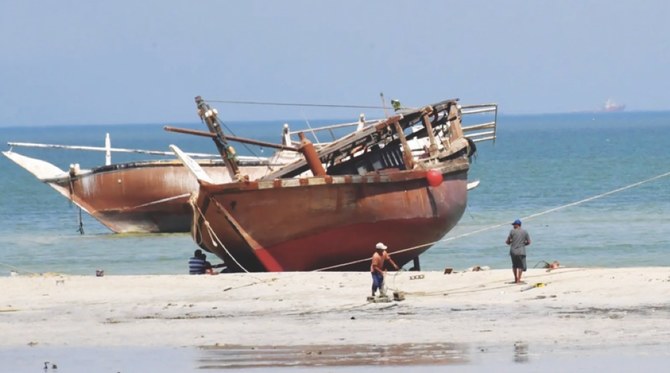
Fishermen of Saudi Arabia’s Eastern Province gear up for shrimp season

Saudi Arabia has affirmed its commitment to protecting sustainable fish stocks and the livelihoods of fishermen, and investing in aquaculture projects. (SPA)
Short Url
Updated 25 July 2024
Follow

Fishermen of Saudi Arabia’s Eastern Province gear up for shrimp season

  • For the 2024 season, 710 fishing boats have been authorized, including large and small fishing boats

RIYADH: Fishermen in Saudi Arabia’s Eastern Province are preparing for this year’s shrimp season, which begins on Aug. 1 and lasts six months.

Shrimp fishing will take place along the Arabian Gulf coasts of the Eastern Province, stretching some 1,000 km from Khafji Governorate in the north to Uqair Governorate in the south.

For the 2024 season, 710 fishing boats have been authorized, including large and small fishing boats.

These are distributed as follows: 30 fishing boats at the Manifa port, 20 fishing boats at the Safaniya port, 330 fishing boats at the Jubail port, 160 fishing boats at the Qatif port and 170 fishing boats at the Darin Island port.

The director of the Eastern Province Branch of the Ministry of Environment, Water and Agriculture, Fahd bin Ahmed Al-Hamzi, told the Saudi Press Agency that the ministry is providing top-quality services to the Kingdom’s fishermen.

The ministry has reduced the time required to issue shrimp fishing permits and opened online applications, he added.

The region will also see the development of new fishing ports as part of a ministry project, as well as a scheme to supply and install engines and emergency radios for fishing boats.

Saudi Arabia has affirmed its commitment to protecting sustainable fish stocks and the livelihoods of fishermen, and investing in aquaculture projects.


Economic growth and resilience at heart of 2nd AlUla Emerging Market Economies Conference

Updated 03 February 2026
Follow

Economic growth and resilience at heart of 2nd AlUla Emerging Market Economies Conference

  • Event on Feb. 8 and 9 will bring together ministers, governors of central banks, policymakers, economic experts and international financial institutions
  • Emerging-market economies a ‘pivotal element’ in global economic system due to effect they have on growth and stability, says Saudi Finance Minister Mohammed Al-Jadaan

RIYADH: The second annual AlUla Conference for Emerging Market Economies, which Saudi Arabia will host next week, offers a platform to exchange views on global developments and discuss policies and reforms that support inclusive growth and strengthen economic resilience, the Kingdom’s finance minister said.

The event on Feb. 8 and 9 will bring together finance ministers, governors of central banks and policymakers, alongside economic experts and representatives of international financial institutions.

Organized by the Saudi Ministry of Finance in partnership with the International Monetary Fund, it takes place as emerging-market economies face mounting challenges amid rapid global economic change.

Finance Minister Mohammed Al-Jadaan said the decision to host the conference reflects Saudi Arabia’s ongoing commitment to efforts that support global financial and economic stability, and highlights the growing influence of emerging economies on worldwide growth.

Emerging-market economies represent a “pivotal element” in the global economic system due to the direct impact they have on economic growth and stability, he added.

“The AlUla Conference for Emerging Market Economies provides a unique platform for exchanging views on global economic developments, and discussing policies and reforms that will support inclusive growth and enhance economic resilience, in light of broader international cooperation that contributes to confronting common challenges,” Al-Jadaan said.

Kristalina Georgieva, managing director of the IMF, said the event would help emerging economies deal with growing uncertainty driven by technological change, demographic shifts and geopolitical tensions.

“The AlUla conference provides a vital platform for emerging economies to discuss how they can navigate the risks and embrace the opportunities ahead,” she said.

“In these times of sweeping transformations in the global economy, policymakers face a more challenging and uncertain environment. Countries should work together to strengthen resilience through sound macroeconomic and financial policies.”