

Pakistan PM pledges ‘full support’ for ECO amid push for regional trade, connectivity

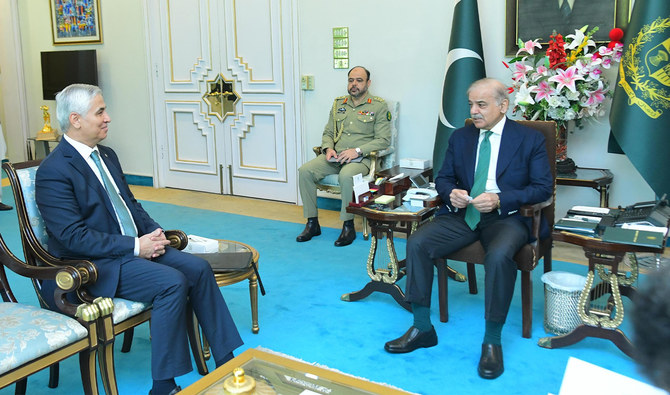
Outgoing Secretary General of Economic Cooperation Organization, Khusrav Noziri (left), calls on Pakistan's Prime Minister Shehbaz Sharif in Islamabad on July 25, 2024. (PM Office)
Short Url
Updated 25 July 2024
Follow

Pakistan PM pledges ‘full support’ for ECO amid push for regional trade, connectivity

  • Economic Cooperation Organization seeks to promote economic interests of member states in West, South and Central Asia
  • Pakistan has increasingly south to position itself as trade and transit hub connecting Central Asian states to rest of the world

ISLAMABAD: Prime Minister Shehbaz Sharif on Thursday reaffirmed Pakistan’s commitment to extend its “full support” to the Economic Cooperation Organization (ECO) as Islamabad eyes greater regional connectivity and trade to sustain its fragile economy. 

Founded by Pakistan, Iran and Turkiye in 1964, the ECO describes itself as one of the oldest intergovernmental organizations that seeks to improve regional connectivity and enhance economic cooperation for countries in West, South and Central Asia. 

Sharif met the ECO’s outgoing Secretary-General Khusrav Noziri in Islamabad on Thursday during which the two spoke about Noziri’s contributions to the regional platform. 

“The Prime Minister reaffirmed his commitment that Pakistan would continue to lend its full support to ECO in enhancing intra-regional trade among ECO countries as well as on the ECO reforms agenda,” a statement from Sharif’s office said. 

Sharif said Pakistan was proud that the incoming ECO secretary-general was Dr. Asad Majeed Khan, Pakistan’s former foreign secretary. 

“The secretary-general conveyed his gratitude for Pakistan’s consistent support to him during his tenure as secretary-general ECO,” the Prime Minister’s Office (PMO) said. 

PAKISTAN’S INVESTMENT, CONNECTIVITY PUSH

Pakistan has recently sought to forge deeper trade and economic ties with Central Asian countries. There has been a flurry of recent visits, investment talks and economic activity between Pakistan and these Central Asian countries, including meetings of top Pakistani officials with the leaders from Uzbekistan and Azerbaijan.

Located in a landlocked but resource-rich region, Central Asian countries need better access to regional markets including Pakistan, China, India and countries of West Asia. Meanwhile, Islamabad is seeking to bolster trade and investment ties with allies to stabilize its fragile $350 billion economy as it faces an acute balance of payment crisis amid soaring inflation and rising external debt.

It hopes to achieve this by positioning itself as a trade and transit hub connecting Central Asian countries to other parts of the world. Pakistan recently offered Central Asian states to become part of the China-Pakistan Economic Corridor project, under which Beijing has pledged around $65 billion in energy, infrastructure and other projects in Pakistan

Pakistan is seeking to enhance its foreign exchange reserves and bolster its economy as it tries to cut reliance on international financial institutions such as the International Monetary Fund (IMF) whose financial bailout packages come at a heavy cost for Islamabad. 

Sharif has repeatedly said his government wants mutually rewarding partnerships, not just loans, from regional allies. 


High-level Libyan delegation meets Pakistan PM, discusses areas for future cooperation

Updated 03 February 2026
Follow

High-level Libyan delegation meets Pakistan PM, discusses areas for future cooperation

  • The meeting comes over a month after Pakistan reportedly struck a $4 billion defense deal to sell military equipment to Libyan National Army
  • PM Sharif reaffirms Pakistan’s commitment to fostering friendly ties with Libya, emphasizes the importance of continued engagement and dialogue

ISLAMABAD: A high-level delegation from Libya on Tuesday called on Pakistan Prime Minister Shehbaz Sharif in Islamabad and discussed areas for future cooperation between the two sides, PM Sharif’s office said.

The delegation comprised Dr. Osama Saad Hamad, who governs eastern Libya, Libyan National Army (LNA) Commander-in-Chief Khalifa Abu-al-Qasim Haftar and his deputy, Lt. Gen. Saddam Khalifa Haftar.

During the discussions, both sides exchanged views on matters of mutual interest and underscored the importance of strengthening bilateral relations, according to PM Sharif’s office.

“The meeting reflected the shared desire to enhance cooperation in areas of common concern and to promote peace, stability, and development at regional and international levels,” Sharif’s office said in a statement.

The development comes more than a month after reports suggested Pakistan had struck a $4 billion defense deal to sell military equipment, including JF-17 fighter jets and Super Mushshak trainer aircraft, to the LNA that controls eastern Libya.

The reports followed the visit of Pakistani Defense Forces Chief Field Marshal Asim Munir to Libya in December. There has been no official confirmation of the deal so far.

Libya has been subject to a UN arms embargo since 2011, requiring approval from the UN for transfers of weapons and related material. It was not clear whether Pakistan or Libya had applied for ⁠any exemptions to the UN embargo.

PM Sharif reaffirmed Pakistan’s commitment to fostering friendly relations with Libya and emphasized the importance of continued engagement and dialogue, according to his office. The Libyan leadership appreciated Pakistan’s role and expressed interest in expanding collaboration between the two countries.

“The meeting concluded with an understanding to maintain close contact and explore avenues for future cooperation,” Sharif’s office said.

On Monday, LNA Commander-in-Chief Haftar also met Field Marshal Munir and discussed with him military cooperation and regional security, according to the Pakistani military.

“Both sides exchanged views on matters of mutual interest, with particular focus on security dynamics in respective regions and professional cooperation,” the Pakistani military said.

“The discussion underscored the importance of continued engagement and collaboration between the Armed Forces of Pakistan and Libya.”