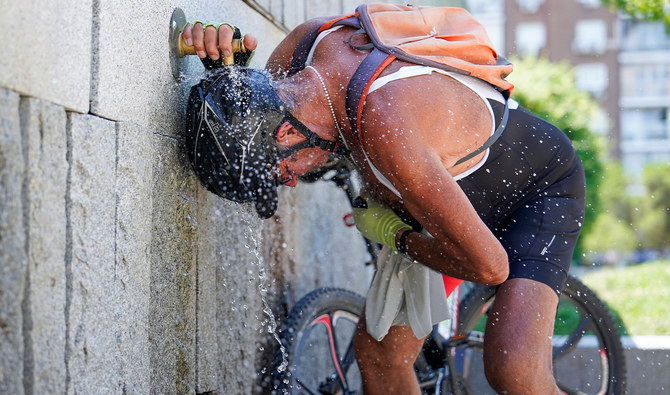
United Nations, United States: Humanity is suffering from an “extreme heat epidemic,” UN Secretary-General Antonio Guterres warned Thursday, calling for action to limit the impacts of heat waves intensified by climate change.
“Billions of people are facing an extreme heat epidemic — wilting under increasingly deadly heat waves, with temperatures topping 50 degrees Celsius around the world,” he said. “That’s 122 degrees Fahrenheit. And halfway to boiling.”
According to the European Copernicus network, July 21, 22 and 23 were the three hottest days ever recorded worldwide, with July 22 holding the absolute record of 17.16 degrees Celsius (62.9 degrees Fahrenheit).
Guterres repeated his call for humanity to fight its “addiction” to fossil fuels.
“Today, our focus is on the impact of extreme heat. But let’s not forget that there are many other devastating symptoms of the climate crisis: ever-more fierce hurricanes. Floods. Droughts. Wildfires. Rising sea levels. And the list goes on,” he said.
“To tackle all these symptoms, we need to fight the disease. And the disease is the madness of incinerating our only home. The disease is the addiction to fossil fuels. The disease is climate inaction,” he stressed, calling in particular on G20 countries to take action.
While 2023 was the hottest year on record, and 2024 could set a new record, temperatures well above 40C (104F) are increasingly common.
In the space of a year, the 50C threshold has even been exceeded in at least 10 places, from Death Valley in the United States (53.9C on July 7) to Agadir in Morocco, and also in China and India.
The intense heat, often less visible than other devastating impacts of climate change such as storms or floods, is nonetheless more deadly.
This “silent killer” is responsible for around 489,000 deaths per year between 2000 and 2019, compared with 16,000 deaths per year from cyclones, according to the UN’s “Call to Action” document published on Thursday.
Extremely high temperatures also have an economic impact, with the UN estimating economic losses from heat stress at work will reach $2.4 trillion in 2030.
According to a report by the International Labor Organization published on Thursday, more than 70 percent of workers were exposed to excessive heat in 2020, 8.8 percent more than in 2000.
“The good news is that we can save lives and we can limit its impact,” Guterres said Thursday.
The UN has called for the world community to first act to protect “the most vulnerable” — including young children, the elderly and also humanity’s poorest.
In this context, early warning systems should include extreme heat, warning populations of the arrival of heat waves and informing them of the precautions to take, the document says.
The call to action also recommends an “increase (to) equitable access to and scale up (of) low-carbon cooling.”
This would involve investing in passive cooling systems — which include climate-sensitive urban design measures, reflective surfaces and natural cooling systems — and the phase-out of climate-warming gases that are used in many cooling systems.


Humanity suffering from ‘extreme heat epidemic,’ UN chief warns
https://arab.news/wztft
Humanity suffering from ‘extreme heat epidemic,’ UN chief warns

- UN chief repeats call for humanity to fight “addiction” to fossil fuels amid global warming
- UN estimates economic losses from heat stress at work will reach $2.4 trillion by 2030

I want answers from my ex-husband, Gisele Pelicot tells AFP
- Gisele Pelicot, the French woman who became a symbol in the global fight against sexual violence, told AFP why she wants to visit her ex-husband in jail and her joy at finding love again
PARIS: Gisele Pelicot, the French woman who became a symbol in the global fight against sexual violence, told AFP why she wants to visit her ex-husband in jail and her joy at finding love again.
In an interview ahead of the publication of her memoirs on Tuesday, she also said she hopes to inspire other rape victims to believe in a brighter future — and to change attitudes along the way.
Her book, titled “A Hymn to Life,” covers the full arc of her 50-year marriage which ended when she discovered that her husband had been repeatedly drugging her and inviting strangers over to their house to rape her.
It will be published in 22 languages.
The title of your book in French is “And the joy of living.” Have you found joy again?
“I’m doing better. After the trial (of her husband and 50 other men in 2024), I took stock of my life and today I am trying to rebuild on this field of ruins.
Despite all these ordeals, even in the darkest periods, I have always sought flashes of joy; I am looking toward the future, toward joy. I know this may surprise some who expect to see me in tatters, but I am determined to remain standing and dignified.”
Some describe you as an icon. Do you embrace that status?
“I do not use that word. I think my story has become a symbol. I know where I come from and who I am. It seems to me that we do not suspect the strength we have inside us until we are forced to draw on it, and that is also what I would like to say to victims.”
Why did you write this book?
“I needed to bear witness to my life journey, to address all those who supported me; it was a way of responding to them. Writing this book with (French author) Judith Perrignon, in whom I had complete trust, was both painful and fascinating.
Beyond the case itself, it retraces my life, the journey of three generations of women: my grandmother, my mother and myself. Their example explains my strength because I experienced tragedies very young. When you lose your mother at age nine, you grow up faster than others.”
Have you had professional psychological help to overcome your trauma?
“Of course, I could not get through this alone. How do you sort through 50 years of memories tainted by this series of crimes? I lived for half a century with Mr. Pelicot and I have no memory of the rapes, only the memory of happy days.
I cannot throw my whole life in the bin and tell myself that those years were nothing but a lie. If I did that, I’d collapse.”
At the end of the book, you announce your intention to visit Mr.Pelicot in prison. Why?
“I would like to do it for myself. That visit would be a stage in my reconstruction, an opportunity, for the first time since his arrest in November 2020, to confront him face to face.
How could he have done this to me? How could he have put our entire family through hell? What did he do to (our daughter) Caroline? He may not answer my questions, but I need to ask them.
For the moment, no date has been set for the visit. I do not think it will take place before the end of the year.”
In the book, you speak about your relationships with your three children. Where do they stand?
“It is wrong to think that such a tragedy brings a family together. It is impossible. Each of my children is now trying to rebuild as best they can.
Caroline’s suffering devastates me. She is in a state of anger that I do not share. And there is this doubt (about whether she was raped by her father) that condemns her to a perpetual hell.
I do not question her word, but I do not have the answers. Today, our relationship is calmer and I am happy about that. I will try to support her as best I can.”
Do you intend to remain a public figure?
“I am in my 74th year. I long for calm. I am not a radical feminist; I am a feminist in my own way. I know there is still a long way to go, despite progress on consent. I leave it to the younger generations to change this patriarchal society.
We can pass all the laws we want, but if we do not change mindsets, we will not succeed. That therefore begins above all with the education of our children. Parents must get involved.”
You are about to begin a tour to present your book. With what message?
“A message of hope. After hardship, you can once again allow yourself happiness and be happy. That is what I am doing. I am lucky enough to love again — it is magnificent. I think a life without love is a life without sunshine.”